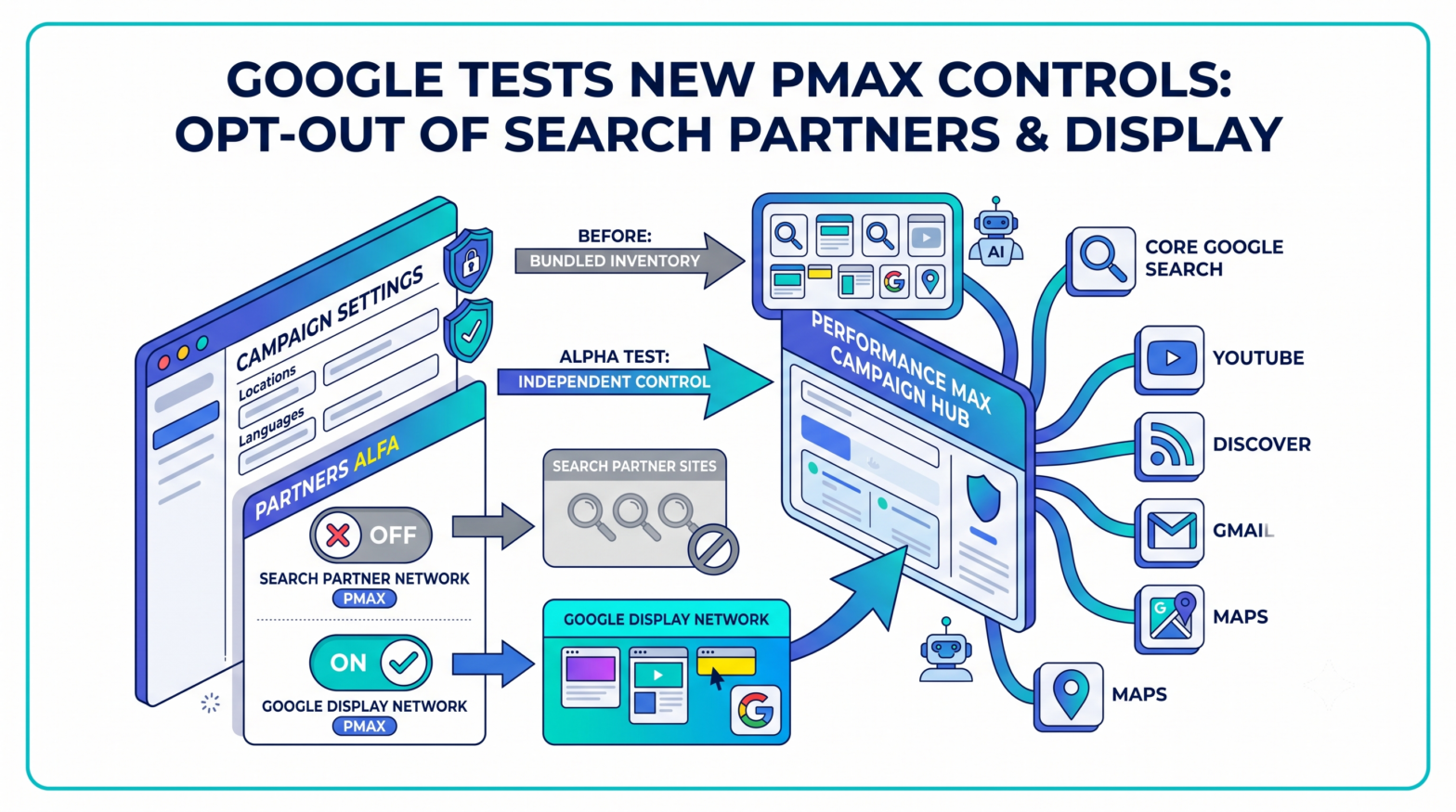
Performance Max advertisers may soon be able to decide, for the first time at the campaign level, whether their budgets reach the Search Partner Network and the Google Display Network. Google is alpha-testing a new "Partners" setting inside Performance Max that gives advertisers independent toggles for both networks, a control that has not previously existed within the campaign type.
A Control That Did Not Exist Before
Performance Max automatically serves ads across all Google Ads channels, Google Search, the Google Display Network, YouTube, Discover, Gmail, Maps, and Search Partners, and unlike standard Search campaigns, it has bundled this inventory into the automated optimization process without granular network control options.
The alpha test, observed this week in live Google Ads accounts, would let advertisers individually toggle the Search Partner Network and the Google Display Network on or off for the first time. A screenshot circulating among PPC professionals shows a new "Partners" row sitting below the standard Locations and Languages fields under "Other settings" inside a Performance Max campaign.
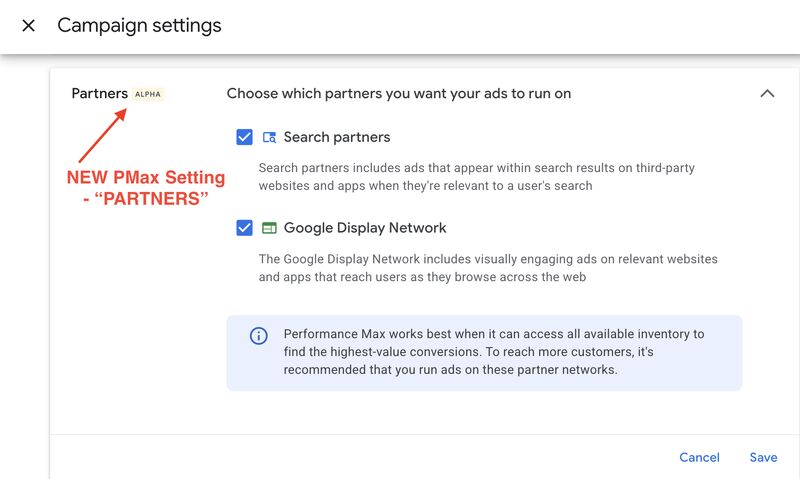
Previously, Performance Max bundled both networks with no independent toggle, meaning advertisers either accepted both or neither. The new setting appears to separate them entirely. The Google Display Network refers to a broad set of websites and apps where visual, responsive, and remarketing-oriented inventory can appear, making this not one small toggle, but a control over two materially different traffic sources.
Why Network Control Has Been a Persistent Demand
For years, the absence of granular network controls inside Performance Max has ranked among the most persistent complaints from search marketers, and reporting improvements came gradually during 2025, but the ability to switch entire networks on or off remained out of reach.
Performance Max was designed as a fully automated campaign type in which Google's systems choose which networks to run ads on, which creative assets to use, and how to allocate budget, and the tradeoff for that automation has always been reduced advertiser control. Many advertisers found their PMax spend flowing to Search Partner Network sites and Google Display placements that converted at lower rates than core Google Search, with no mechanism to limit that traffic.
A January 2026 investigation documented that Google Ads purchases X inventory programmatically through Search Partners and Video Partners extensions, exposing brands to a platform many had policies to avoid, an issue that affected Performance Max, Demand Gen, and Display campaigns alike, because automated optimization in those campaigns gravitates toward cheap inventory.
Previously, if a PMax advertiser wanted to exclude partner placements, the only option was to exit Performance Max entirely and rebuild campaigns in individual campaign types where network exclusions are available, a tradeoff that was often not viable for accounts where PMax was the primary campaign structure.
Google's Incremental Transparency Improvements
The Partners alpha does not arrive without context. Google has been expanding Performance Max transparency incrementally since April 2025, when it announced channel-level performance reporting, full search terms reporting, and enhanced asset metrics.
In January 2026, Google activated account-level placement exclusions that apply simultaneously across Performance Max, Demand Gen, YouTube, and Display campaigns, removing the need to replicate exclusion lists across individual campaigns. Also in January 2026, Google rolled out Performance Max channel reporting with Search Partner Network segmentation to all Customer IDs, extending the feature to Search Ads 360, providing campaign-level performance summaries showing Search Partner contribution to conversion goals.
Google gradually added visibility back into Performance Max: search terms reporting, richer asset reporting, channel performance reporting, placement reporting for brand safety use cases, and segmentation that made Search Partner Network activity easier to spot; each of those steps gave advertisers better diagnostic power, but not always better control.
Scope and Availability
The feature, labelled "Partners Alfa" inside the interface, was spotted by Adriaan Dekker on LinkedIn, who credited Renaldo Spin with finding the setting during what Dekker described as a "PMAX placement test." A second observation of the feature in accounts was subsequently documented by Thomas Eccel.
Broader availability across accounts has not been confirmed. Whether this specific implementation reaches general availability, or whether it is modified or absorbed into a different control mechanism, remains to be seen. Google has not issued a formal announcement about the setting or provided a timeline for wider rollout.
Implications for Performance Max Campaign Management
For advertisers currently running Performance Max, the practical effect of this setting, if it reaches general availability, would be the ability to isolate core Google inventory from partner and display traffic without abandoning the campaign type's automated bidding and creative optimization. Search Partners are often associated with lower-quality traffic, while Display placements have frequently raised concerns around invalid traffic, spammy clicks, and ghost conversions, and the new exclusions could help advertisers improve traffic quality, reduce wasted spend, and gain more control over where PMax ads appear. Advertisers in compliance-sensitive industries or those managing strict brand safety requirements would stand to gain the most from campaign-level network exclusions, as account-level exclusions currently apply only to individual placements rather than entire networks.
Google is alpha-testing independent partner network controls for Performance Max campaigns, allowing advertisers to toggle the Search Partner Network and Google Display Network separately for the first time, a change that, for brands where partner placement quality directly affects ROAS or brand safety, alters how PMax campaigns can be configured.