

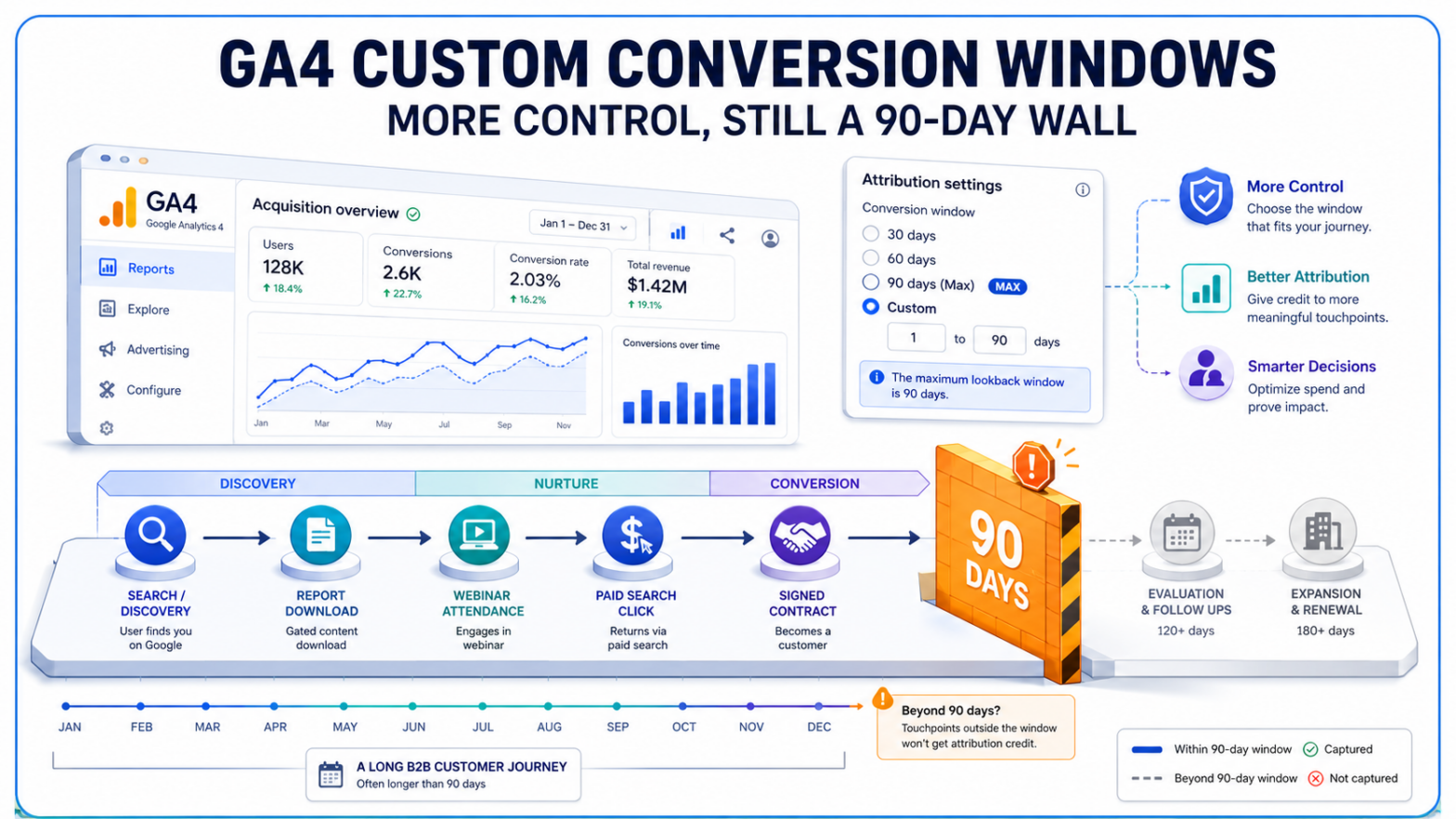
For a B2B company, the campaign that creates demand and the contract that closes can be separated by months.
That gap has always been awkward inside Google Analytics. Conversion attribution depends on a defined window, and once an earlier interaction falls outside it, that touchpoint is no longer eligible for credit.
Google is now giving advertisers more control over conversion windows as it brings Google Analytics and Google Ads conversion management closer together. But there is an important limit hiding behind the word “custom.”
A longer sales cycle does not automatically get a longer attribution horizon.
GA4 Is Moving Conversion Settings Closer to the Conversion Itself
Historically, GA4’s key-event attribution settings have been relatively broad.
Google’s current Analytics documentation says acquisition events such as first_open and first_visit use a 30-day lookback window by default, with seven days as the alternative. Other key events use 90 days by default, with 30- and 60-day options also available.
That property-level framework still appears in Google’s documentation.
The newer conversion-management layer gives marketers more granular control over conversions shared between Google Analytics and Google Ads. Google describes Analytics as a centralized place for managing conversion settings across both products, including conversion windows, counting methods and the channels eligible to receive credit.
That distinction matters.
A business may want a relatively short window for a webinar registration while allowing more time for a qualified demo request or another action closer to revenue. Treating every meaningful event as if buyers need the same amount of time can distort how channels appear to contribute.
Google Ads already supports conversion-window settings at the individual conversion-action level. Depending on the conversion source, Google says click-through windows can be configured from one day up to 90 days.
For marketers already trying to reconcile GA4 with campaign reporting, more conversion-level control removes some unnecessary rigidity.
It does not remove the upper limit.
A 12-Month Enterprise Deal Still Does Not Fit Inside 90 Days
Consider an enterprise software company.
A prospect discovers the company through organic search in January, downloads a technical report in February, attends a webinar in March, returns through a paid search campaign in May and finally signs a contract in October.
That is a perfectly ordinary shape for a complex buying journey.
It is not a journey that a 90-day attribution window can preserve from beginning to end.
Google defines the conversion window as the period during which a previous touchpoint remains eligible for attribution credit. Once an interaction sits outside that period, it is excluded from the conversion path considered by the attribution system.
Changing the attribution model cannot recover it.
Data-driven attribution can decide how eligible touchpoints share credit. It cannot make an interaction eligible after the applicable window has expired.
That makes the distinction between attribution model and attribution window unusually important for high-ticket B2B reporting. The model decides how credit is distributed. The window decides which interactions are allowed into the calculation in the first place.
For companies with six-, nine- or 12-month buying cycles, that second question is often the bigger problem.
Longer Windows Can Change Which Campaigns Appear to Work
Attribution windows are not simply reporting preferences.
They determine the population of marketing interactions available for conversion credit.
A short window naturally favours activity occurring near the end of the buying process. Branded search, remarketing, direct response campaigns and other late-stage interactions are more likely to remain inside the eligible period.
Earlier discovery activity is easier to lose.
That can create an uncomfortable reporting pattern for B2B teams. Campaigns responsible for introducing qualified accounts may appear weak when performance is evaluated only against eventual closed revenue, while campaigns encountered shortly before the sale receive more visible credit.
Expanding a window can bring more of those earlier interactions back into consideration, provided they remain within Google’s supported maximum.
There is a trade-off. Longer attribution windows can also introduce touchpoints that are less closely connected to the final decision. A 90-day window is not automatically more accurate than a 30-day one.
The right setting depends on what the conversion represents.
A form submission occurring within hours or days of a campaign interaction may justify a relatively short measurement window. An opportunity-stage event can require considerably more time. Using the same setting for both makes conversion tracking easier to administer, but not necessarily easier to interpret.
GA4 and Google Ads Are Becoming More Tightly Coupled
The conversion-window changes sit inside a broader restructuring of measurement across Google’s advertising stack.
Google now allows conversions based on Analytics events to be managed across Google Analytics and Google Ads, with settings designed to remain consistent between the two platforms. Those conversions can also support campaign reporting and bidding.
Google says that when “Paid and organic channels” is selected for web conversion attribution, conversion-window settings must be managed through Analytics. Under Google paid channel attribution, changes can be made from Google Ads.
That makes configuration more consequential than a reporting-interface preference.
A conversion used for Smart Bidding is not merely a number being displayed in a dashboard. Its definition can become an optimization signal.
Google Ads states that Smart Bidding strategies count and optimize toward conversions within the selected conversion window. Teams changing conversion settings therefore need to distinguish between reporting adjustments and changes that affect the data being used by automated bidding systems.
Google has been moving steadily toward a shared measurement layer. Earlier this year, the company also opened cross-channel conversion reporting through the Analytics Data API in alpha, giving developers programmatic access to paid and organic conversion data. TechWyse covered that expansion of conversion attribution when Google introduced the API support in May.
Conversion-window controls are another piece of the same architecture.
CRM Attribution Still Has to Carry the Long End of the B2B Journey
For B2B marketers, the practical implication is narrower than the headline might suggest.
Teams should configure conversion windows around the expected time between a marketing interaction and the specific conversion being measured, rather than applying one arbitrary window to every event. That can improve comparisons between lead-generation actions with very different decision periods.
But a 90-day ceiling still leaves a measurement gap when revenue arrives six or 12 months after initial acquisition.
That is where analytics and revenue attribution diverge.
GA4 can document on-site behaviour, campaign interactions and conversion events within its attribution framework. CRM systems can preserve account and opportunity histories across much longer sales cycles, including offline stages that happen after a user leaves the website.
Google has also been shifting offline conversion infrastructure toward deeper first-party integrations. In June, for example, the company began directing new Google Ads API offline-conversion adopters toward Data Manager API, another sign that Google Ads measurement increasingly depends on connecting downstream business data back to advertising systems.
Custom conversion windows give marketers a better dial.
They do not erase the clock.
For a buyer who enters the pipeline in January and signs in October, the earliest marketing interactions can still sit far beyond the attribution horizon Google currently documents. The contract may close inside the CRM, but GA4 will not suddenly reconstruct a year-long path just because the conversion was worth more.