Offline conversion tracking is getting a new gatekeeper.
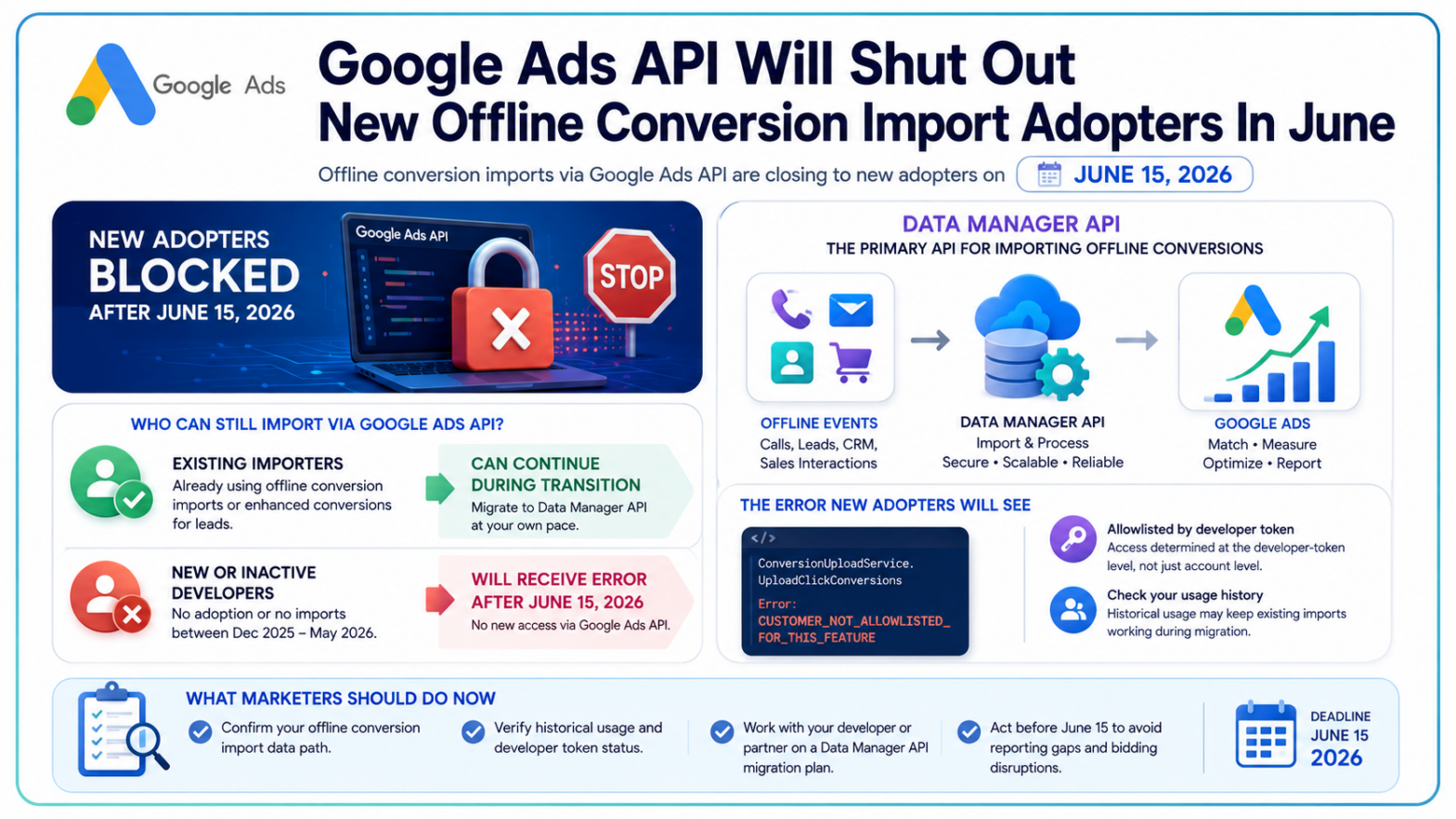
Starting June 15, 2026, Google Ads API users who have not already adopted offline conversion imports will no longer be able to begin using that workflow through the Google Ads API. Google says Data Manager API is now the primary API for importing offline conversions, including enhanced conversions for leads.
Existing Importers Get Time. New Ones Get Blocked.
The change does not immediately cut off every advertiser or developer using offline conversion imports through the Google Ads API.
Google said developers who have already adopted offline conversions or enhanced conversions for leads can continue importing through the Google Ads API while they integrate with Data Manager API. The transition window is aimed at current users, not new implementations.
The line is narrower for developers who have not used the feature recently. Google said developers who have not adopted offline conversion imports or enhanced conversions for leads, or who have not imported offline conversions between December 2025 and May 2026, will receive an error if they attempt to import offline conversions after the rollout.
That makes usage history the deciding factor.
The Error Will Come Through UploadClickConversions
The technical cutoff is tied to the Google Ads API’s ConversionUploadService.UploadClickConversions method.
Once the change rolls out, new adopters will receive the error CUSTOMER_NOT_ALLOWLISTED_FOR_THIS_FEATURE when attempting to use that method for offline conversion imports, according to Google’s Ads Developer Blog notice.
Google also said developers will be allowlisted by developer token. In practice, that puts the access decision at the developer-token level rather than simply at the account or customer level.
For teams that maintain multiple client integrations under one developer token, that distinction matters. A token with qualifying historical usage may keep existing import paths working during migration, while net-new implementations are being directed away from Google Ads API and into Data Manager API.
Data Manager API Is Becoming The Default Data Pipe
This is not an isolated API cleanup.
Google linked the move to earlier changes involving session attributes and IP address support, as well as Customer Match. In those cases, Google also positioned Data Manager API as the primary route for importing certain advertiser data.
The pattern is clear enough: Google is consolidating more first-party data ingestion around Data Manager API while keeping legacy Google Ads API paths available mainly for existing users during transition periods.
That does not make offline conversion imports less important. If anything, it places them deeper inside Google’s broader measurement infrastructure.
Offline conversion imports are commonly used when a lead or sale happens outside the website session — for example, after a phone call, form follow-up, CRM update or sales-team interaction. Enhanced conversions for leads add hashed user-provided data to improve match quality where eligible.
The Deadline Is Close For New Builds
June 15 is not far away for teams still planning a Google Ads API implementation.
Advertisers, agencies and martech providers building new offline conversion workflows now need to evaluate Data Manager API as the starting point. Google’s own offline conversion documentation already warns that new offline conversion workflows should not be implemented using the Google Ads API and points developers toward Data Manager API for an improved developer experience and additional features.
Existing Google Ads API users are not being told to stop overnight. But the direction of travel is explicit.
New adopters are being shut out first.
What Marketers Should Check Before June 15
For marketers, the immediate issue is operational visibility. Teams should confirm whether their offline conversion imports are handled through Google Ads API, Data Manager API, Google Ads Data Manager, CRM connectors or another integration layer. Accounts relying on agency tooling or third-party platforms should also confirm whether their provider has historical allowlisted usage and a migration plan. Broken offline imports can affect reporting and automated bidding signals, so the key practical step is identifying the data path before the cutoff date.
The Migration Pressure Is Now On Developers
Google has published migration guidance for Google Ads API users moving offline conversion imports to Data Manager API. It also directs questions to Google Ads API support, Data Manager API support and the Google Advertising and Measurement Community Discord server.
The company has not described this as a full sunset of offline conversion imports through the Google Ads API for existing users. The June 15 change is more targeted: no new adopters, continued access for qualifying existing users, and a clear push toward Data Manager API for the next implementation cycle.