For months, the advertising industry was working from clues.
Now there is a product.
OpenAI officially began testing ads inside ChatGPT on February 9, 2026, turning years of speculation about monetizing the conversational interface into an actual paid media channel. The company has since expanded the pilot beyond its initial U.S. test and built out buying, bidding and measurement tools for advertisers.
For media teams, the question has changed. It is no longer whether ChatGPT will carry advertising.
It is where the first test budget should come from.

ChatGPT Ads Start Where Search Ads Usually End
Google Search advertising begins with a query. Social advertising often begins with an audience signal.
ChatGPT has something different: a conversation already in progress.
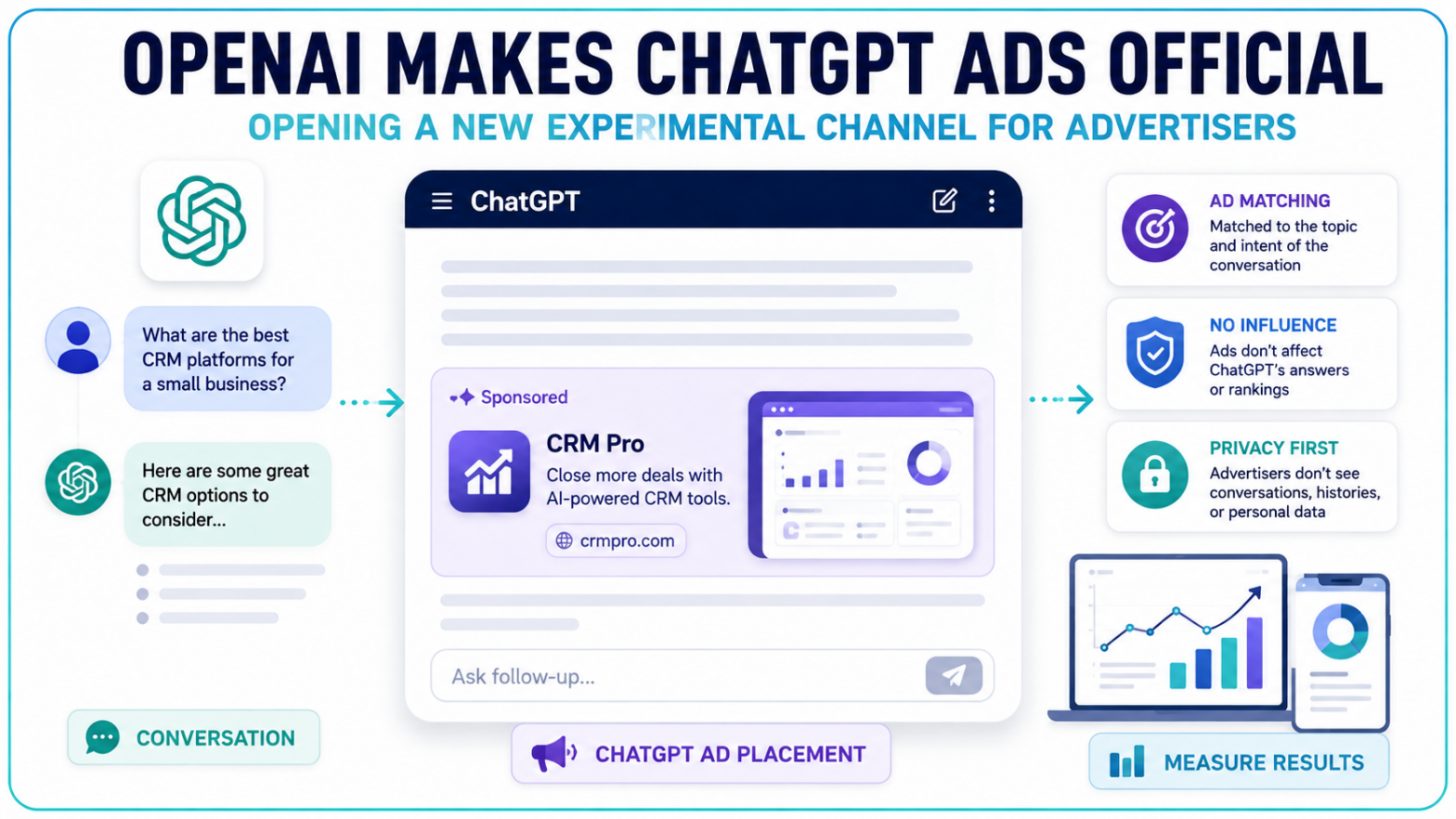
Under OpenAI's official ChatGPT ads test, sponsored placements can be matched against the topic of a user's conversation. If multiple advertisers qualify, OpenAI says it selects the advertiser it considers most relevant to that chat.
That creates an unusually rich commercial context.
Someone asking about running shoes may still be researching. Someone comparing accounting platforms, planning a holiday, narrowing down software options or looking for a meal-delivery service may be much closer to a decision.
OpenAI explicitly describes ChatGPT as a place where people are "actively exploring options, comparing ideas, or working toward a decision."
That is what makes ChatGPT ads materially different from another display placement.
The ad is not being dropped beside unrelated content. It can appear after a system has already interpreted what the user is trying to accomplish.
OpenAI Is Keeping the Answer Out of the Auction
The most important design choice is also the one OpenAI is emphasizing most heavily.
Ads do not determine ChatGPT's answers.
OpenAI says sponsored placements operate separately from the model's organic response and are clearly labelled. Advertisers cannot pay to alter, rank or shape the answer a user receives.
That distinction matters because conversational interfaces carry a different expectation from conventional media.
A sponsored search result is understood as advertising. A sponsored social post is obvious once labelled. A chatbot response can feel more like direct guidance, which makes the separation between editorial-style output and paid placement far more consequential.
OpenAI appears to understand that risk.

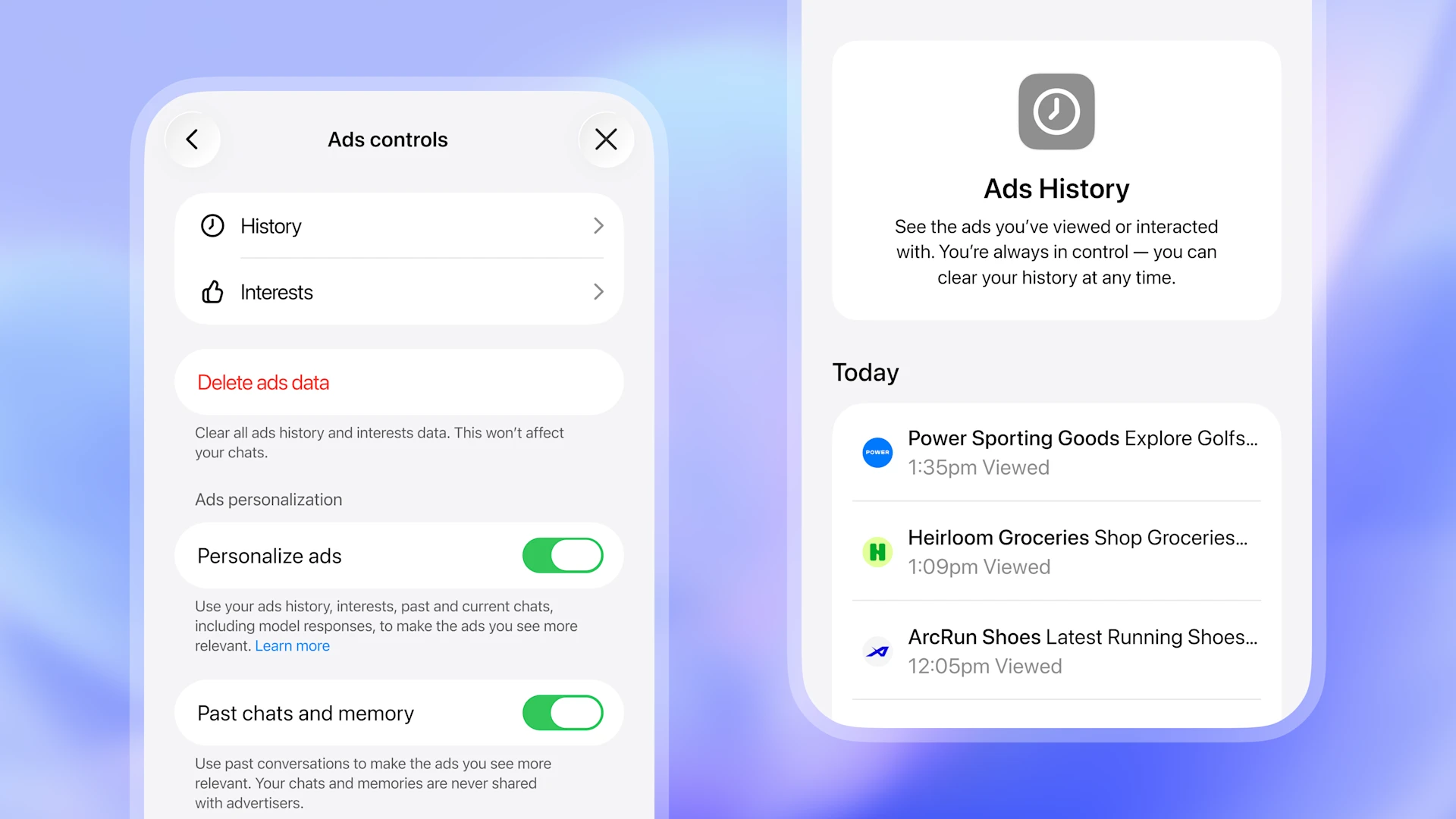
Ads currently appear below responses rather than inside them. The company also says advertisers do not receive users' conversations, chat histories, memories or personal information. Advertisers receive aggregated performance data such as views and clicks.
The targeting system can still use substantial context internally. OpenAI says ad selection may consider the current conversation and, when personalization is enabled, previous chats, memories and interactions with advertising.
The data stays inside ChatGPT rather than being handed to the advertiser.
That creates a very different version of AI advertising from the audience-list model marketers have spent years using across programmatic and social platforms.
The First Opportunity Is Experimental Budget, Not Core Spend
Advertisers do not need to decide whether ChatGPT will replace Google Ads.
That is the wrong benchmark this early.
The more useful comparison is with the experimental portion of a paid media budget: money reserved for channels where the audience behaviour looks promising but historical benchmarks are still thin.
ChatGPT fits that category almost perfectly.
There is clear intent.
There is enormous consumer usage.
There is a distinct ad environment.
There is also not yet enough longitudinal performance data to treat ChatGPT like a mature search or social platform.
That combination is exactly where experimental spend tends to live.
A marketer can test whether conversational intent produces qualified traffic without pulling a large percentage of spend away from proven channels. Conversion quality, cost per acquisition, downstream revenue and assisted conversions can then determine whether the platform earns more budget.
OpenAI has already moved beyond a simple impression-based experiment.
The company introduced cost-per-click buying, a beta self-serve Ads Manager and additional conversion measurement capabilities in May. TechWyse has previously covered the expansion of ChatGPT CPC advertising as OpenAI began making the channel more recognizable to performance marketers.
That infrastructure matters.
A new ad placement becomes much easier to test when buyers can use familiar mechanics rather than negotiating a bespoke pilot.
Conversational Advertising Changes What Counts as Intent
Search marketers have spent decades treating keywords as a proxy for intent.
ChatGPT can see the question around the keyword.
Consider the difference between someone searching "best CRM software" and someone spending several turns explaining that they run a 12-person service company, need automated follow-up, use a specific accounting platform and have a limited monthly budget.
Both users may be commercially valuable.
The second interaction contains far more context.
That does not automatically make conversational advertising more effective. OpenAI still needs to prove that contextual relevance inside a chat produces measurable business outcomes at scale.
But it changes what advertisers can potentially compete against.
Instead of bidding only around a keyword or demographic profile, advertisers are entering an environment where the surrounding conversation may reveal the user's objective, constraints and stage of consideration.
That could make relevance increasingly important.
An ad that technically matches the topic but ignores the user's actual problem may have less room to hide behind broad targeting.
OpenAI Has Already Moved Past a Single-Market Experiment
The original pilot began with logged-in adults on the Free and Go tiers in the United States. Plus, Pro, Business, Enterprise and Education plans remained ad-free.
OpenAI later expanded the program internationally.
By March, the company said early testing had produced no measurable decline in consumer trust metrics, while ad dismissal rates remained low. It announced expansion into Canada, Australia and New Zealand, followed by plans for the United Kingdom, Mexico, Brazil, Japan and South Korea.
OpenAI's current advertiser infrastructure has also become substantially more developed than it was at launch.
Self-serve buying is available through Ads Manager. CPC bidding has been introduced. Conversion measurement has expanded. More recent tests have included multi-advertiser placements and additional campaign controls.
TechWyse has tracked that progression through the rollout of the ChatGPT Ads Manager, which opened direct campaign creation to a much broader group of advertisers.
The sequence matters because it shows what OpenAI is actually building.
Not just ads inside an AI product.
An advertising platform.
Practical implications for marketers
For paid media teams, ChatGPT is best treated as a controlled testing environment rather than an immediate replacement for established search and social campaigns. Small budgets can be used to establish early benchmarks around click-through rate, conversion rate, lead quality and acquisition cost while measurement standards are still developing. Marketers should compare those results against existing channel economics rather than assume conversational intent will automatically produce stronger performance.
The Competition for AI Intent Has Started
Google built one of the world's largest advertising businesses around the moment a user types what they want.
Meta built another around knowing who the user is likely to be interested in.
OpenAI is testing whether advertising can work inside the conversation where a user explains the decision itself.
That is a new piece of media inventory.
OpenAI is still calling its program a pilot, and many of the controls advertisers take for granted elsewhere are continuing to evolve. The company has also placed clear restrictions around minors, sensitive topics and how advertiser access to user information works.
The commercial direction is much less ambiguous than it was when the industry was working from leaks.
ChatGPT now has ads. Advertisers now have buying tools.
The experiment has moved from OpenAI's roadmap into media plans.