

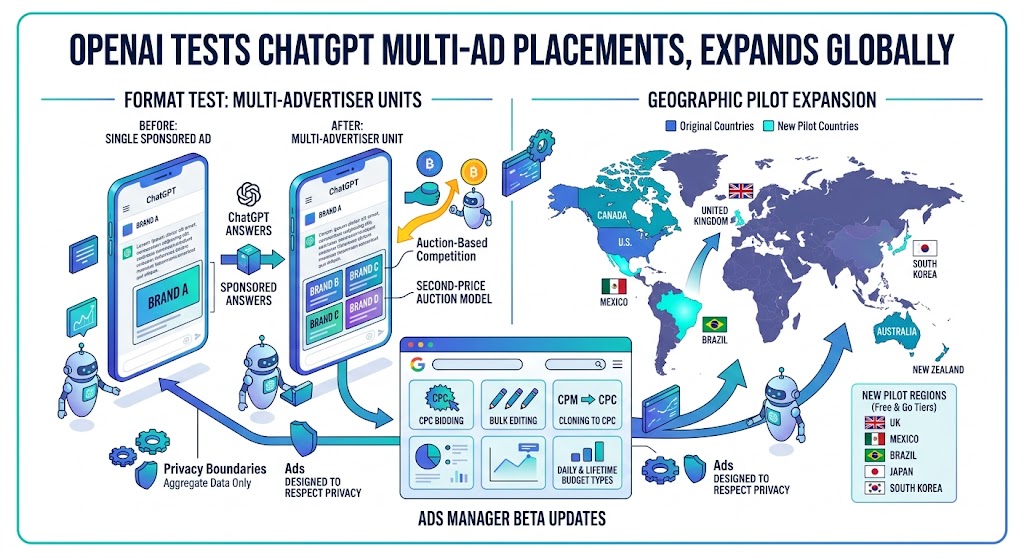
Advertisers using ChatGPT may soon compete directly against one another within a single ad placement. OpenAI notified advertisers through a product update that it is beginning an early test of multi-advertiser ad units across a subset of ChatGPT placements, a format shift that introduces direct auction-based competition between brands inside the same sponsored slot.
Multi-Advertiser Format Replaces Single Sponsored Results
The new ad experiences "build on our existing ad unit by presenting multiple relevant ads together within a single placement," OpenAI stated. Eligible ads will be priced through a second-price auction model, a common pricing mechanism used across digital advertising platforms. OpenAI described the objective as improving product discovery for users while increasing advertiser access to high-intent conversations.
The shift is structurally significant. Until this test, ChatGPT's ad model operated by selecting the single most relevant advertiser from a pool of eligible candidates. During the test, users may see a single ad unit below a ChatGPT response, and that unit may feature one or more items from an advertiser or multiple advertisers. The second-price auction mechanism means winning bids are priced at one cent above the second-highest bid, a model that closely mirrors the auction infrastructure underpinning Google Ads and Meta's ad platform.
Geographic Expansion Confirmed for Five New Markets
Separately, OpenAI confirmed in a May 7 update to its Testing Ads in ChatGPT page that the ads pilot will expand to the United Kingdom, Mexico, Brazil, Japan, and South Korea in the coming weeks. The pilot was previously available only in the U.S., Canada, Australia, and New Zealand. "We're excited to begin expanding the ChatGPT ads pilot into additional regions following strong interest from businesses looking to reach users in a more conversational, intent-driven environment," said David Dugan, head of global ads solutions at OpenAI, in a statement.
In a March 26 update, OpenAI noted that the ads pilot was focused on supporting broader access to ChatGPT while preserving consumer trust, and said early results had been encouraging, with no impact on consumer trust metrics, low dismissal rates, and ongoing improvements in ad relevance. The geographic expansion follows that assessment.
The UK represents OpenAI's first European-regulated market in the pilot. The company's updated EU advertising policy ties personalized ads in the Free and Go tiers to explicit user consent. Consenting users receive ads informed by past chats, memory, ad history, and advertiser-supplied data. Non-consenting users see contextual ads only, drawn from location, time of day, and current conversation context.
In the U.S., capabilities are more advanced, advertisers can reach both logged-in and logged-out users and can manage campaigns themselves through a self-serve ads manager that OpenAI opened to U.S. advertisers of all sizes earlier this week. UK advertisers must currently register interest with OpenAI directly, as the self-serve Ads Manager remains U.S.-only.
Ads Manager Beta Adds Campaign Management Features
Alongside the geographic and format updates, OpenAI announced several additions to the ChatGPT Ads Manager Beta. Updates include the ability to edit campaign budget type, switching existing campaigns from lifetime budgets to daily budgets, and a clone-to-convert function that lets advertisers convert CPM campaigns to CPC bidding with a single button click. Impression-based campaigns now support custom CPM max bids, bulk editing is available within the Ads Manager interface, and daily budgets will shift to an average daily budget model with weekly pacing flexibility.
OpenAI is also introducing cost-per-click (CPC) bidding, adding another layer of performance optimization beyond the CPM-based model already available in the pilot. Alongside this, OpenAI confirmed expanded measurement support through Conversions API and pixel-based attribution tools.
Platform Context and Privacy Boundaries
OpenAI states that ads are designed to respect user privacy. Advertisers do not have access to user chats, chat history, memories, or personal details. Advertisers receive only aggregate information about how their ads perform, such as the number of views or clicks.
Ads are not eligible to appear near sensitive or regulated topics, including personal health, mental health, or politics. Advertisers in sensitive or regulated verticals such as dating, health, financial services, or politics are excluded from advertising on ChatGPT at this time. Ads do not appear in accounts where someone tells OpenAI, or where OpenAI predicts, that the user is under 18.
Implications for Advertisers
For digital marketers, the introduction of multi-advertiser placements combined with a second-price auction model brings ChatGPT's ad infrastructure closer to the bidding environments they manage daily on Google and Meta. Brands in eligible categories operating in the U.S. can now access the platform through the self-serve Ads Manager and test CPC bidding, a lower-risk entry point than the $200,000 minimum commitment required at the pilot's February 9 launch. Advertisers in the UK, Japan, South Korea, Brazil, and Mexico who want early access to the new markets will need to register directly with OpenAI, while self-serve access remains U.S.-only.
As OpenAI expands the pilot, the company has stated that its core principles remain the same: ChatGPT's answers remain independent and unbiased, conversations stay private, and people keep meaningful control over their experience.