
ChatGPT advertising is starting to look less like an experiment and more like a media platform advertisers can actually manage.
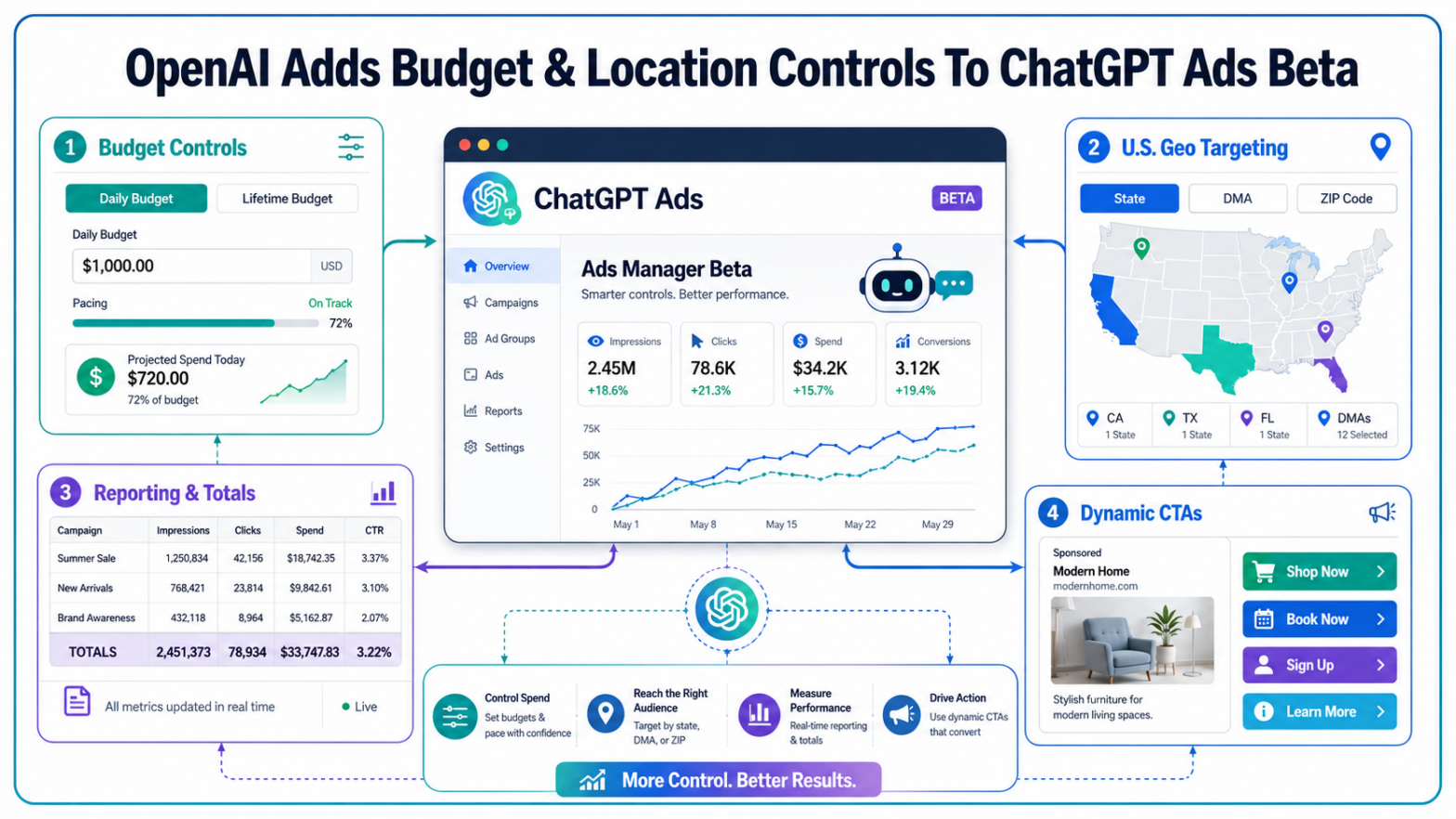
OpenAI is expanding Ads Manager Beta with daily-budget controls, more granular U.S. location targeting, aggregate reporting totals, and a small test of dynamic calls to action inside ChatGPT ads. The changes are incremental. That is the point. OpenAI is filling in the operational controls advertisers expect before they commit larger budgets to a new channel.
The Beta Is Moving From Access To Control
OpenAI’s public Ads Manager Beta documentation describes the platform as a place to create, launch, manage, and measure ChatGPT campaigns from one interface. It also makes clear that the product remains in beta and that capabilities will continue to evolve.
That context matters. Early ad products often begin with limited campaign controls, especially when the platform is still testing user experience, brand safety, measurement, and inventory quality. OpenAI is now adding controls that sit closer to the day-to-day needs of paid media teams: budget pacing, geography, and faster reporting reads.
The biggest operational change is budget structure. Advertisers creating new campaigns can now choose between a daily budget and a lifetime budget. Until now, advertisers working inside the beta had fewer pacing options than they would typically find in mature ad platforms.
Daily budgets are currently limited to newly created campaigns. Existing campaigns are not included in the initial rollout, based on the advertiser update. For marketers, that keeps the change narrower than a full account-wide budget migration, but it also gives OpenAI a controlled way to test how daily pacing behaves across campaign types and advertiser demand.
The distinction is not cosmetic. Lifetime budgets work well for campaigns with fixed dates, defined launches, or short promotional windows. Daily budgets are better suited to always-on testing, steady lead generation, and campaigns that need predictable spend limits across longer periods.
In plain terms: advertisers now have a tighter lever for keeping ChatGPT ad spend from running too hot too early.
Local Targeting Gets More Than Country-Level Reach
OpenAI is also adding more granular U.S. geo targeting inside Ads Manager Beta. Advertisers can now target by state, designated market area, and ZIP code, according to the advertiser update.
That is a meaningful shift for regional advertisers.
OpenAI’s public campaign setup documentation already notes that campaigns include targeting information and that campaigns define the objective, budget, and country targeting. The new controls push beyond broad geography into the kinds of location segments advertisers use for franchise campaigns, regional service businesses, local retail, event promotion, and city-level demand testing.
DMA targeting is especially relevant for advertisers who plan media around broadcast-style markets or regional buying patterns. ZIP-code targeting gives local advertisers a narrower option, though it also raises the need for careful audience-size planning. Overly narrow geography can reduce delivery on any ad platform, especially in a beta environment where inventory and ad load may still be limited.
The controls can be configured during campaign setup or changed later in campaign settings. That flexibility matters because geo targeting often gets adjusted after early delivery data shows where spend is moving, which locations are producing engagement, and where coverage is too thin.
For small and mid-sized advertisers, the practical change is straightforward: ChatGPT ads are becoming easier to test without buying national reach.
Reporting Totals Reduce The Spreadsheet Tax
OpenAI is adding aggregate totals to Ads Manager table views for metrics including impressions, clicks, and spend. The totals are available across campaign, ad group, and ad-level reporting views.
That may sound small. It is not small for anyone managing spend.
OpenAI’s Help Center already says Ads Manager Beta reporting includes impressions, clicks, spend, click-through rate, average CPC, average CPM, and conversions when conversion measurement is configured. It also says those metrics are available in table views, chart views, and CSV exports.
The new aggregate totals make the interface more useful before export. Instead of downloading data to check total spend or combined engagement across a filtered set of campaigns, advertisers can get a faster read inside the platform. That is basic functionality on established ad platforms, but basic functionality becomes important when a channel is trying to move from controlled testing into routine media planning.
The reporting change also fits with OpenAI’s broader measurement direction. The company’s ad documentation supports CPM and CPC buying options, with campaign objectives tied to reach or clicks. It also allows advertisers to use conversion measurement and static tracking parameters such as UTMs for downstream analytics.
OpenAI is not yet presenting ChatGPT Ads Manager as a fully mature performance stack. The current direction is more measured: provide enough campaign, reporting, and measurement infrastructure for advertisers to evaluate whether the channel deserves continued spend.
Dynamic CTAs Put More Weight On The Ad Unit
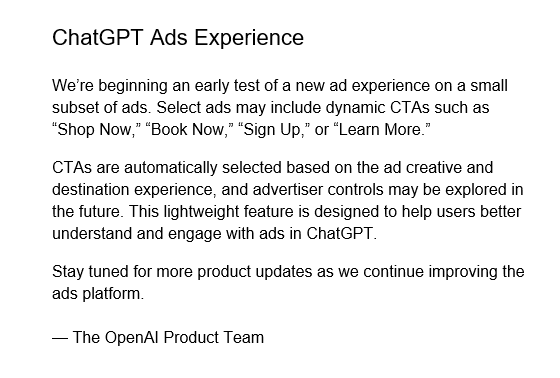
Alongside the Ads Manager changes, OpenAI is testing a new ad experience in ChatGPT. A small subset of ads may now show dynamic calls to action such as “Shop Now,” “Book Now,” “Sign Up,” and “Learn More.”
The CTAs are automatically selected based on the ad creative and destination experience. Advertiser controls for CTA selection may be explored later, according to the advertiser update.
That is a subtle but important product decision. In a conversational environment, the ad unit has to do more than sit beside content. It has to make its purpose clear without interrupting the user’s task. A CTA can help users understand whether an ad points to a purchase, booking flow, registration page, or informational landing page.
OpenAI’s public ads guidance has repeatedly emphasized separation between ads and ChatGPT answers. In its February 2026 ads test announcement, later updated in March and May, the company said ads would remain clearly labeled, visually separated from organic answers, and unable to influence ChatGPT’s responses. It also said advertisers do not receive users’ chats, chat history, memories, or personal details, only aggregate performance information such as views or clicks.
Those principles shape how far OpenAI can push ad engagement. More prominent CTAs may help performance, but the company is still positioning ad experiences as separate from the answer itself.
That boundary will be watched closely as ad formats become more interactive.

What Marketers Can Do With These Controls
For marketers, the near-term impact is practical rather than strategic hype. Daily budgets make controlled testing easier. ZIP-code, state, and DMA targeting make local and regional campaign structures more realistic. Aggregate totals reduce the need to export data for basic pacing checks. Dynamic CTAs may improve clarity on ad intent, though advertisers do not yet appear to have direct CTA selection controls.
The channel still needs careful measurement discipline. Advertisers testing ChatGPT ads should separate beta learning from core channel assumptions, use UTM parameters where appropriate, and compare performance against campaign objectives rather than treating early ChatGPT results as a direct substitute for search or social benchmarks.
OpenAI Is Building The Boring Parts First
The latest changes are not flashy. They are the plumbing.
That makes them more important than they may look. Paid media teams do not scale budgets on novelty alone. They need pacing controls, targeting precision, readable reporting, and enough measurement continuity to explain spend decisions to clients or internal stakeholders.
OpenAI is still testing ads inside ChatGPT, and Ads Manager Beta remains an evolving product. The new controls suggest the company is working through the same operational checklist every major ad platform has had to solve: how advertisers buy, target, monitor, and adjust campaigns without adding unnecessary friction.
For now, ChatGPT ads remain a beta channel with expanding controls, not a finished media ecosystem.