AI crawlers can consume thousands of pages without sending a single customer back.
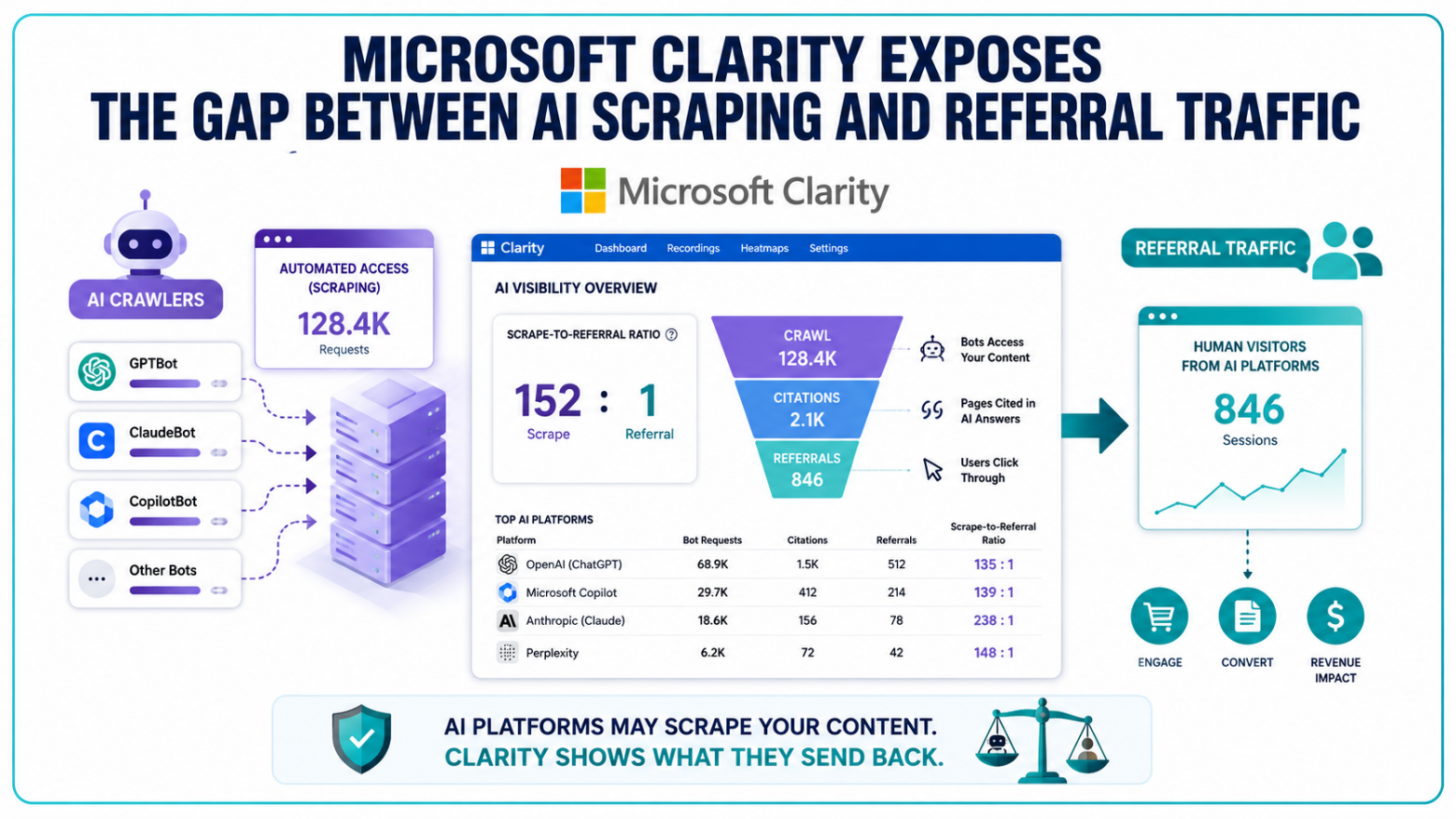
That distinction has been difficult to quantify at the website level. Microsoft Clarity is now putting it directly in front of marketers through its AI Visibility reporting, including a scrape-to-referral ratio designed to show how automated content access compares with the human traffic AI platforms return.
For enterprise teams trying to put a business case around AI search, that is a much more useful question than simply asking how often ChatGPT, Copilot or another AI system crawled the site.
Being Crawled Is Not the Same as Being Recommended
AI crawler activity has become a new visibility metric almost by default.
A marketer sees GPTBot, ClaudeBot or another recognizable crawler requesting pages and assumes that the brand is gaining exposure inside AI answers.
Microsoft is drawing a harder line.
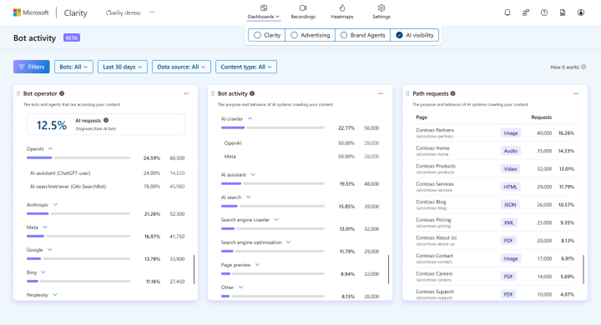
Its official Bot Activity documentation says crawler requests show automated access to content, but they do not prove that the material was retrieved for an answer, grounded, cited or surfaced to a user. Nor does crawler activity guarantee downstream traffic or attribution.
That qualification matters.
TechWyse previously reported on how websites are becoming more selective about AI crawlers, particularly as businesses distinguish between bots that collect training data and bots connected with user-facing AI search products.
The problem for marketers is that raw crawler volume alone does not reveal whether allowing that access produces anything valuable.
A bot could request the same product catalogue repeatedly. That does not tell the marketing team whether a shopper ever saw the brand mentioned in an AI answer, clicked a citation, visited the website or bought something.
Microsoft Clarity's expanding AI search analytics layer is trying to connect more of those stages.
The Scrape-to-Referral Ratio Puts an Exchange Rate on AI Access
The scrape-to-referral ratio is conceptually simple: compare how much an AI platform accesses a website with how much referral traffic it sends back.
That creates a useful diagnostic signal.
High crawling combined with meaningful referral traffic suggests an AI platform is not only consuming the site's information but also creating some measurable path back to the publisher or brand.
High crawling with almost no referrals tells a different story.
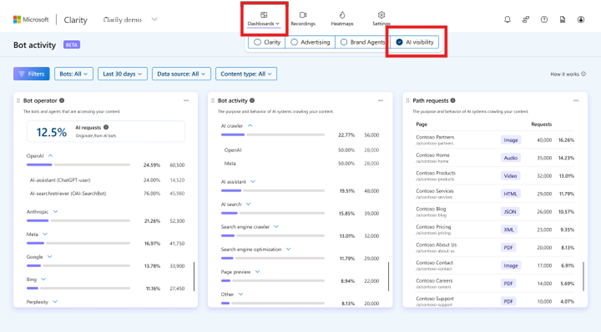
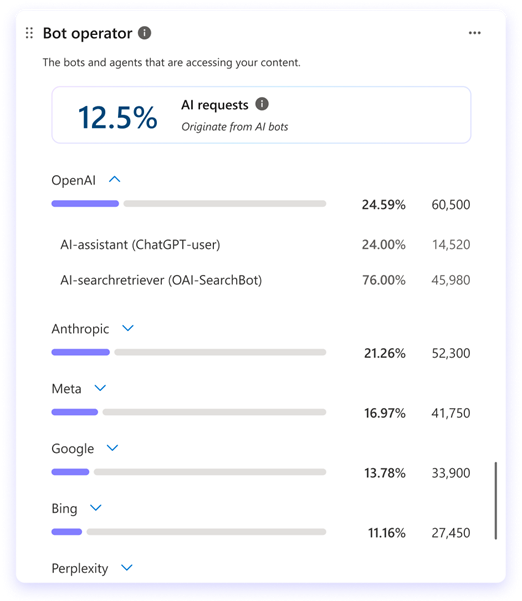
The AI system may be repeatedly accessing the content while users remain inside the AI interface. The website absorbs the crawling activity, while traditional analytics see little downstream benefit.
Microsoft's broader AI Visibility platform is built around separating those stages. Clarity can surface which AI bots request a site, how frequently they appear and which pages receive automated attention. It can then place that information alongside AI citation and referral signals.
That is especially relevant for enterprise publishers, retailers and large content operations where AI crawler traffic can represent more than an abstract SEO metric.
Crawler requests consume infrastructure resources. Microsoft specifically notes that sustained automated access can create overhead and performance concerns, particularly when there is little evidence that the activity creates downstream value.
The scrape-to-referral view gives those conversations a commercial dimension.
The question is no longer, "Is OpenAI crawling us?"
It becomes, "What are we receiving in return?"
Microsoft Is Building a Funnel From Crawl to Citation to Click
Clarity's latest reporting makes more sense when viewed alongside Microsoft's other AI measurement releases.
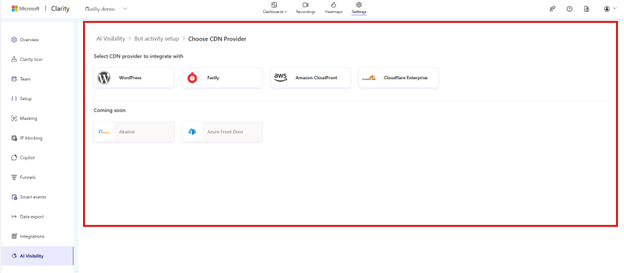
Bot Activity covers the upstream end of the journey. It uses server-side logs from supported CDN and server integrations to identify verified automated requests, including which operators are active and which paths they request.
The AI Citations dashboard moves one stage further. It reports when site pages are referenced in supported AI-generated answers, the grounding queries associated with those citations, a site's share of authority and the percentage of sessions arriving from AI assistants.
Microsoft is effectively giving marketers three different signals.
First, did the AI system access the content?
Second, did that content become part of an AI-generated answer?
Third, did a human eventually arrive at the website?
Those signals have often been collapsed into the loose category of "AI visibility." They are not interchangeable.
TechWyse recently covered Microsoft's expansion of Bing AI visibility reporting, where Intents, Topics, Citation Share and comparison tools are pushing measurement beyond simple citation counts.
Clarity attacks the same measurement problem from the website side.
Together, the products show Microsoft moving toward something closer to an AI discovery funnel rather than another rank-tracking dashboard.
Referral Traffic Still Does Not Capture the Whole AI Journey
There is one obvious limitation.
A scrape-to-referral ratio can measure direct referrals. It cannot identify every customer whose decision was influenced by an AI answer.
Someone could ask ChatGPT for accounting software recommendations, see a brand mentioned, close ChatGPT and search the company name on Google five minutes later. Analytics might attribute that visit to organic search rather than AI.
TechWyse has already seen evidence of that behaviour. Recent data covered in our report on ChatGPT mentions driving branded search found that AI recommendations can lead users back into conventional search rather than producing a direct chatbot click.
Google has begun solving another piece of the attribution problem by adding an AI Assistant channel to GA4, which separates identifiable chatbot referrals from generic referral traffic.
Neither system can perfectly reconstruct an AI-influenced customer journey.
That does not make the scrape-to-referral ratio weak. It defines what the number actually measures.
It is a comparison between observable AI access and observable referral traffic, not a complete calculation of AI-generated revenue.
That distinction should matter in executive reporting.
Enterprise AI Reporting Can Finally Ask a Harder Question
For marketers, the practical implication is straightforward.
Teams evaluating Microsoft Clarity AI Visibility can stop treating crawler counts as a success metric on their own. High bot activity should be read alongside citations, AI referral sessions, conversion behaviour and the pages receiving both crawler and human attention. A heavily scraped section that never earns citations or referrals tells a different story from one that regularly appears in AI answers and sends qualified visitors into the funnel.
Microsoft's own historical Clarity data gives that referral side more weight. In a study of more than 1,200 publisher and news sites, the company found AI-driven referral traffic grew 155.6% over eight months while remaining below 1% of overall traffic. AI-referred visitors also recorded stronger conversion rates in the dataset, including a 1.66% sign-up conversion rate compared with 0.15% from search. Those results describe the sites and conversion events Microsoft studied rather than a universal benchmark, but they show why referral quality cannot be judged on volume alone.
The new reporting also comes with a technical requirement. Microsoft says Bot Activity depends on server-side log collection through supported CDN or server integrations. Clarity itself does not charge for AI Visibility or Bot Activity, although infrastructure providers can impose their own logging or data-transfer costs.
That still leaves marketers with a more defensible way to discuss AI performance.
An enterprise website may discover that an AI company is one of its most aggressive automated consumers and one of its weakest referral sources. Another platform might crawl less frequently but deliver visitors who convert.
Those are very different relationships.
AI crawlers have always been able to take content without showing marketers exactly what happened next. Microsoft's latest Clarity reporting does not make every part of that journey attributable, but it makes the imbalance between consumption and returned traffic much harder to ignore.