
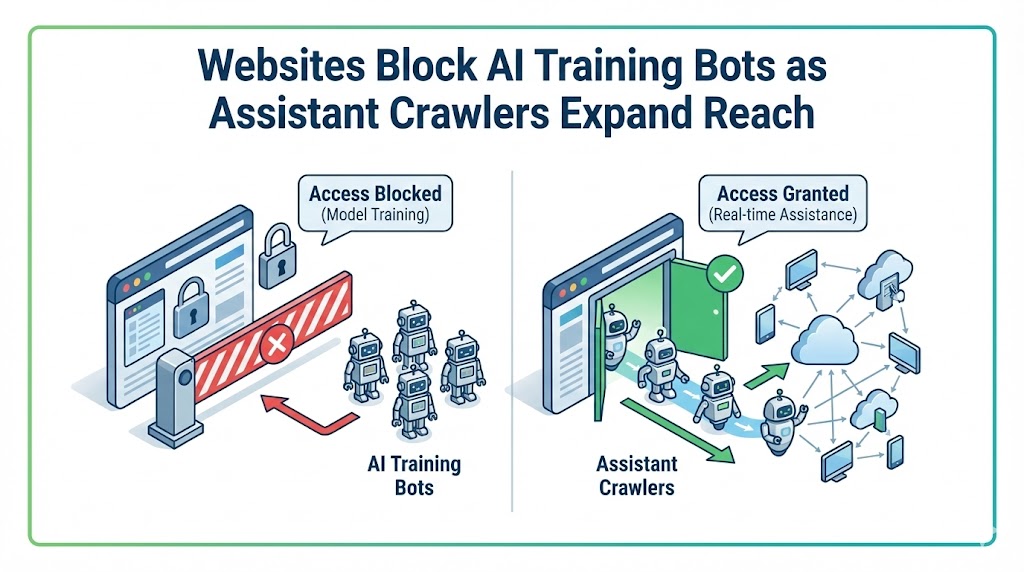
Website owners are increasingly restricting access to AI systems used for model training, even as crawlers that power consumer-facing AI assistants expand their reach across the web. New large-scale traffic analysis suggests this divergence could have unintended consequences for how brands and content are represented in AI-driven discovery.
Diverging treatment of AI crawlers
Recent analysis of anonymized website logs spanning billions of bot interactions indicates that organizations are drawing a sharp distinction between AI crawlers used for training large language models and those used to deliver real-time answers through AI assistants.
Over a multi-month period in 2025, assistant-oriented crawlers significantly increased the proportion of sites they access. In contrast, access granted to training-focused crawlers dropped steeply, with many sites opting out entirely within a short timeframe. Traditional search engine crawlers, by comparison, showed little change in overall coverage.
The data points to a shift in how businesses perceive risk and value across different forms of AI access, rather than a blanket rejection of AI-driven indexing.
What blocking training bots actually does
Training crawlers collect information that becomes embedded in an AI model’s long-term knowledge. When a site blocks these bots, its content is excluded from that foundational learning process. As a result, AI systems may rely on secondary sources, aggregators, or third-party references to form an understanding of a brand, product, or topic.
For businesses concerned with how they appear in AI-generated answers, this tradeoff is significant. Allowing training access gives organizations an opportunity to supply first-party context about who they are, what they offer, and how they describe themselves. Blocking that access removes this influence entirely.
Visibility without attribution
At the same time, many of the same sites continue to allow AI assistant crawlers to retrieve and summarize their content on demand. These systems power conversational interfaces that often deliver answers without requiring users to click through to a source.
This dynamic means businesses may still contribute information to AI responses while receiving less direct traffic, brand exposure, or contextual framing in return. For ecommerce and comparison-driven sites, this can complicate attribution, pricing control, and messaging consistency as more of the customer journey occurs inside AI interfaces.
Intellectual property concerns drive decisions
For some publishers, especially those producing highly specialized or proprietary content, blocking AI training bots is a deliberate strategy to prevent models from replicating niche expertise without attribution. In these cases, limiting AI access may help preserve demand for direct visits.
However, the same approach may be less advantageous for brands operating in competitive or commoditized spaces, where exclusion from AI models’ core knowledge could reduce long-term discoverability as AI-assisted search and recommendations continue to expand.
A strategic choice, not a default
The emerging pattern suggests that AI access decisions are becoming more granular, with organizations selectively permitting or denying crawlers based on perceived value rather than technical capability alone.
As AI assistants play a larger role in how users evaluate products, services, and information, the decision to block or allow AI training bots carries strategic implications beyond intellectual property protection. For many businesses, the risk may not be AI exposure itself, but diminished control over how they are understood when AI systems mediate discovery and decision-making.