


An AI-generated advertisement can accurately describe a product and still communicate the wrong message about the business selling it. For advertisers investing in brand positioning, that distinction becomes increasingly important as advertising platforms automate creative production.
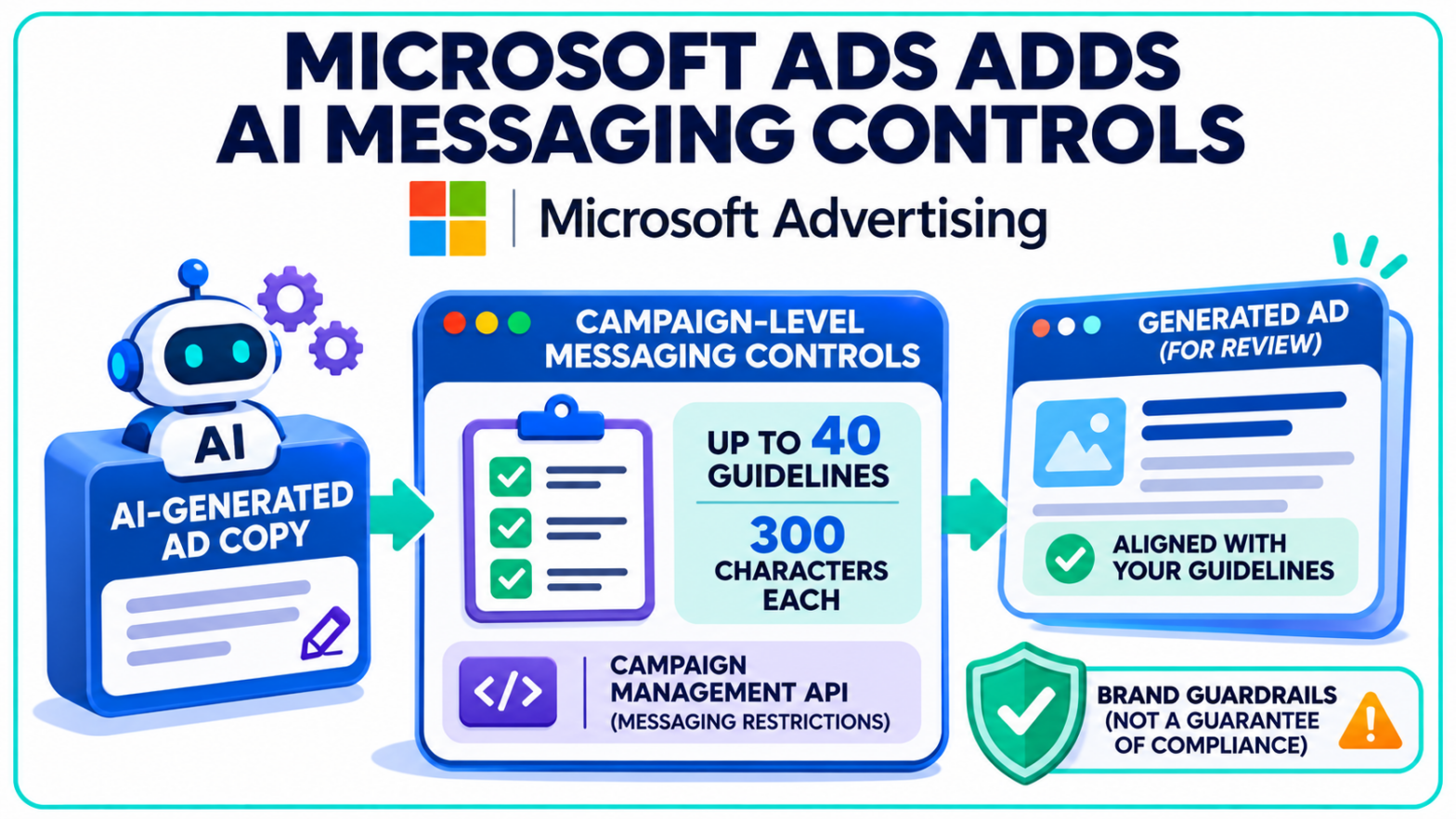
Microsoft Advertising has updated its Campaign Management API to support campaign-level messaging restrictions, allowing advertisers to establish up to 40 natural-language guidelines governing automatically generated ad copy.
Each guideline can contain up to 300 characters, giving businesses room to describe acceptable messaging, prohibited claims and preferred brand positioning beyond individual keyword exclusions.
Microsoft's November 2026 API release notes confirm support for the new functionality in its software development kit. The development extends messaging guidelines that Microsoft introduced through an open pilot in October.
The API integration brings brand messaging controls into the programmatic workflows that agencies, large advertisers and third-party advertising platforms already use to manage campaigns.
Microsoft Advertising Moves Beyond Individual Term Exclusions
Preventing an automated advertising system from using a particular word is relatively straightforward. Preventing it from communicating an undesirable idea is considerably more complicated.
Microsoft Advertising already supports campaign-level term exclusions, allowing advertisers to identify up to 25 words or phrases that generated ad copy should not contain, with a maximum of 30 characters per entry.
The new MessagingRestrictions property, documented in Microsoft's Campaign Management API reference, introduces a more contextual form of control.
Consider a premium furniture retailer that wants to avoid competing primarily on price. Excluding terms such as cheap and discount may prevent specific wording, but automatically generated advertisements could still describe the retailer as a budget-friendly destination.
A messaging guideline could instead instruct the system to emphasize craftsmanship, material quality and product longevity without positioning the furniture as a low-cost alternative.
Microsoft's October advertising announcement confirms that messaging guidelines can address both unwanted concepts and preferred communication styles.
Term exclusions and messaging guidelines can operate alongside one another. Advertisers retain control over specific terminology while gaining a way to communicate broader brand requirements to the creative generation system.
Campaign-Level Messaging Restrictions Could Help Prevent Misleading Product Claims
The ability to describe prohibited claims in natural language has implications beyond brand tone.
Businesses operating in industries such as healthcare, insurance, financial services and professional services often need to distinguish carefully between what their products can offer and what their advertising can legitimately promise.
Automatically generated ad copy may introduce wording that overstates a benefit, removes an important qualification or implies an outcome that the business cannot guarantee.
Potential applications for campaign-level messaging guidelines include:
- Financial services: Avoid implying guaranteed investment returns, loan approvals or universal eligibility.
- Healthcare: Describe available treatments without promising specific patient outcomes.
- Insurance: Avoid suggesting that every incident or expense is covered regardless of policy exclusions.
- E-commerce: Prevent unsupported claims about product durability, environmental benefits or promotional pricing.
- Professional services: Avoid suggesting guaranteed legal, financial or commercial results.
These are illustrative applications rather than industry-specific compliance templates provided by Microsoft.
The effectiveness of each guideline will depend partly on how the advertiser describes its requirements and how the generation system interprets them.
Microsoft's existing guidance on AI-generated advertising and advertiser responsibility establishes that businesses remain accountable for the content they distribute.
Messaging restrictions add a preventative control, but they do not establish that generated advertisements have passed legal or regulatory review.
API Integration Brings Brand Guidelines Into Campaign Management at Scale
The most significant aspect of the November development is not the introduction of messaging guidelines themselves. It is their availability through a programmatic interface.
Microsoft initially introduced messaging guidelines in an open pilot for Performance Max campaigns and Search campaigns with AI Max enabled.
The Campaign Management API now represents messaging restrictions as a collection of linked text assets within the campaign object. Developers can work with these campaign settings through four existing operations:
- AddCampaigns
- UpdateCampaigns
- GetCampaignsByIds
- GetCampaignsByAccountId
These operations allow campaign management systems to configure restrictions when creating campaigns, update existing settings and retrieve previously configured guidelines.
For an agency managing numerous advertising accounts, this could support a centralized library of approved messaging rules. Account managers could maintain brand-specific instructions and apply them programmatically to relevant campaigns rather than configuring each campaign manually.
A national retailer, for instance, could maintain common brand guidelines while applying different promotional restrictions to campaigns targeting individual provinces or product categories.
Campaign-level configuration also allows businesses to distinguish between advertising objectives. A premium product campaign may require different positioning from a seasonal clearance campaign, even when both promote products from the same retailer.
Microsoft's AI Max Bulk API documentation also describes support for messaging restrictions within bulk campaign records, providing another route for managing generated text guidance.
Microsoft AI Max Is Expanding Automation Alongside Advertiser Controls
Messaging restrictions form part of a broader effort by Microsoft to give advertisers greater influence over automated campaign decisions.
The global expansion of Microsoft Advertising AI Max earlier in 2026 introduced capabilities that extend conventional Search campaigns through expanded query matching, generated creative and automated landing page selection.
Microsoft subsequently introduced AI Max URL inclusion controls, allowing advertisers to influence which website pages inform automated campaign activities.
While URL inclusion controls help determine which content the system can draw upon, messaging guidelines address how generated advertisements communicate that information.
Microsoft has also introduced AI-generated image and video disclosure controls, giving advertisers additional options for identifying synthetic creative assets.
These developments address distinct aspects of advertising automation: source material, messaging, creative production and disclosure.
They also illustrate a growing distinction between giving an advertising system permission to generate creative and giving it unrestricted discretion over the resulting content.
For advertisers, the ability to configure these elements separately could make automation more compatible with established brand management processes.
Automated Creative Still Requires Human Review
Messaging guidelines could reduce the frequency of undesirable creative outputs and the amount of manual editing required across large advertising accounts. Microsoft has not, however, published independent performance measurements establishing how consistently generated advertisements follow these instructions.
There is also no evidence that using all 40 available guidelines necessarily produces better creative results than maintaining a smaller collection of precise, relevant instructions.
For paid media teams, effective implementation may involve translating existing brand standards into concise campaign-level rules, reviewing generated assets for inconsistencies and revising instructions when products, promotions or business requirements change.
Where automated text generation presents unacceptable risks, Microsoft's AI Max campaign documentation describes a separate setting that allows eligible Search advertisers to disable generated text without disabling the entire AI Max feature.
The November API update provides another option between unrestricted creative generation and opting out of automated text entirely.
Microsoft originally announced messaging guidelines as an open pilot for eligible campaigns. Its November API documentation confirms programmatic support for the feature, but does not independently establish universal availability across every advertising account, campaign type or market.