
An AI-generated ad can carry a disclosure and still be misleading. Microsoft’s latest advertising guidance puts that distinction at the centre of creative review, alongside consent and the information that identifies how an asset was made.
The company has published dedicated guidance covering generated, manipulated and other synthetic advertising content. Its focus extends beyond adding a label: advertisers remain responsible for permissions, accurate representations and disclosure obligations in the markets where their campaigns appear.
For businesses using Microsoft Advertising, the central question is what must be checked before an AI-assisted asset is approved.
Microsoft’s Creative Tools Leave Responsibility With the Advertiser
Using a platform’s own generation tools does not transfer responsibility for the resulting ad to the platform.
Microsoft’s advertising agreement already makes that allocation explicit. Advertisers who use optional tools that assist with selecting or generating ads remain responsible for those ads. The agreement also requires the rights, authorizations and permissions needed for Microsoft to use the submitted content.
That applies to the finished material, including assets produced through a workflow involving outside creative suppliers.
An advertiser cannot treat an available generation feature as evidence that every output is suitable for publication. The tool supplies material; the advertiser still submits it under the account’s obligations.
Microsoft has actively encouraged AI-assisted production. In its May 2025 discussion of generative advertising, the company described generating copy variations, changing tone and localizing campaigns. The same article called for human oversight of accuracy and brand fit.
The latest guidance gives those review responsibilities a more specific synthetic-content context as AI-generated ads become easier to produce inside campaign tools.
AI Ad Disclosures Depend on the Applicable Requirement
Microsoft’s new synthetic-content guidance addresses disclosures where they are required. It should not be presented as a universal instruction to label every ad that received any AI assistance.
The guidance calls for clear disclosure near the relevant content and recommends embedding it in image or video assets. Microsoft also points advertisers to its existing disclaimer feature for supported formats.
Placement is part of the disclosure question. A notice has to communicate with the person encountering the creative, rather than merely exist somewhere in the campaign’s supporting material.
The same issue arises across AI ad disclosures: a platform’s available labelling tools and an advertiser’s obligations are related, but they are not interchangeable. A control offered by one network does not establish how another network handles the asset.
Campaign geography remains relevant. The guidance places responsibility for applicable disclosure and permission requirements with advertisers wherever their campaigns run.
A Watermark and a Consumer Notice Serve Different Purposes
The guidance also addresses preserving metadata, watermarks and other provenance signals. Microsoft AI tools can include machine-readable indicators in generated image, audio and video content, but those indicators may be imperceptible to consumers.
A hidden signal cannot be assumed to communicate what a visible or audible disclosure would.
Microsoft Research’s media authenticity analysis explains the technical distinction. Provenance concerns the source and history of digital content, including how it was modified. Its research examines secure provenance records, imperceptible watermarking and fingerprinting as different methods with different strengths.
The researchers also caution that the design and display of these signals affect how people interpret them. A visible marker alone can create misplaced confidence when viewers take it at face value.
For advertising, that leaves separate questions to resolve. One concerns what the file records about its creation. Another concerns what the audience understands. A third concerns whether the commercial representation is accurate.
An asset’s documented origin can help establish how it was produced. It does not, by itself, substantiate a product claim or prove that a depicted person approved an endorsement.
Deepfake Restrictions Were Already in Place
The new guidance identifies prohibited deepfakes, impersonation, unauthorized likeness or voice use, missing required disclosures and interference with provenance information as potential grounds for rejection, restriction or removal.
A label does not supply permission to impersonate someone.
Microsoft’s enforcement history shows that synthetic creative was already subject to restrictions. In its 2024 advertising safety review, published in June 2025, the company said it had revised its policies in October 2024 to address deepfake technology.
That report described financial scams involving fabricated celebrity endorsements, manipulated imagery and phishing sites. Microsoft said it combined policy changes with improved moderation and AI-assisted analysis to identify deceptive material.
Those restrictions predate this guidance.
The company reported removing or restricting more than one billion policy-violating ads during 2024 across its network. That total covered multiple categories of violations and should not be read as a count of AI-generated or deepfake ads.
The current development is dedicated guidance about synthetic creative within an advertising system that already prohibited deceptive uses.
The Approval Decision Reaches Beyond the Label
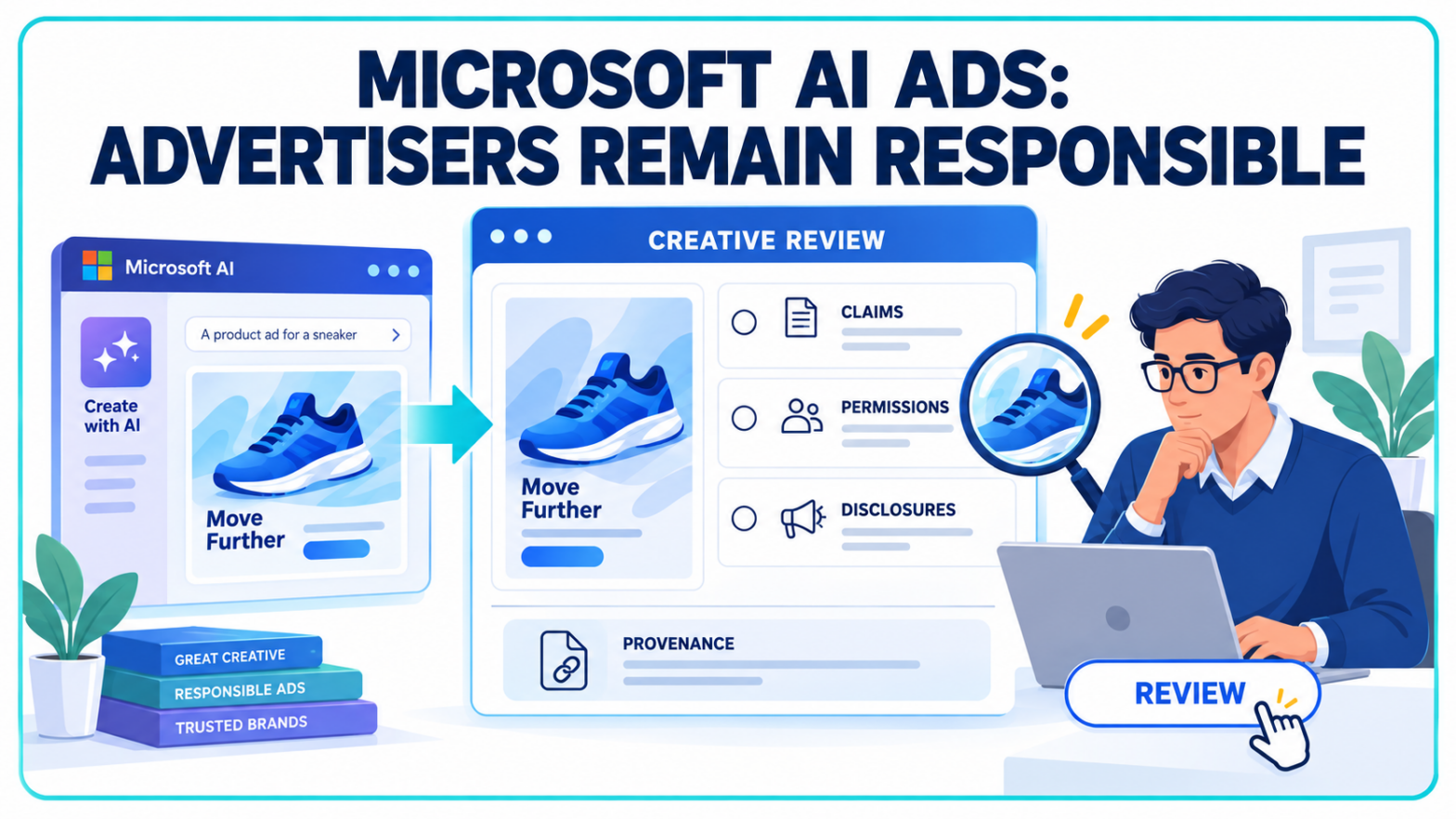
For marketing teams, the practical implication is to review the final exported asset together with its claims, permissions and applicable disclosure treatment. The person approving a campaign needs to know what AI generated or altered, whether required provenance signals remain intact, and whether the disclosure is present in the version actually submitted. Supplier approval or a clean visual preview alone does not answer those questions.
This is especially relevant when one source asset becomes several campaign variants. A different crop, edit or format creates another finished version to assess.
Microsoft’s agreement reserves its right to review and restrict submitted content and to request information reasonably necessary to demonstrate compliance. Approval of creative inside an advertiser’s workflow therefore remains separate from acceptance by the advertising platform.