Microsoft is not replacing Search campaigns with another black box.
It is putting a much larger AI layer on top of them.
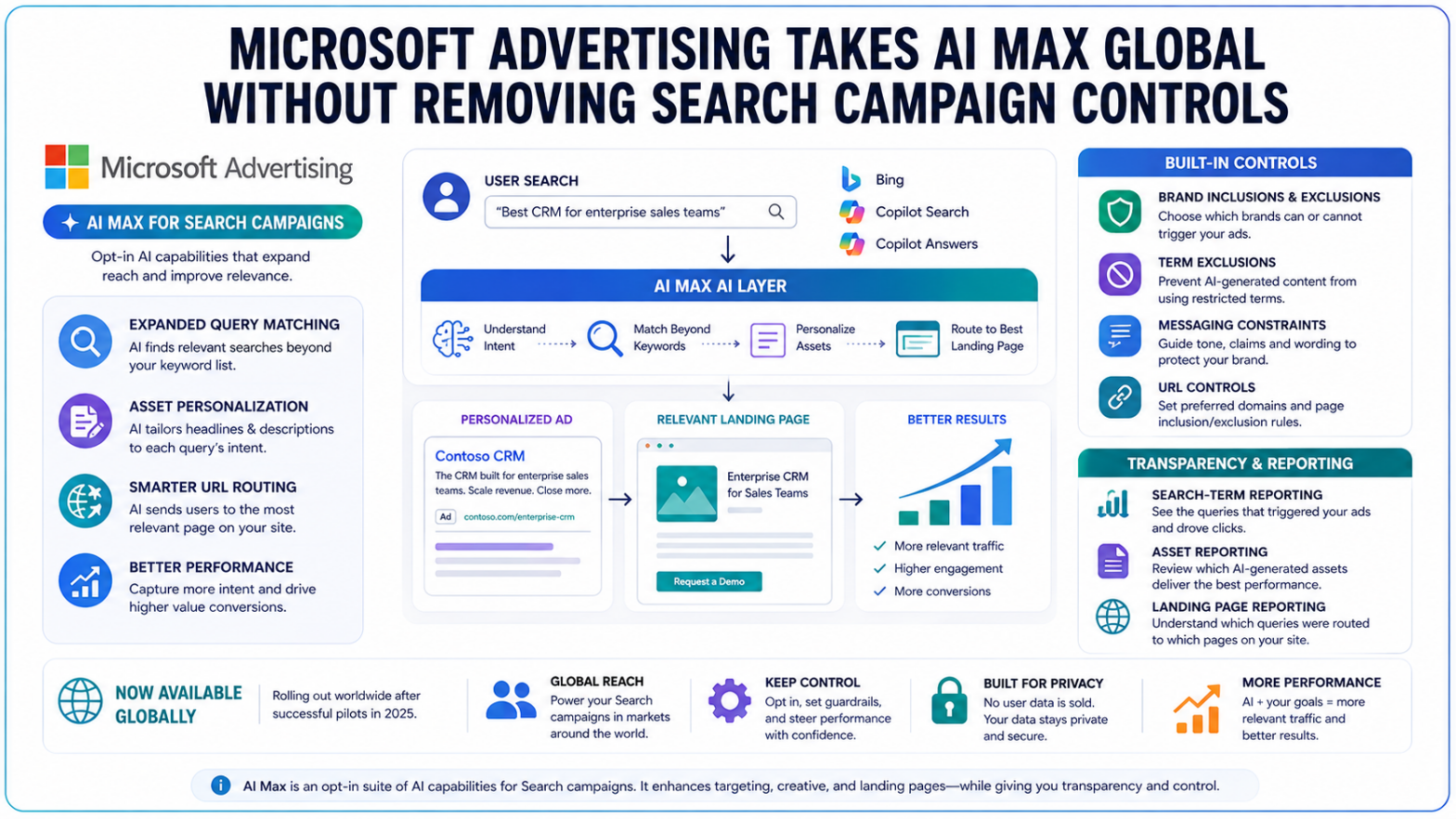
Microsoft Advertising has begun rolling out AI Max globally for Search campaigns after testing the feature through closed and open pilots earlier this year. The system expands query matching, personalizes ad assets and can route users to more relevant landing pages, while Microsoft is simultaneously adding controls intended to keep that automation from drifting too far from an advertiser’s strategy.
The result looks familiar to anyone watching Google Ads. Search advertising is becoming less dependent on the exact keywords, ads and URLs marketers configure manually.
Microsoft’s version, however, is making transparency part of the pitch.
AI Max Turns Keywords Into One Signal Among Several
Search campaigns have traditionally revolved around a tightly defined connection: advertiser chooses keyword, user enters query, platform determines whether the two match.
AI Max loosens that relationship.
Microsoft says the feature uses AI to improve Search campaign performance through expanded query matching, asset personalization and smarter URL routing. The goal is to capture relevant demand that may not be represented in an advertiser’s existing keyword list.
That matters as searches become longer and more conversational, particularly on AI-driven surfaces.
Microsoft has explicitly positioned AI Max as a way for advertisers to capture intent across Bing as well as experiences including Copilot Search and Copilot Answers, where user questions can be more nuanced than conventional keyword searches.
A campaign targeting “enterprise CRM software,” for example, no longer needs to depend exclusively on a finite list of keyword variations if Microsoft’s models can determine that a more detailed query expresses commercially relevant intent.
That resembles the direction Google has taken with AI-powered search advertising, where keyword targeting is increasingly supplemented by machine learning, landing page content and other contextual signals.
The distinction is important: AI Max is not a separate campaign type.
Microsoft describes it as an opt-in collection of AI capabilities applied to Search campaigns. Performance Max remains the company’s cross-channel automated campaign format, while AI Max enhances Search specifically.
Microsoft Is Automating the Ad and the Landing Page
Query matching is only one layer.
AI Max can also personalize text assets and determine which landing page is most appropriate for a search.
That expands the number of campaign decisions traditionally controlled at setup.
Microsoft describes asset personalization as a way to tailor messaging based on query context. Smarter URL routing allows the system to direct users toward a relevant page on the advertiser’s website rather than necessarily relying on one static final URL for every eligible search.
For large websites, that could materially change campaign architecture.
An enterprise advertiser may have hundreds of product, service and category pages that correspond to different forms of search intent. Manually mapping every variation becomes difficult as query language grows more conversational.
AI Max lets Microsoft perform more of that interpretation dynamically.
The tradeoff is familiar across modern paid search automation: every automated decision creates another place where relevance can improve or where the system can make a choice the advertiser would not have made manually.
Microsoft appears unusually conscious of that tension.
Brand Controls Arrive With the Automation
Microsoft’s rollout is not simply broadening AI access and asking advertisers to trust the model.
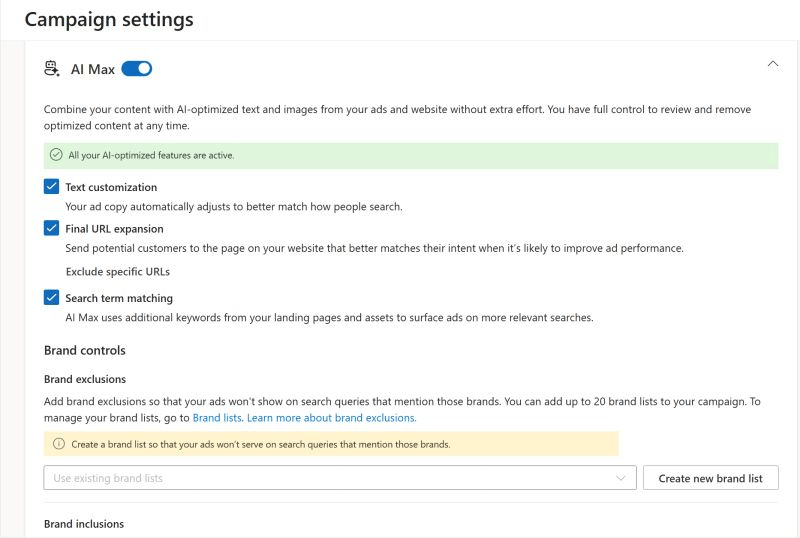
Brand inclusions and exclusions are part of the AI Max control set, giving marketers more ability to determine which branded searches the campaign should or should not capture.
Term exclusions are also being added for asset optimization, letting advertisers prevent generated text from using language that conflicts with brand standards. Microsoft has separately announced messaging constraints and additional URL controls as part of its broader AI Max roadmap.
Those controls matter for advertisers operating in regulated categories or environments where wording cannot be left entirely to generative systems.
They also address one of the biggest objections to automated advertising: loss of steering.
Microsoft has repeatedly framed AI Max around a combination of automation and advertiser direction. In its April announcement, the company said advertisers would be able to opt into AI Max while using guardrails including brand inclusions, exclusions and messaging controls.
That positioning is deliberate.
Google Ads has faced persistent advertiser criticism as automation expanded faster than reporting in products such as Performance Max. Microsoft appears to be trying to avoid repeating that sequence.
Search-Term Transparency Is Part of Microsoft’s Competitive Pitch
The most notable part of Microsoft’s AI Max strategy may not be the AI itself.
It is what the platform says advertisers will still be able to see.
Microsoft says AI Max has supported search-term and asset reporting from the beginning, allowing advertisers to inspect how automated matching and creative decisions contribute to campaign performance.
That reporting philosophy extends elsewhere in Microsoft Advertising.
The company recently emphasized that it provides search-term transparency for queries that generate clicks, positioning those reports as a core optimization tool even as AI begins mediating more discovery journeys.
Microsoft has also announced search-term landing page reporting for AI Max, which is designed to show advertisers which queries were associated with specific destination pages.
That is a meaningful control point.
If AI determines both which query is relevant and which page should receive the visitor, advertisers need visibility into both decisions to diagnose performance.
A low-converting search may indicate a poor match. Or the query may be relevant while the automatically selected landing page is wrong.
Without that reporting, the distinction is difficult to make.
Existing Search Campaigns Will Not All Change the Same Way
The global rollout also creates an important implementation detail for advertisers already using Microsoft's automated features.
Some AI Max capabilities overlap with functionality that existed before the AI Max label.
Microsoft is consolidating features including predictive matching and automatically generated text assets under AI Max. Campaigns already using those capabilities may therefore show the corresponding AI Max settings enabled as the rollout reaches their accounts.
That should not be confused with Microsoft automatically activating the entire feature set.
The broader AI Max package remains opt-in, consistent with Microsoft's stated approach to advertiser control.
For marketers, the practical implication is straightforward: existing Search campaigns should be reviewed as AI Max arrives rather than assuming their current configuration will remain visually or operationally identical.
Campaign teams will need to understand which automated functions were already active, which have simply moved under the AI Max interface and which new capabilities require deliberate activation.
The same scrutiny applies to imported campaigns.
Microsoft Advertising has long made Google Ads imports a central part of its acquisition strategy, and automation settings can become particularly important when campaign structures move between platforms. Advertisers should verify how targeting, asset generation, URLs and exclusions are represented after import rather than assuming identical behaviour across both systems.
Microsoft Is Following Google’s Direction, Not Copying Its Product
The broad strategic pattern is hard to miss.
Google is expanding AI across query matching, creative generation, landing page selection and automated campaign optimization. Microsoft is moving in the same direction because the economics of modern search push both platforms there.
More conversational queries make exhaustive keyword lists less useful.
Larger websites make static URL mapping harder.
Generative systems make customized creative possible at a scale manual production cannot match.
Microsoft’s AI Max product therefore fits the same larger shift that is reshaping search campaign automation.
But the products are not identical.
Microsoft is placing particular emphasis on opt-in controls, search-term visibility, asset reporting and the ability to inspect where automated traffic is being sent. Those differences may become more important than the AI label itself as advertisers compare platforms.
For paid media teams, AI Max is best treated as an additional optimization layer rather than an instruction to abandon conventional Search campaign management. Query quality, generated messaging, destination-page selection and conversion performance still need to be evaluated against business outcomes.
Microsoft has been moving toward this release for months. AI Max was announced in April, entered an open pilot in May and is now progressing beyond testing into broader availability.
The global rollout makes Microsoft's direction clear: keywords are not disappearing from Search campaigns, but they are increasingly sharing control with models that decide what a relevant query, ad and landing page should look like.