


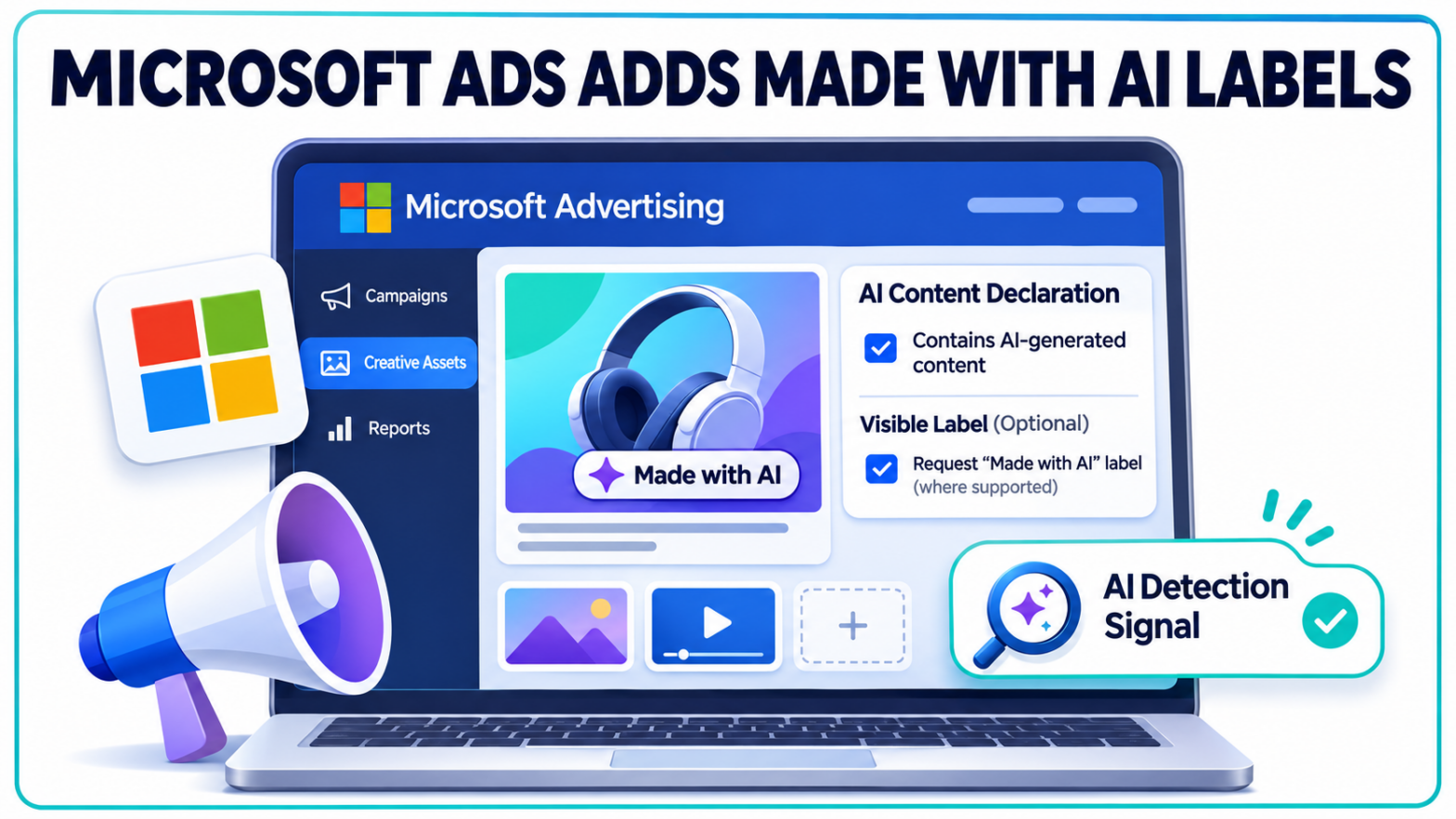
AI-generated advertising images are getting a more visible identity. Microsoft Advertising has introduced new transparency controls that allow advertisers to declare when their creative contains AI-generated content and request a "Made with AI" label on supported advertisements.
The change brings AI content disclosure directly into campaign management, where marketers can identify AI-generated images and videos, manage declarations across multiple assets and access Microsoft's own AI detection signals.
In its November 19, 2026, product announcement, Microsoft confirmed that the AI content transparency controls are now generally available.
The update addresses an increasingly common challenge in paid advertising: identifying how creative assets were produced as generative AI becomes part of everyday campaign development.
However, the new controls do not establish a universal requirement to display an AI watermark on every AI-assisted advertisement. Microsoft leaves advertisers responsible for deciding which declarations and disclosures are required under applicable laws and advertising policies.
Microsoft Advertising Adds AI Content Declarations to Creative Assets
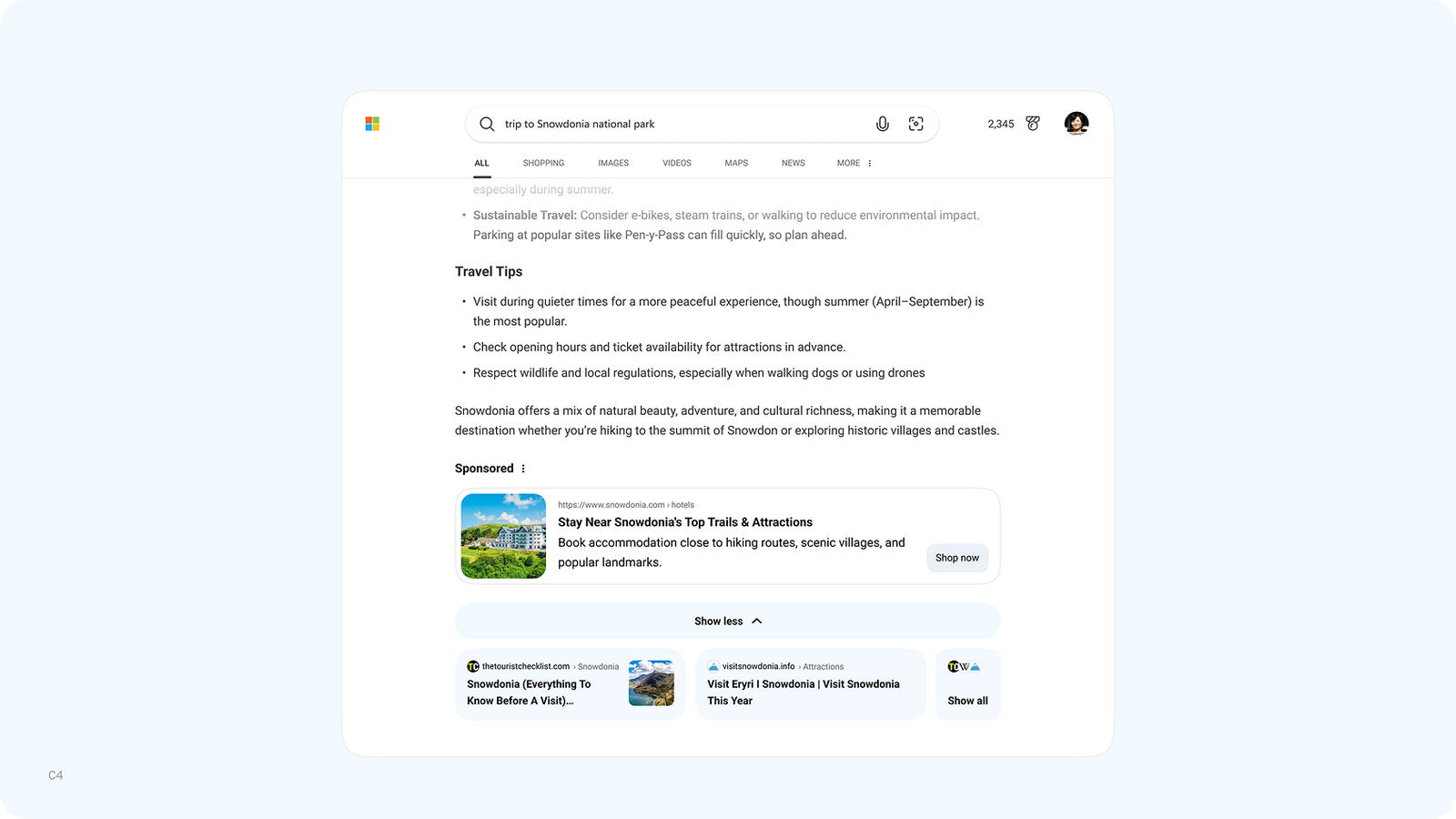
The new controls allow advertisers to specify whether an image or video contains AI-generated content.
Advertisers can make these declarations when managing creative assets and choose whether to request a visible watermark where the advertising format supports one.
Microsoft has also added the ability to manage declarations across multiple assets through its Ads Studio Library. The functionality extends to supported Microsoft Advertising APIs and product feeds, allowing businesses and agencies to update larger collections of creative assets without reviewing every declaration individually.
This is particularly relevant for campaigns that use multiple image variations, product photographs, promotional graphics and video assets.
An advertiser might create several versions of a product advertisement using AI-generated backgrounds or visual elements. Rather than managing disclosure information separately throughout the campaign, the new controls provide a more structured way to identify how those assets were produced.
The declaration is associated with the creative asset, bringing information about AI involvement into the same operational environment used to manage advertising materials.
Microsoft's earlier guidance on AI-generated advertising and advertiser responsibility established that brands remain accountable for the content they publish, including material created with automated tools.
The November release adds practical controls for recording AI involvement and managing supported disclosures within the advertising platform.
How the Made With AI Watermark Appears Across Ad Formats
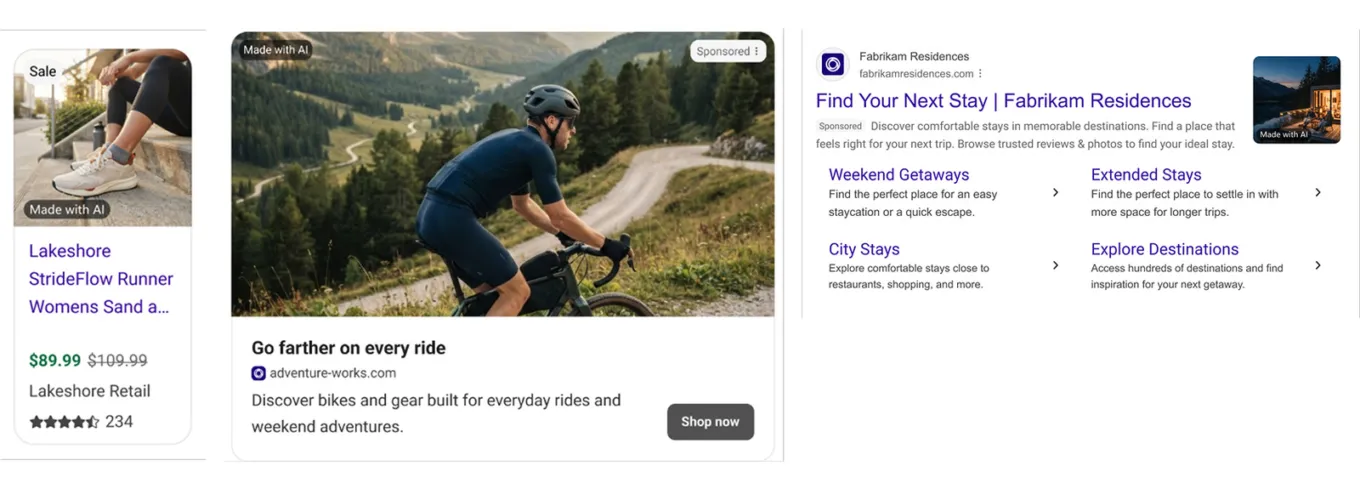
The most visible part of Microsoft's update is the introduction of AI disclosure labels on supported advertisements.
These can appear as a "Made with AI" watermark on advertising imagery, allowing consumers to recognize when AI-generated content has been used.
Microsoft says the new transparency controls support several advertising formats, including Product Ads, Multimedia Ads, Audience Ads, Display Ads, Video Ads and assets used in Performance Max campaigns.
The available declaration and watermark options can differ depending on the format and workflow. Microsoft also notes that watermark size and placement may vary according to the advertisement's placement and serving environment.
Importantly, making an AI content declaration does not automatically mean that every advertisement will display a visible watermark.
Advertisers can identify AI-generated content without requesting a visible label, or request a watermark where the format supports one. The appropriate choice depends on the creative, applicable disclosure requirements and available platform functionality.
This distinction matters for campaign teams managing advertisements across several placements. An image displayed in a product listing may receive a different visual treatment from the same creative used in a display advertisement.
Microsoft has not announced a universal rule requiring every AI-generated advertising asset to carry an identical visible label.
The company instead provides disclosure controls that advertisers can use to meet applicable requirements while accounting for differences between advertising formats.
AI Detection Signals Help Advertisers Review Their Creative
Microsoft's update also introduces another layer of information: AI detection signals.
The advertising platform can identify certain indications that an asset was generated or modified using artificial intelligence. Advertisers can review these signals when determining how their creative should be declared.
According to Microsoft's AI Content Labels API documentation, the system distinguishes between an advertiser's declaration and Microsoft's own detection results.
The advertiser declaration identifies whether an asset contains AI-generated content and whether a visible watermark has been requested.
Microsoft's separate detection field can indicate that an asset was generated using Microsoft AI, that an AI-related signature was detected, or that no supported signal was found.
These signals are informational rather than definitive.
The absence of a detectable signature does not prove that an image was created without artificial intelligence. Similarly, a detected signal does not replace the advertiser's responsibility to assess the asset and make an appropriate declaration.
Microsoft's documentation also confirms that the detection signal is read-only. Advertisers cannot directly modify Microsoft's system-generated assessment through the declaration controls.
The distinction separates two questions that are sometimes treated as interchangeable: what the advertising platform can detect and what the advertiser knows about the asset's production.
For example, a business may commission creative from an external design agency that uses generative AI during production. The final image might not carry a detectable signature, but the advertiser may still know that AI-generated material was incorporated.
Under Microsoft's approach, the advertiser remains responsible for accurately identifying that involvement, regardless of what the detection system reports.
AI Labelling Is Becoming a Cross-Platform Advertising Requirement
Microsoft's announcement follows similar transparency developments across other major advertising platforms.
Earlier in 2026, Google introduced controls that allow advertisers to identify images and other creative assets generated or edited using AI. Meta also expanded its use of AI information labels for supported advertising images.
TechWyse previously examined how Google and Meta are incorporating AI disclosure information into advertising workflows.
Although these platforms share an interest in identifying synthetic content, their disclosure systems are not identical.
Google can display AI-related information through its advertising transparency interfaces and apply visible labels in certain circumstances. Meta uses AI information labels associated with eligible advertising creative.
Microsoft's latest implementation adds its own asset declarations, detection signals and visible watermark options.
For advertisers running campaigns across several networks, the differences create an additional production consideration. A single AI-generated image may require different disclosure settings depending on the platform, placement and applicable local regulations.
The wider regulatory environment is also influencing these developments. Microsoft acknowledges that governments are introducing laws that may require disclosure of certain AI-generated content.
However, the company has not stated that every use of generative AI in commercial advertising automatically requires a visible watermark.
Disclosure requirements remain dependent on the nature of the content, applicable laws and relevant advertising policies.
Creative Approval Now Includes How an Advertisement Was Produced
For paid media teams, the practical significance of Microsoft's update extends beyond adding a label to an image.
Creative approval increasingly involves understanding whether artificial intelligence generated or materially altered an asset, how that information was recorded and what disclosures may apply when the advertisement runs.
A campaign might include original product photography, AI-generated lifestyle backgrounds, automated image variations and externally produced promotional graphics. Those assets may require different assessments even when they appear together in the same campaign.
Microsoft's bulk declaration functionality could simplify this administrative work for businesses managing large creative libraries.
However, automation does not remove the need for accurate asset information.
If a creative team does not know whether an external supplier used AI, Microsoft's detection signals cannot conclusively resolve the question. Internal production records and supplier information remain relevant to the declaration process.
Advertisers must also distinguish content disclosure from advertising accuracy. A clearly labelled AI-generated image can still contain misleading product representations, unauthorized likenesses or unsupported promotional claims.
Microsoft's existing advertising policies and broader legal requirements continue to apply regardless of whether an AI watermark appears.
The company's latest controls therefore introduce a more structured process for identifying synthetic creative without replacing the advertiser's responsibility for reviewing the finished advertisement.
As of November 23, 2026, Microsoft Advertising describes its AI content transparency controls as generally available, although specific functionality varies by advertising format and workflow. The company has not announced a blanket mandatory watermark requirement or a date when every supported advertisement will display an AI disclosure label.