

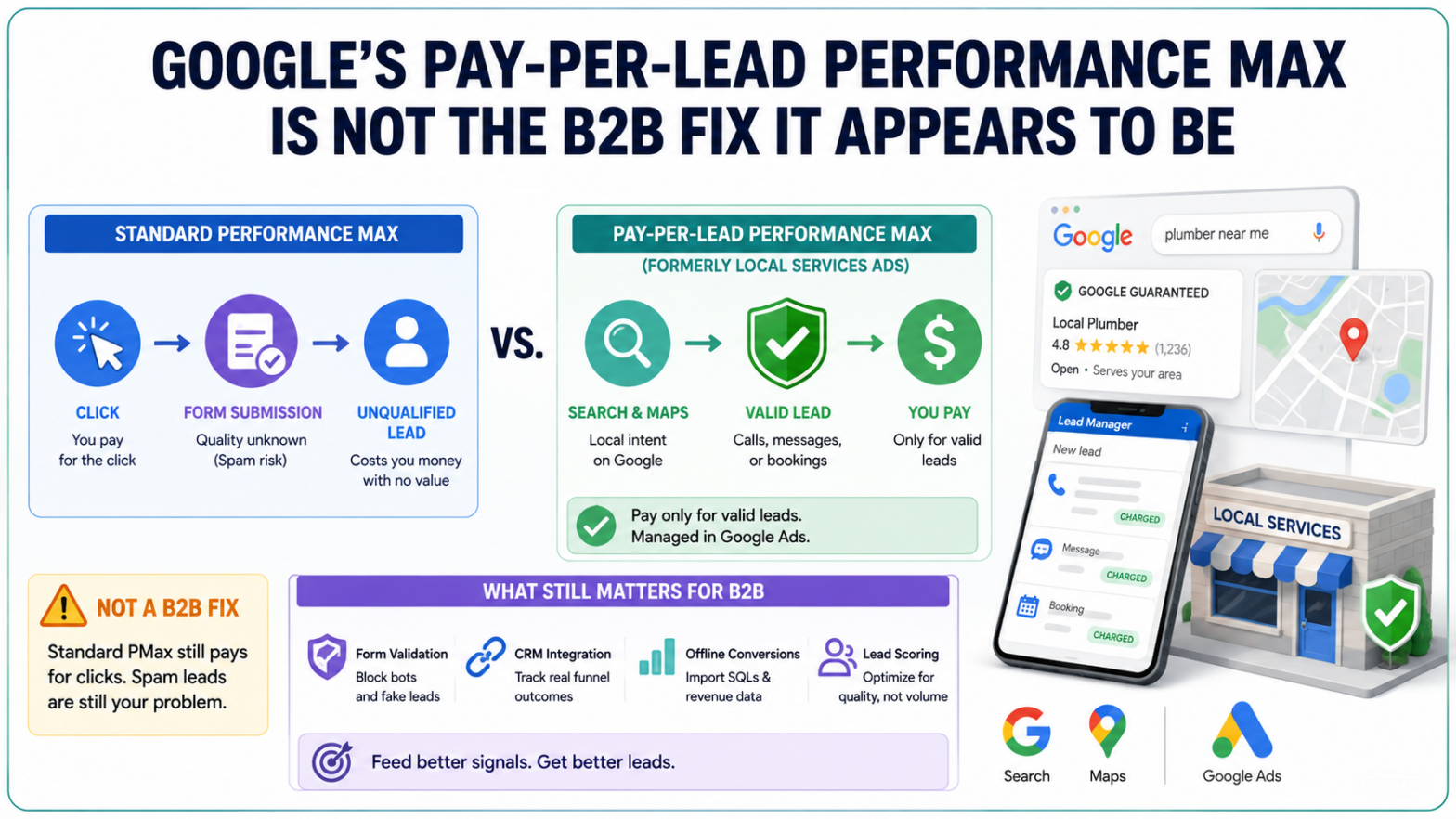
Performance Max has never had trouble generating form submissions. The harder question is whether any of those submissions belong in a sales pipeline.
Google has now published formal documentation for Performance Max campaigns with pay-per-lead goals. The name suggests a new answer to one of PMax’s oldest problems: advertisers paying for clicks while automation chases low-quality conversions, spam forms, and inquiries that sales teams cannot use.
That is not what Google is launching.
The documented campaign type is a specialized replacement for Local Services Ads. It will retain Local Services’ valid-lead billing model, appear only on Search and Maps, and remain limited to eligible local service businesses.
For conventional B2B advertisers running standard Performance Max campaigns, the spam problem has not disappeared.
Pay-Per-Lead PMax Is Local Services Ads in a New Home
Google’s new help pages explain how advertisers will configure, target, and manage Performance Max campaigns with pay-per-lead goals inside Google Ads.
These campaigns are part of Google’s previously announced Local Services Ads migration. Starting in August 2026, select home and storefront service advertisers in the United States will begin moving from the standalone Local Services Ads dashboard into the main Google Ads interface.
The migration will expand to more advertiser groups later in 2026. Non-U.S. accounts and remaining eligible business categories are scheduled to transition in 2027.
TechWyse previously covered the broader Local Services Ads migration to Performance Max, including the retirement of the separate Local Services dashboard and the loss of historical campaign-level reporting after migration.
Google’s latest documentation fills in more of the operating detail.
Advertisers will manage budgets, service categories, locations, schedules, leads, and selected business information through Google Ads. Core details such as the business name, physical address, and standard operating hours will continue to sync from the advertiser’s Google Business Profile.
The campaign label is changing. The underlying product is much closer to Local Services Ads than to the Performance Max campaigns most paid media teams already know.
Google Will Charge for Valid Leads, Not Traffic
Standard Performance Max campaigns use a cost-per-click model. Advertisers can optimize bidding toward conversions or conversion value, but they are still charged when someone clicks an ad, whether that visitor becomes a qualified prospect, submits a fake form, or leaves without taking action.
Campaigns with pay-per-lead goals work differently.
Google says advertisers will pay only for valid leads, including eligible phone calls, messages, and bookings. The Google Ads interface will report charged leads under the Conversions column, total advertising spend under Cost, and average cost per lead under Cost per conversion.
That billing model moves some lead-validation responsibility back to the platform. It also gives the campaign type an advantage over ordinary Performance Max lead generation, where a completed form can become an optimization signal before the advertiser knows whether the person is a real prospect.
Google is also bringing the Local Services lead inbox into Google Ads.
The new Lead Manager interface will show whether a lead was charged, how it arrived, and the available customer details. Advertisers will be able to review lead records, provide feedback, download leads for CRM import, and respond to eligible message leads without returning to the old Local Services dashboard.
Existing customer lead history, including earlier messages and call recordings, is expected to transfer. Historical campaign reports will not.
Advertisers affected by the migration will need to export their old performance data before their transition date.
This Is Not a Full-Funnel Performance Max Campaign
The Performance Max name carries expectations that do not apply here.
A standard PMax campaign can distribute ads across Google Search, Shopping, YouTube, Display, Discover, Gmail, and Maps. It uses creative assets, audience signals, conversion data, landing pages, product feeds, and Google’s automated bidding systems to identify potential customers across that inventory.
Pay-per-lead campaigns will serve only on Google Search and Google Maps, in the placements already used by Local Services Ads.
They will remain keywordless.
Targeting will be based primarily on the services a business provides, the geographic areas it covers, its business category, and information connected to its Google Business Profile. Advertisers will not build keyword lists or use the full creative framework associated with standard Performance Max.
Google’s documentation says common PMax assets such as headlines, videos, and sitelinks do not apply to these campaigns. Advertisers can instead manage business photos and service-related callouts that support the local profile displayed to potential customers.
The distinction matters because the new campaign type does not open pay-per-lead billing to every advertiser.
A B2B software company, manufacturer, consultancy, or commercial service provider cannot assume it will be able to convert an existing PMax campaign into this model. Eligibility remains connected to the Local Services ecosystem, supported markets, approved business categories, and Google’s verification requirements.
The campaign may live inside Google Ads, but it is not a universal replacement for conventional Google Ads lead generation.
Google Is Trading Manual Bids for a Unified Target
Moving Local Services campaigns into Google Ads will change how advertisers control lead costs.
Local Services Ads previously supported manual bidding options, including maximum amounts advertisers were willing to pay for individual leads. Google is removing that approach during the migration.
Weekly budgets will be converted into average daily budgets by dividing the existing weekly amount by seven. Google says monthly billing will remain capped at the average daily budget multiplied by 30.4, although spend may vary between individual days.
Advertisers using different target costs for separate service categories will face another change.
Google Ads does not support vertical-level Target CPA settings inside these migrated campaigns. Where an advertiser previously maintained different targets for services such as plumbing and HVAC, Google will calculate a unified campaign-level target.
Businesses that need separate cost controls will have to split those categories into different campaigns.
That creates a structural decision rather than a minor settings change. Combining high-value and low-value services under one target may give Google more conversion data, but it can also blur the economics between service lines. Separating them preserves bidding control while dividing the available lead volume.
New pay-per-lead campaigns cannot yet be created directly inside Google Ads. Google says advertisers who need another campaign or local account should continue using the Local Services setup process until campaign creation becomes available in the main platform.
The Spam Lead Problem Still Belongs to Conversion Tracking
For eligible local advertisers, valid-lead billing reduces the financial impact of some unusable inquiries. Google, rather than the advertiser alone, determines which leads qualify for a charge under the program.
Standard Performance Max campaigns still depend on the conversion signals advertisers provide.
When a campaign treats every submitted form as equally valuable, Google’s bidding system learns to find more people likely to submit forms. It does not automatically know which submissions contain fake contact information, which prospects meet the company’s qualification criteria, or which opportunities eventually produce revenue.
Cheap conversions can therefore become a trap.
A campaign may report a falling cost per lead while the sales team receives more spam, job applications, vendor pitches, support requests, and low-intent inquiries. From the bidding system’s perspective, those conversions can look successful unless better downstream data reaches Google Ads.
Google has been building more tools around that gap. Its lead management dashboard lets advertisers classify Google-hosted form leads and feed lead status information back into campaign optimization. Offline conversion imports can connect later-stage CRM outcomes, including qualified leads and completed sales, to the original ad interaction.
TechWyse has also examined how offline conversion imports influence Google Ads optimization, particularly when the meaningful business event happens after a sales call or CRM review rather than on the landing page.
Pay-per-lead PMax does not remove the need for that infrastructure outside eligible Local Services campaigns.
B2B advertisers still need to separate raw inquiries from marketing-qualified leads, sales-qualified leads, opportunities, and closed revenue. Those stages can then be assigned as primary or secondary conversion actions according to how the campaign should bid.
Form validation, CAPTCHA controls, server-side checks, CRM integrations, enhanced conversions for leads, and offline conversion imports remain the practical defences against polluted automation.
What Advertisers Should Take From the New Documentation
Local Services advertisers should treat the help pages as migration instructions, not as the launch of an entirely new acquisition channel.
The immediate priorities are operational: export historical reports, review the daily budget Google creates, check the unified Target CPA, confirm transferred service areas and categories, and verify that calls and messages route to the correct destination.
Advertisers running multiple service categories should also decide whether one campaign-level target reflects the economics of every service. Where lead values differ sharply, separate campaigns may provide cleaner budget and bidding control.
For B2B marketers, the release offers a useful contrast rather than a new campaign option.
Google clearly has the technical and commercial framework to bill certain advertisers for validated leads instead of clicks. It is applying that framework to Local Services businesses whose lead types, service categories, verification requirements, and local placements are tightly defined.
The broader Performance Max ecosystem remains conversion-based, not outcome-guaranteed.
Google’s documentation confirms that migrated campaigns will continue appearing in the same Local Services positions on Search and Maps. They will still use the same pay-per-lead model and keywordless targeting. What changes is the management layer, the bidding structure, and the name attached to the campaign.
Performance Max is absorbing Local Services Ads.
It is not yet absorbing the risk of every bad B2B lead.