Google Ads advertisers running call campaigns will now have their conversions evaluated by AI rather than by call duration. Google confirmed in its Google Ads Help documentation, published April 17, 2026, that AI-qualified call leads are now available as a call conversion measurement feature, and that call recording has been enabled by default across eligible accounts.
How AI-Qualified Call Leads Work
Google Ads had historically classified a call as a conversion based primarily on call duration, a standard that does not always reflect actual lead quality. The new system replaces that approach with AI analysis of recorded calls.
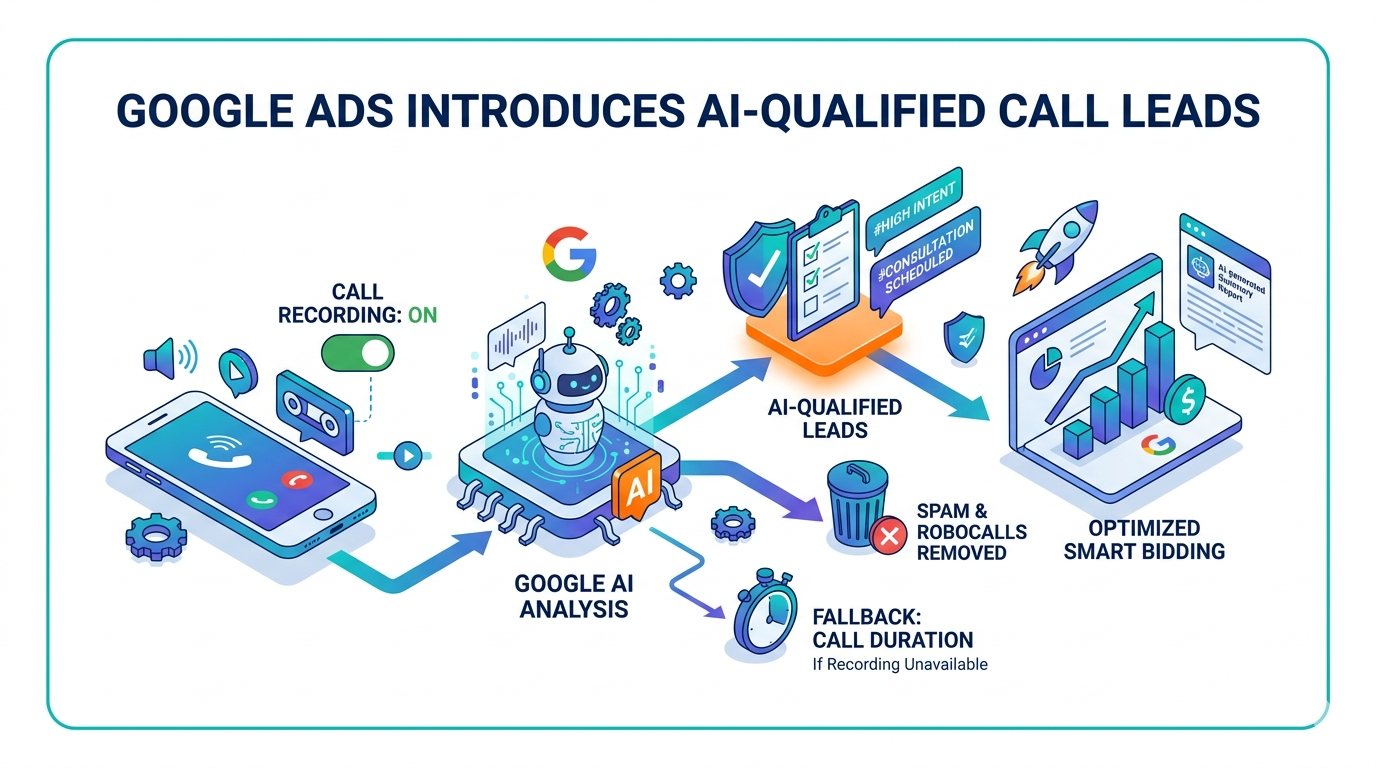
AI-qualified call leads use Google AI to evaluate call recordings, with the call recording required to be turned on, to determine the actual quality of the conversation, looking for signals of intent such as a customer inquiring about specific services, scheduling a consultation, or showing readiness to purchase.
To enhance conversion reporting accuracy, Google has implemented filters to remove non-qualified interactions such as robocalls, spam calls, and misdials that previously met the call duration threshold.
A Three-Tier Conversion Classification System
The system operates on a tiered hierarchy: when call recording is enabled, all calls are recorded and evaluated by AI, with only qualified calls counting as conversions. If a call cannot be recorded, it counts as a conversion based on call duration. In the rare event that a Google Forwarding Number is unavailable, conversions are classified based on ad interaction data.
Call Recording Now On by Default
Google has adjusted its default account behaviour so that the call recording setting is now enabled by default to allow for AI-powered lead qualification.
Call recording will remain turned off for accounts where it was previously disabled, or where the business has been identified as operating in healthcare or financial services. Advertisers in those categories can manually enable call recording at any time.
For sensitive industries such as healthcare and financial services, call recording is automatically skipped to protect user privacy, unless the advertiser explicitly enables it by accepting the Call Ads Supplemental Terms.
When recording is active, callers will hear a short automated message at the beginning of the call notifying them that the conversation will be recorded for quality purposes.
Geographic Restrictions and Data Use
Call recording and AI-qualified call conversions are currently only available for calls where both the dialling and receiving phone numbers are located in the United States or Canada.
Calls must also flow through a Google Forwarding Number, which requires call reporting to be turned on in account settings.
According to Google's help documentation, recordings are used to evaluate lead quality, monitor spam and fraud, and improve the accuracy of conversion reporting. Use of the call recording feature is governed by the Call Ads Supplemental Terms.
Reporting and Bidding Changes
Advertisers can review call recordings directly within their reports to see how the AI classified each interaction. Call Details reports now feature an AI-generated summary of each call along with intent hashtags such as "#HighIntent" and "#ConsultationScheduled."
By feeding higher-quality conversion data into Smart Bidding, Google Ads can optimize spend toward customers who are more likely to convert.
Smart Bidding now optimizes against AI-classified qualified calls when recording is on, and falls back to call duration as the signal when it is not. Advertisers who prefer call duration as the primary conversion signal can turn recording off in account settings.
Compliance Considerations for Advertisers
The default enablement of call recording introduces obligations that go beyond campaign configuration. By using call recording features, advertisers agree to the Call Ads Supplemental Terms and acknowledge that they have provided notice to their agents, employees, and any other party that may participate in the communications.
Advertisers using call recording should review whether Google's automated notification to callers complies with their own legal obligations regarding recorded calls. In the United States, call recording consent laws vary by state, with several requiring two-party consent, a standard that may demand advertiser-level disclosure beyond the automated Google message.
Advertisers that do not plan to use AI-qualified call leads are still producing recordings that Google analyzes for lead quality, spam, and fraud, unless they turn recording off. Advertisers who want to avoid this should navigate to Account Settings within the Admin menu, open the Call Ads drop-down, and select Off under Call Recording before saving.