

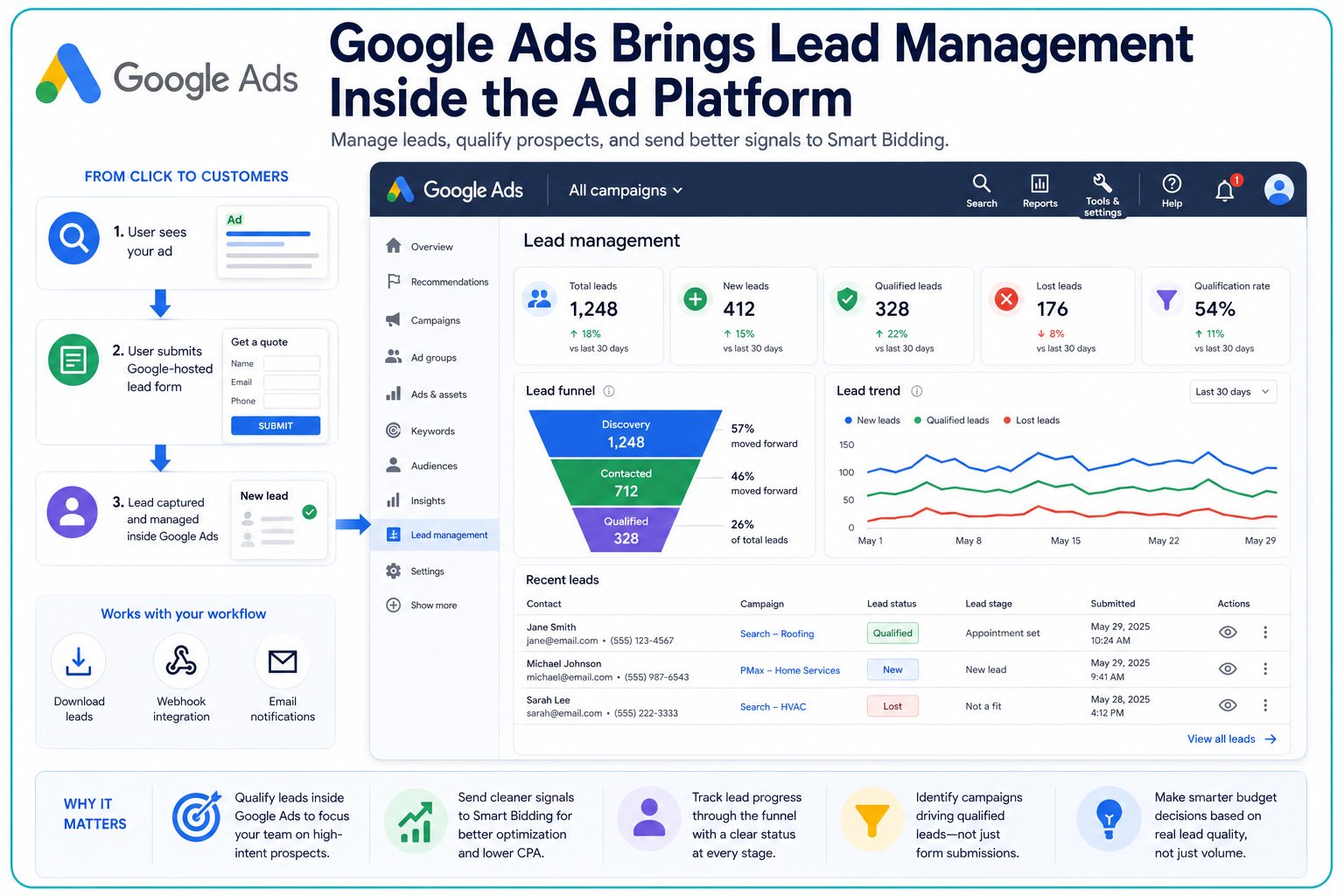
Google Ads is moving closer to the sales pipeline.
Advertisers using Google-hosted lead forms can now manage form leads inside Google Ads, with a new lead management dashboard built to track lead status, qualify prospects, and feed better conversion signals back into the platform’s AI bidding systems.
The change gives Google Ads a more direct role in what happens after a user submits a form. For lead generation advertisers, that is the messy part of the funnel: sorting low-intent inquiries from sales-ready prospects, keeping lead records organized, and making sure campaign optimization is not being trained on junk conversions.
Google already lets advertisers create Google-hosted lead forms inside eligible campaigns, including Search and Performance Max. Its Help Center documentation says advertisers can add the “Submit lead form (Google hosted)” conversion goal when creating a leads campaign, then choose fields such as name, email, phone number, and custom questions before setting up delivery through downloads, webhook integrations, or email notifications.
The new dashboard pulls more of that workflow back into Google Ads itself.
The Form Fill Is No Longer the Finish Line
For years, lead campaigns had an obvious weakness: a submitted form looked like success, even when the person behind it had no real buying intent.
That distinction matters. A campaign can generate a high volume of form submissions while still creating weak pipeline for a sales team. Google’s own lead form guidance now emphasizes proactive lead management and data strength, not just form setup. The new dashboard fits that same direction by giving advertisers a place to review lead activity after submission instead of treating every completed form as equal.
According to the rollout details, the dashboard includes a consolidated view of total leads, new leads, qualified leads, lost leads, and lead progression through the funnel. Advertisers can also review individual lead records, including contact details and stage.
That makes the product less like a reporting table and more like a lightweight lead workspace.
The feature is not a full customer relationship management system. It does not replace a sales team’s CRM, nurture sequences, or offline revenue tracking. Its value is narrower and more immediate: Google Ads can now see more of the lead-quality layer that usually sits outside the ad platform.
For advertisers running Google Ads, that creates a cleaner bridge between media performance and lead handling.
Smart Bidding Gets a Cleaner Signal
The more important change may not be the dashboard itself.
It is the signal loop.
Google Ads bidding systems have always depended on the quality of conversion data. When every submitted form is counted as a valuable conversion, automated bidding can optimize toward volume without understanding whether those leads become consultations, quotes, appointments, opportunities, or closed sales.
That is where lead qualification changes the equation.
By marking leads as qualified or lost inside Google Ads, advertisers can give the platform a more precise view of downstream quality. That can help Smart Bidding identify the types of users, searches, placements, and patterns associated with stronger leads rather than more form fills.
TechWyse has covered the same principle in the context of Smart Bidding strategies: poor conversion inputs produce poor optimization. Google’s automation is only as useful as the signals it receives.
Lead gen campaigns are especially vulnerable here because conversion quality is rarely uniform. A homeowner requesting a quote, a competitor checking pricing, and a student filling a form for research can all appear as the same conversion unless advertisers pass more context back into the system.
Google’s existing documentation for lead form audiences also points in this direction. Lead form audiences can automatically populate based on users who submit information through lead form assets, allowing advertisers to create and manage segments from those responses. The dashboard gives advertisers another layer for interpreting what those leads actually represent.
Not every advertiser will use this well.
If lead statuses are updated inconsistently, the signal can become noisy. If sales teams do not align on what qualifies as a strong lead, the dashboard may simply move messy data from one system into another. The benefit depends on disciplined lead review, consistent definitions, and enough conversion volume for bidding systems to learn from.
A Smaller CRM Layer For Advertisers Without Heavy Infrastructure
The dashboard also addresses a practical gap for smaller advertisers.
Many local service businesses, clinics, agencies, education providers, and B2B firms run lead campaigns without a sophisticated CRM setup. Some rely on email notifications. Others download lead files manually or route submissions through a webhook. Google’s current lead form setup documentation still lists those delivery options, including direct CRM delivery through webhook integrations.
That flexibility is useful, but it also creates leakage.
A form arrives in an inbox. A salesperson misses it. A CSV is downloaded late. A promising inquiry gets no status update. The media team sees a conversion, but the sales team knows it was never contacted.
The new interface gives advertisers a native place to monitor those leads and classify their movement through the funnel. For businesses without mature sales operations, that could reduce the gap between ad response and follow-up. For larger advertisers, it may serve more as a quality-control layer before data moves into external systems.
The timing also lines up with Google’s broader push to make campaign workflows more AI-assisted and consolidated. At Google Marketing Live 2026, Google framed its ad updates around AI-powered systems that help marketers create, capture, and convert demand more efficiently. Lead management sits neatly inside that pattern. Google is not only automating media buying; it is asking for more business-context data so the automation can make better choices.
That is a meaningful shift for Performance Max campaigns, where automation spans multiple Google surfaces and depends heavily on conversion goals, audience signals, creative assets, and budget allocation.
The dashboard gives advertisers a more immediate way to tell the system which leads are worth chasing.
Lead Quality Becomes a Campaign Management Task
The update also changes how paid media teams may need to think about optimization.
A lead campaign can no longer be evaluated only by cost per lead, form submission volume, or conversion rate. Those metrics still matter, but they do not tell the whole story. If two campaigns produce the same number of leads at the same cost, the campaign producing more qualified prospects should receive different treatment.
That has been true for years. The difference is that Google is making the quality layer easier to manage inside the ad product.
For marketers, the practical implication is straightforward: lead status hygiene becomes part of campaign management. Teams should define what counts as new, qualified, and lost; update statuses consistently; and compare campaign performance against both lead volume and lead quality. That is standard lead-generation discipline, but the new Google Ads dashboard reduces the friction of applying it to AI bidding.
The same logic applies to value-based bidding, where advertisers try to optimize toward higher-value outcomes instead of treating every conversion as interchangeable. Even when advertisers are not assigning revenue values to each lead, qualification data can still help separate weak activity from meaningful demand.
There is also a reporting advantage. Funnel visibility inside Google Ads can make it easier to spot campaigns that are efficient on paper but weak in sales reality. A campaign with cheap leads and a low qualification rate may need different keywords, stronger form questions, improved targeting, or a different bidding setup.
A campaign with fewer leads but stronger qualification may deserve more budget.
That is the kind of decision raw form-submit data cannot support on its own.
Google Ads Is Moving Deeper Into the Revenue Conversation
Google’s lead management dashboard is part of a larger pattern across paid media: platforms want more first-party and downstream business data.
That does not mean advertisers should hand over every sales process to the ad platform. It does mean the boundary between campaign management and lead operations is getting thinner. Google Ads is no longer only asking whether a user converted. It is increasingly built to ask whether the conversion was useful.
For advertisers, the immediate value will depend on adoption. A dashboard that nobody updates will not improve lead quality. A dashboard that reflects real sales outcomes can give Google’s bidding systems a clearer target.
The launch also creates a new expectation for agencies and in-house teams managing lead generation campaigns. Media performance and sales follow-up can no longer be treated as separate reporting worlds. The campaign may start with a click, but Google Ads is now giving advertisers more tools to judge what happened after the form was submitted.
The strongest use case is not replacing a CRM. It is closing the gap between form activity and campaign optimization.
When advertisers can see which Google-hosted form leads are new, qualified, lost, or still moving through the funnel, the cost-per-lead number becomes less isolated. It sits beside the thing that matters more: whether those leads are turning into real sales opportunities.
That is the quiet shift behind this update. Google Ads is giving lead generation advertisers a native way to separate volume from value, and its bidding systems will be better positioned when that distinction is maintained accurately.