On mobile Search, the first thing users see from an advertiser may no longer be the ad.
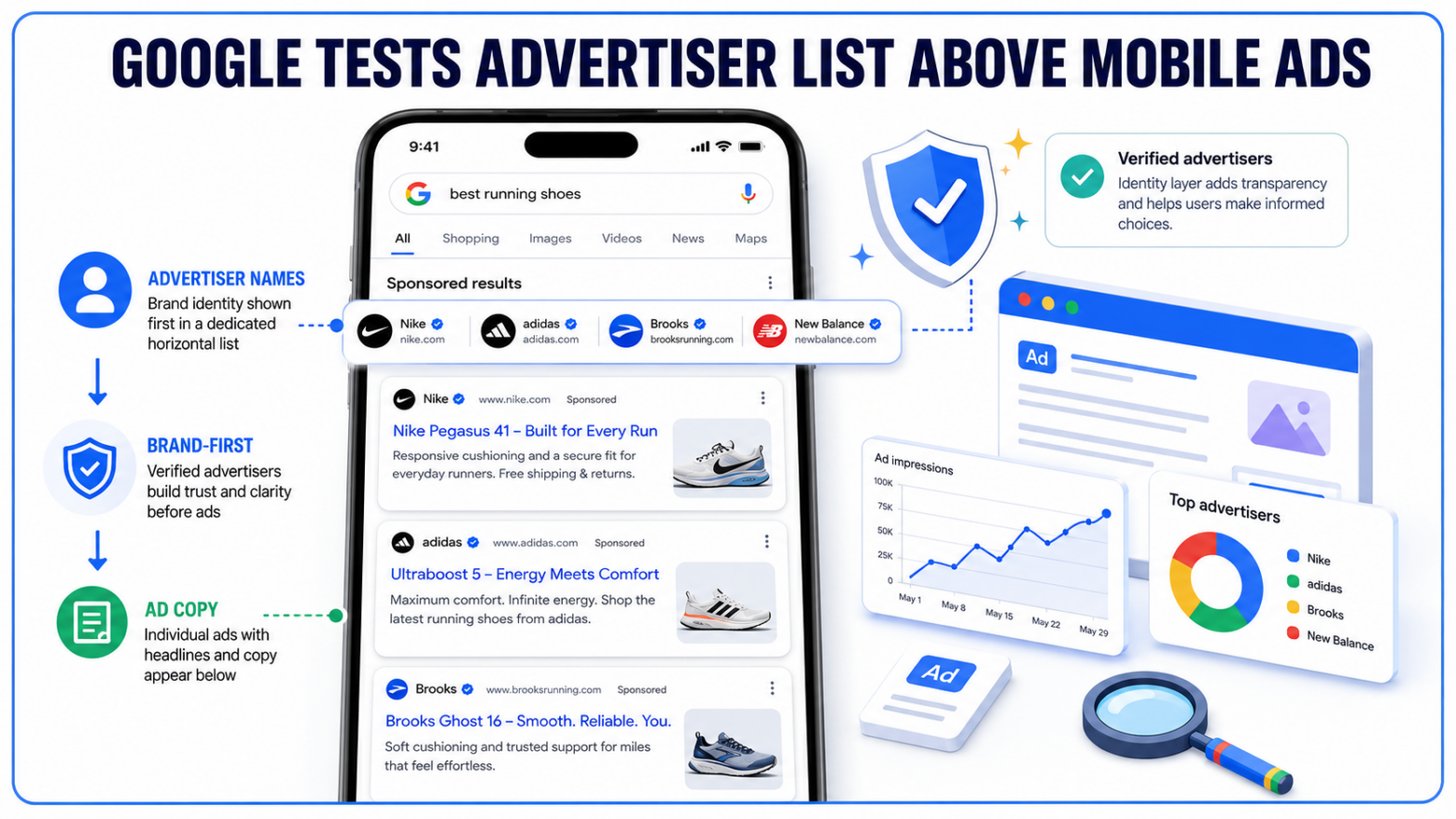
Google is testing a layout that places a row of advertiser names, favicons and domains above the individual ads inside a sponsored results block. The experiment gives brands their own piece of mobile screen space before headlines, descriptions or other ad assets get a chance to make the pitch.
For advertisers, that changes the order of competition.
Brand recognition arrives first. Ad copy comes second.
Google Is Giving Advertiser Identity Its Own Layer
The test was spotted on mobile Search by digital marketer Sachin Patel, who shared the interface on X. Rather than moving directly from Google's "Sponsored results" label into the first advertisement, the experimental layout inserts a separate advertiser list between them.
Google tests sponsored results with new subheading.https://t.co/i3ZGhGl1YZ pic.twitter.com/nsbJID2u1o
— Sachin Patel (@SachuPatel53124) August 11, 2026
Each advertiser shown in that section can be identified by its favicon and domain before the corresponding ad appears farther down the page.
Google has not publicly confirmed a broader rollout or provided documentation explaining how advertisers are selected for the feature. The interface should therefore be treated as a test rather than a permanent change to Google Search ads.
Still, it fits a much larger redesign already underway.
In October 2025, Google changed how text ads are organized on Search by grouping them beneath a single "Sponsored results" heading instead of repeatedly labelling individual placements. Google said the larger heading remains visible as a user scrolls, while a "Hide sponsored results" control allows the entire group to be collapsed. The company also said a grouping would contain no more than four text ads.
The new advertiser-list experiment appears to add another navigational layer to that sponsored block.
Mobile Search Could Become a Brand Scan Before an Ad Scan
That distinction matters on a phone.
Desktop Search has enough horizontal and vertical space for several elements to compete simultaneously. Mobile results force users through information in a much tighter sequence.
Placing advertiser identities at the top of a sponsored section could encourage users to scan who is advertising before considering what each advertiser is saying.
That is a different interaction model for mobile search ads.
A familiar retailer, financial institution or national service brand may be recognized immediately from its name and favicon. A lesser-known advertiser appearing beside it gets visibility as well, but it may not receive the same instant recognition.
The result could make brand equity more noticeable within auctions where advertisers previously depended heavily on headlines, offers and extensions to distinguish themselves.
It could also redistribute attention before any individual ad earns a conventional impression from the user's eye.
None of that establishes that click-through rates will increase or decrease. Google has published no performance data for the experiment, and the test itself does not demonstrate a CTR effect.
What it does change is the visual hierarchy.
Google Has Been Making Advertiser Identity More Visible for Years
The experiment is not arriving in isolation.
Google began adding site names to mobile Search results in 2022 and said at the time that similar attribution would be extended to Search ads. That update also introduced the bold "Sponsored" label for mobile advertising as part of Google's effort to make paid placements identifiable at a glance.
Advertiser identity has continued to become more structured since then.
Google Ads currently allows eligible businesses to supplement desktop and mobile text ads with business names and logos. Eligibility includes completing advertiser verification, and Google says those assets are intended to let advertisers use their existing brand equity within the ad experience.
That makes advertiser verification more than a back-end compliance process.
Google has also operated a global advertiser identity verification program since 2020. Its Ads Transparency Center lets users search advertising from verified advertisers and inspect information about the businesses behind those ads.
The advertiser-list test brings some of that identity emphasis directly into the Search results interface.
Instead of requiring a user to open an ad menu or inspect advertiser information after noticing an ad, the brand itself becomes part of the sponsored section's opening presentation.
Paid Search Creative May Be Competing Later in the Scroll
Search advertisers traditionally spend considerable effort improving the elements inside an ad: headlines, descriptions, assets, landing-page relevance and offers.
Those elements still matter.
The experiment simply introduces something before them.
If users begin scanning the advertiser strip first, the competitive sequence becomes brand recognition followed by creative evaluation. For businesses with established awareness, the advertiser name itself could become a meaningful part of paid search visibility.
Smaller advertisers may face a different trade-off. Being listed alongside recognized competitors gives them a prominent brand mention, but users could also make an early choice about which advertiser they want to inspect before reaching every ad in the block.
That possibility is especially relevant as Google continues reorganizing Search advertising around larger, more consolidated surfaces.
Google's 2025 sponsored-results redesign already placed multiple text ads inside one labelled unit. Google's newer AI Search formats are also pushing ads into interfaces where conventional blue-link layouts are no longer the only way commercial results are presented.
The advertiser list continues that interface shift without changing the underlying ad message itself.
Practical implications for advertisers
For paid media teams, the test is a reason to watch mobile performance by device rather than assume desktop and mobile users are seeing equivalent ad hierarchies. Advertisers should also keep eligible business-name, logo and verification information accurate because Google increasingly uses advertiser identity directly in Search presentation. Until Google confirms a rollout or publishes experiment data, CTR changes should be evaluated through account-level performance rather than attributed to the interface test alone.
The Experiment Still Has More Questions Than Answers
Google has not said how widely the layout is being tested, which markets are included, whether every advertiser in a sponsored block qualifies for the advertiser strip, or whether the format will survive testing.
There is also no official indication that advertiser rankings within the list differ from the order of ads below it.
For now, the clearest change is visible rather than algorithmic: Google is experimenting with giving advertiser identity a separate position above mobile Search ads.
On a screen where every line matters, that is meaningful real estate.