

Google is tightening the language around trust in Local Services Ads.
Not with a sweeping enforcement action. Not with a new ad format. With a quieter update that changes how advertisers are told to qualify, comply, and stay visible.
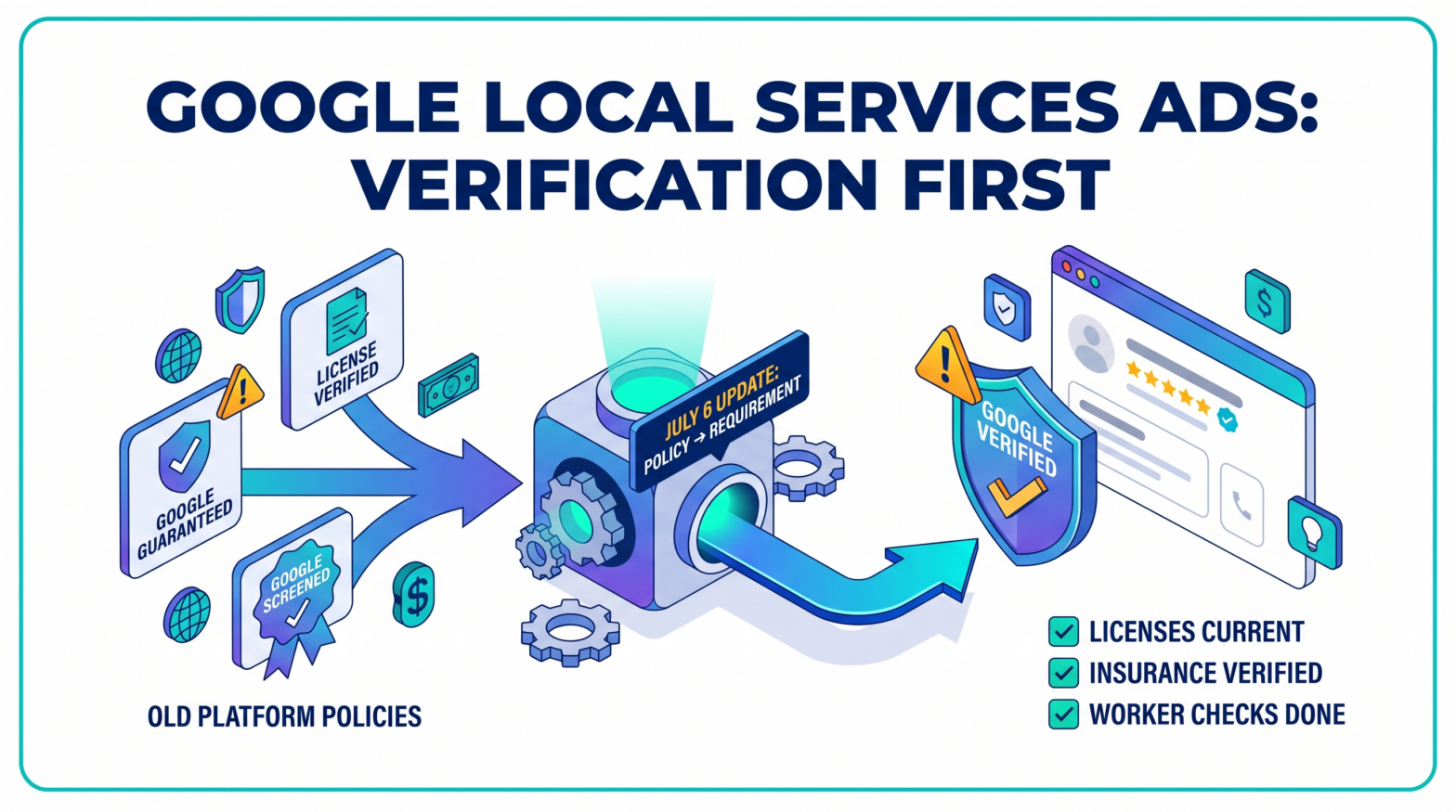
On July 6, Google will rename its “Local Services platform policies” as “Local Services Ads requirements,” a terminology shift meant to make the rules easier to read and better aligned with the company’s newer badge framework. The change follows Google’s broader move away from older Local Services Ads trust badges and toward the Google Verified badge system.
The practical message is simple: Local Services Ads are becoming less about a standalone lead product and more about a verification-led marketplace.
Google Is Rewriting The Rulebook Around Eligibility
The update is mostly about structure and language. Google is not presenting it as a new crackdown on advertisers, and there is no indication that existing advertisers will face a separate July re-verification deadline solely because of the rename.
Still, the wording matters.
Google’s current Local Services documentation says service providers, agencies, lead generation companies, aggregators, and lead management businesses must follow its platform policies when using Local Services. Those rules apply not only to the business owner but also to employees, contractors, subcontractors, and other workers who provide services on the advertiser’s behalf.
That framework already reaches deep into how a local business operates.
The July update changes the label from “policies” to “requirements,” making the language more direct. For advertisers, the difference is not cosmetic. “Policies” can sound like a broad conduct framework. “Requirements” point more clearly to eligibility.
Local Services Ads already work differently from standard Google Ads search campaigns. Businesses do not simply write ad copy, pick keywords, and bid for clicks. They must pass screening checks that vary by country, service category, and advertiser type. Google’s help documentation says these checks can include business verification, license checks, insurance verification, background checks, and other category-specific requirements.
That is the core difference.
A regular search ad competes for attention. A Local Services Ad competes for both attention and verified status.
The Google Verified Badge Is Now The Centre Of Gravity
The policy rename follows a larger badge transition that changed how trust appears inside Local Services Ads.
Google has been shifting Local Services Ads toward the Google Verified badge, replacing older badge labels such as Google Guaranteed, Google Screened, and License Verified by Google in supported contexts. Google’s Local Services Help documentation describes the Google Verified badge as a signal that a business has been verified by Google, while also noting that relevant verifications may be shown on verified profiles to give consumers more transparency.
The old badge model carried more fragmented meanings. One badge emphasized a guarantee. Another signalled screening. Another pointed to licence verification.
The newer badge framework compresses that trust language into a broader verified identity.
That makes the July policy update easier to understand. Google is not only changing a page title. It is making the advertiser rule set match the consumer-facing trust label more closely.
Local Services Ads already display business details that help users choose a provider, including services offered, service area, hours, ratings, reviews, and verification status. Google’s own overview says the ad format may change from time to time as Google adjusts how Local Services Ads appear. The badge system fits into that larger pattern: Google controls the trust layer, the display layer, and the eligibility layer.
For local search advertising, that is a meaningful convergence.
Google is building a cleaner line between what a user sees on the ad and what the advertiser must maintain behind the scenes.
Agencies Will Need Cleaner Compliance Records
The revised requirements language also matters for agencies managing Local Services Ads on behalf of local businesses.
Google’s current platform rules already say businesses acting on behalf of providers are responsible for sharing the policies with those providers and instructing them to comply. That includes agencies, lead generators, aggregators, and lead management companies. In plain terms, a campaign manager cannot treat verification as a one-time onboarding step and ignore the advertiser’s underlying credentials afterward.
Local Services Ads depend on information that changes.
Licences expire. Insurance coverage changes. Workers are hired. Background check requirements may apply. Business profile ownership can shift. Service areas get updated. Photos and headshots may need to meet separate guidelines. A local business that looked clean at onboarding can fall out of compliance later if those records are not maintained.
Google’s provider qualification documentation says advertisers may need to pass various screening procedures depending on service type, country, and whether they advertise directly with Google or through a partner affiliate. It also says some Local Services businesses may need license, insurance, background, or business entity checks before they can run ads.
That places Local Services Ads closer to an operational compliance product than a standard PPC product.
For marketers, the practical implication is straightforward: Local Services Ads account management now requires tighter documentation discipline. Teams should keep advertiser licences, insurance, business profile access, service categories, photos, and worker verification details current, especially in verticals where Google requires screening. This is not speculative campaign strategy. It is the basic operating context of an ad product where eligibility can affect whether an ad appears at all.
That also changes reporting conversations. A drop in lead volume may not always be a bid, budget, or ranking problem. It may be tied to verification, profile status, review quality, responsiveness, or a compliance issue inside the advertiser’s Local Services account.
Local Search Trust Is Moving Into The Ad System
Google’s Local Services Ads rules sit at the intersection of paid search, local SEO, and consumer protection.
That intersection is getting more structured.
The Local Services policy page covers advertiser conduct beyond ordinary ad claims. It includes rules around customer relationships, responsiveness, pricing accuracy, safety, fairness, prohibited practices, photos, headshots, and minimum provider requirements. Google says serious or repeated negative customer feedback, poor responsiveness, or inappropriate conduct can reduce placement, remove messaging options, prevent ads from showing, or lead to suspension.
That is not how traditional keyword advertising has usually been evaluated.
A plumbing company running a search campaign may need landing pages, conversion tracking, budgets, and strong match type controls. A plumbing company running Local Services Ads may also need verified licences, acceptable insurance documentation, screened workers, compliant profile assets, and consistent customer response behaviour.
The ad is only the visible end of the system.
This is also where the July update connects with Google’s wider search advertising direction. Google has been pushing more automation into paid search, from AI Max to Performance Max, while also making local results more dynamic. TechWyse has recently covered how Google is testing video ads inside local pack results, a sign that local search surfaces continue to absorb richer paid formats.
Local Services Ads are moving on a different track. They are not simply becoming more visual or automated. They are becoming more credentialed.
The shift also sits beside Google’s broader AI advertising changes. As TechWyse reported, Google is migrating Dynamic Search Ads into AI Max, pushing advertisers toward systems that rely less on manual keyword construction. In that environment, verification can become one of the remaining hard gates: a business either meets the requirement or it does not.
Local businesses may feel that more directly than national advertisers.
The July 6 Change Is Small, But The Direction Is Clear
Google’s July 6 Local Services Ads update does not appear to introduce a new category of advertiser restriction. The company is refreshing the rule language, removing requirements that no longer apply, and aligning the documentation with the badge framework already reshaping how verified providers appear.
That makes the update administrative on the surface.
Underneath, it reinforces a direction Google has been moving toward for years: more structured trust signals inside local commercial search.
Local Services Ads are not just ads that sit above local results. They are verified business profiles competing for consumer contact in high-intent service categories. The rules governing them need to describe eligibility as clearly as they describe conduct.
For agencies and advertisers, July 6 is a documentation date more than a disruption date. The larger change has already been underway through badge consolidation, business verification, and Local Services account requirements that connect ad visibility to operational facts about the business.
Google’s current Local Services policy page still uses the older platform policy wording. After July 6, that language is expected to shift to “Local Services Ads requirements,” bringing the rulebook closer to the badge system users already see in search.