

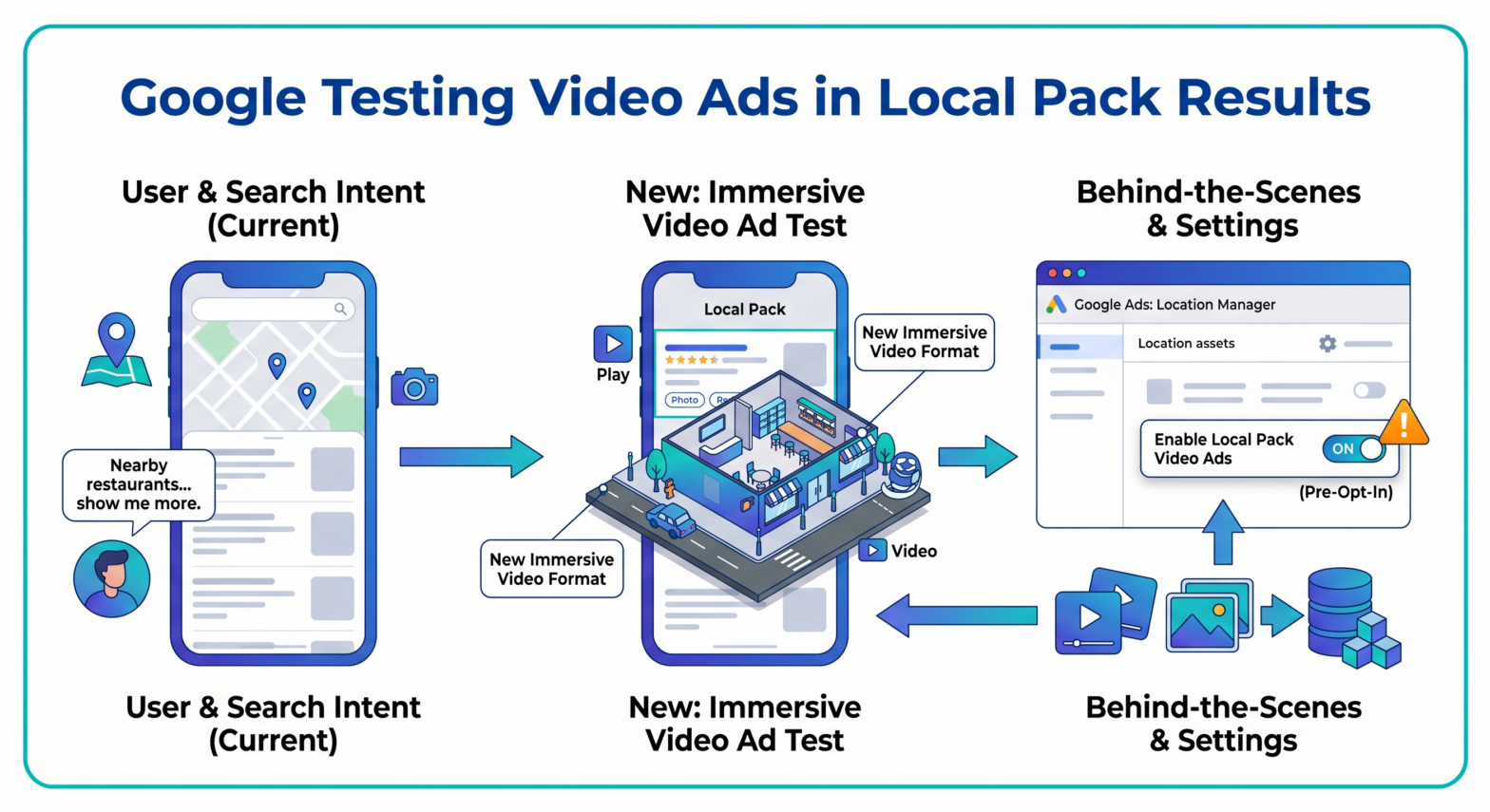
Local search results may soon display autoplay video ads alongside standard business listings. Anthony Higman, founder and CEO of Adsquire, documented the format in a LinkedIn post on April 21, 2026, identifying it as part of an active test in which Google is integrating video into paid local pack placements.
What the Format Is and How It Appears
Google is testing video ads within local pack placements. The format is referred to internally as "immersive map view videos." Rather than a traditional static image or text-based listing, the ads provide a 3D-like immersive experience, similar to Google Maps' Immersive View for landmarks and cities. According to Higman, the video auto-plays.
Higman described the format as tied to Google Maps Street View and the Google Ads Location Manager. The early example circulating publicly shows a standard local-intent search ad paired with an immersive visual map experience. Instead of relying only on headlines, description lines, extensions, and business details, the ad is accompanied by a dynamic map-based view that gives the user more context before the click.
How the Feature Is Configured
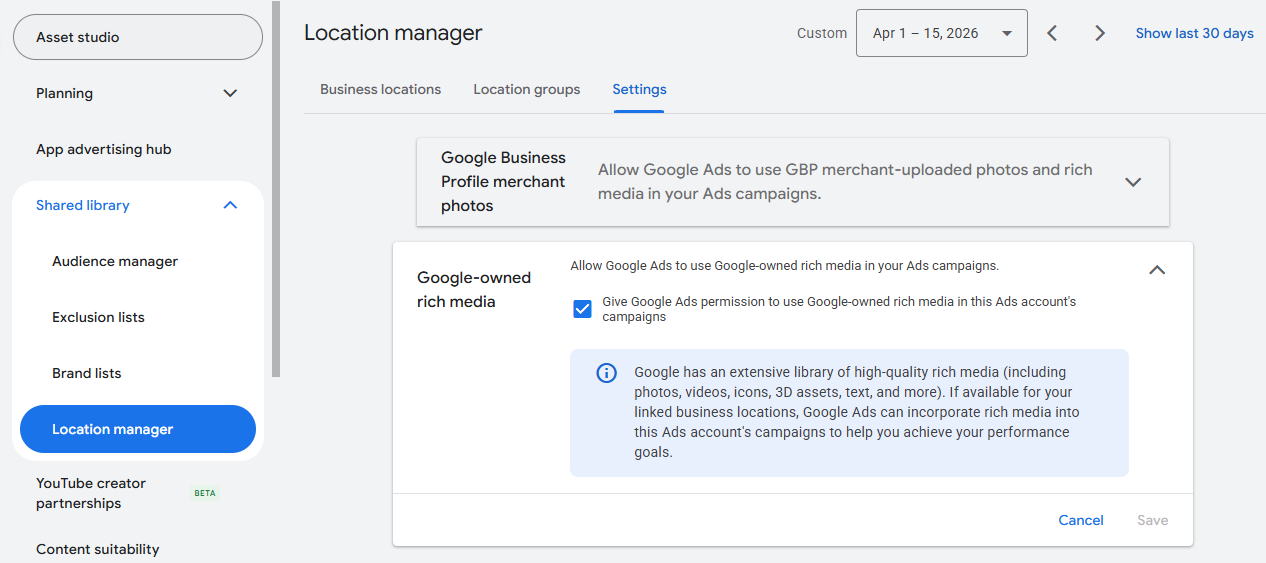
According to Higman, the ads can be configured under the shared library, within Location Manager settings. Higman noted there is "a hidden opt-in setting that controls the feature within Google Ads," adding that Google appears to have pre-opted advertisers in without informing them.
Higman confirmed to MediaPost that the client running the ad is not his own, and that the format appears to be "a live test for some advertisers." The scope of the test has not been disclosed by Google, including how many accounts are included and which markets are affected.
Scale of the Test and Google's Position
Google has not published a formal announcement about the video ad format in the local pack. No statement appears on the Google Ads Product Blog, Google Search Central Blog, or Google Ads announcements page as of April 21, 2026. The test is known only through third-party documentation.
This test comes as Google has significantly expanded the volume of paid placements inside local search results overall. Local pack ads surged from less than 3% to 22% of tracked mobile keywords between November 2025 and January 2026, marking an unprecedented change in search results as Google expanded paid advertising within its local search results at a rate that caught digital marketers by surprise. That expansion relied on existing ad formats; the video test represents a separate development in ad format design, not ad frequency.
The Ad Format in Context
Immersive map view search ads appear to do three things: they preserve the intent-capture function of search advertising in that the user typed a query and the ad answers it; they bring in location context earlier than standard formats; and instead of waiting until the user opens Maps or a business profile, Google can show a spatial view inside the ad experience itself.
The feature appears to be in early testing, and it remains unclear how widely it is available or how performance compares to traditional local ads. There is also the question of creative requirements, as video production adds complexity and cost for advertisers.
Implications for Local Advertisers
If the format moves beyond testing, local advertisers running paid campaigns in competitive markets would need to assess whether video assets are available and eligible within their Google Ads Location Manager settings. Implementation of location-based local pack ads relies on location assets within Google Ads accounts, and advertisers must enable location assets, configure location targeting parameters, and establish location-specific bid adjustments to participate in local pack ad auctions. Adding video to that setup would introduce a new creative layer to campaign management, particularly for small and mid-sized businesses that rely on static formats.
Higman characterized the format as "a live test for some advertisers," meaning the feature is not yet broadly available, and its performance data has not been publicly reported.