
Search ads have always competed on bids, relevance, and quality.
Now, some advertisers will also have to prove they are clear enough to be trusted.
Google is expanding its Limited ad serving policy to cover additional Google Search scenarios, giving the platform more room to restrict impressions from advertisers it considers unqualified on searches with a higher risk of poor ad experiences. The policy update was posted June 12, 2026, and Google says implementation will begin gradually and be completed by 2028, according to its Advertising Policies Help notice.
Search Visibility Is No Longer Just A Campaign Setting
The update adds a dedicated Google Search section to Google’s Limited ad serving policy.
Under the new language, Google may limit ad impressions from unqualified advertisers on searches that are more likely to produce negative ad experiences. That does not automatically mean an ad is disapproved. It means the advertiser may see restricted reach in certain Search contexts while Google evaluates whether the account is qualified.
That distinction matters.
A disapproval is visible and specific. A serving limit can be harder to diagnose because it may affect where and how often ads enter eligible auctions without turning every affected ad into a policy violation.
Google’s existing Limited ad serving policy already allows the company to restrict ads in specific scenarios where there is a higher potential for abuse or poor user experience. The Search expansion brings that logic deeper into the main performance channel many advertisers depend on for lead generation, ecommerce, and branded demand capture.
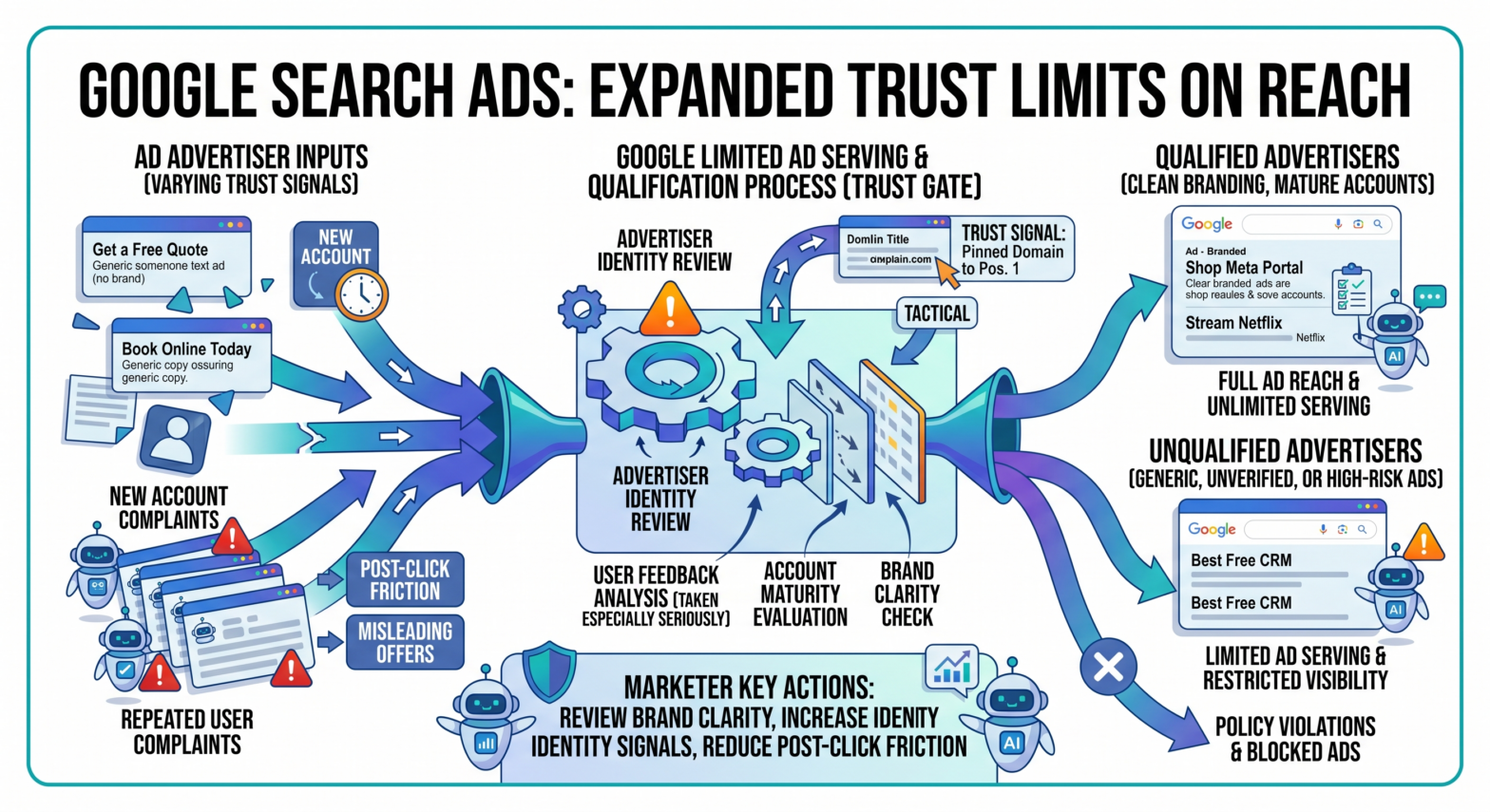
Google says qualified advertisers can serve without impression limits under the policy. Qualification is based on several factors, including account attributes, user activity and reports, account maturity, ad format usage, policy compliance history, advertiser industry, and advertiser verification status, according to the company’s Limited ad serving policy page.
In plain campaign terms: the account itself is becoming part of the eligibility equation.
User Reports Now Carry More Weight
Google is putting special emphasis on user feedback.
The updated Search section says Google takes user reports about an advertiser “especially seriously” when deciding whether that advertiser is qualified. If users persistently and disproportionately report that an advertiser’s content, products, or behaviour does not meet expectations, Google may consider the advertiser unqualified and limit impressions on certain searches.
That creates a broader trust layer around Google Search ads.
Advertisers have always had to comply with policy categories covering restricted products, misrepresentation, editorial standards, financial services, healthcare, and other regulated areas. The new language does not replace those rules. It adds a separate question: do users appear to be having a negative experience with this advertiser?
For brands with clean operations, the change may not be disruptive. For advertisers with vague offers, aggressive landing pages, unclear pricing, weak post-click experiences, or repeated complaints, the effect could be more direct.
The policy also aligns with Google’s broader use of automation and human review in ads enforcement. TechWyse previously covered Google’s 2025 ads safety disclosures in Google 2025 Ads Safety Report: Gemini Blocks 8.3B Ads, where Google described a larger role for AI systems in detecting policy abuse before ads serve.
Limited ad serving is not the same mechanism as a blocked ad.
But it sits in the same trust stack.
Generic Ads Are Becoming A Risk Signal
The clearest operational change is Google’s focus on advertiser identity.
Google says ads that reference other brands, or generic ads with no branding at all, may confuse users about who is actually behind the ad. In those cases, Google may limit impressions on certain searches for branded and generic ads from that advertiser.
That is a major signal for Search advertisers.
Generic ad copy has long been common in competitive categories. “Get a Free Quote,” “Official Service Provider,” “Book Online Today,” and similar language can test well when the advertiser wants the offer, not the brand, to carry the message.
Google is now saying that kind of ambiguity can become a serving problem when the advertiser’s identity is not clear.
The policy does not ban comparison advertising or ads that mention another brand. It asks advertisers to make their own identity and relationship to other brands obvious. That could affect resellers, marketplaces, aggregators, lead generation companies, repair providers, affiliates, franchise-adjacent advertisers, and businesses bidding on competitor or manufacturer terms.
The risk is not just legal confusion.
It is user confusion.
Google’s best practices tell advertisers to clearly display their own brand in both ads and landing pages, avoid generic ad copy and landing page content, and make any association with other brands clear. That wording gives paid search teams a practical checklist, but it also raises the bar for creative discipline in responsive search ads.
Pinning The Domain Moves From Tactic To Trust Signal
Google’s most specific recommendation is unusually tactical: pin the advertiser’s domain to the front of the ad title.
The company says advertisers can do this in a responsive search ad by selecting the pin icon for the field containing the domain and choosing “Show only in position 1.” Google frames this as especially useful for newer advertisers or less well-known brands.
That is not a normal optimization tip.
Pinning a headline can reduce the flexibility of responsive search ads, since Google has fewer combinations to test. Many advertisers avoid over-pinning because it can limit machine learning and ad variation. Here, the tradeoff is different. Google is effectively saying that clarity may be more important than maximum headline flexibility in cases where advertiser identity is at risk of being ambiguous.
For paid media teams, that creates a strategic tension.
A highly flexible RSA may generate more combinations. A more constrained ad may communicate brand identity faster. Under the expanded Limited ad serving policy, the second outcome may matter more for advertisers still building account maturity or operating in sensitive, high-abuse, or confusion-prone categories.
This also connects to a broader shift inside Google Ads, where automation is taking on more campaign execution while advertisers retain responsibility for inputs, exclusions, and business context. TechWyse covered that balance in Ginny Marvin Clarifies AI Max and AI Search After GML 2026, where Google Ads Liaison Ginny Marvin clarified how advertisers remain eligible for AI search ad surfaces through existing campaign structures.
Automation can decide more of the delivery.
It still needs clean identity signals.
New Advertisers May Feel The Policy First
Google’s qualification factors include account maturity and advertiser verification status. That makes newer advertisers a likely pressure point.
A new Google Ads account has less performance history, fewer trust signals, and less evidence of stable user engagement. If the brand is also using generic ad copy, sending traffic to thin landing pages, or bidding in categories where abuse is common, the account may have fewer ways to prove it should serve without limits.
That does not mean new advertisers are being blocked from Search.
Google’s policy says ad serving limits are updated automatically based on assessment and review. Advertisers can also appeal through the Limited Ad Serving Appeals Form if they believe restrictions were applied incorrectly. The path to broader serving is not only a manual support ticket. It is also consistent policy compliance, advertiser verification where eligible, clear branding, and positive user engagement.
The update arrives during a year when Google has been tightening several parts of the ads ecosystem. TechWyse recently reported on related policy movement in Google Ads Tightens Personalized Targeting Rules, where changes affected restricted targeting and sensitive categories. Local trust signals have also been shifting, as covered in Google Updates Local Services Ads Rules.
The pattern is becoming harder to ignore.
Advertiser eligibility is being connected to identity, compliance, category risk, and user confidence across more surfaces.
What Marketers Should Review Before Reach Drops
For marketers, the practical impact is not limited to policy teams. Paid search managers should review whether ads clearly identify the advertiser, whether landing pages reinforce the same brand identity, and whether any references to third-party brands are explained accurately. Accounts with limited history should prioritize advertiser verification where available, reduce generic copy, and document recurring user complaints or lead-quality issues that may point to post-click friction. This is standard account hygiene, but the serving-risk consequences are now more direct.
The biggest change is psychological.
Advertisers often treat Search reach as a function of budget, bids, match types, creative assets, and landing page relevance. Google’s expanded policy adds a trust gate that can sit above those mechanics.
A campaign can be technically compliant and still face limited serving if Google decides the advertiser is not qualified for higher-risk searches.
That puts brand clarity back into the performance conversation. Not as a design preference. As an access signal.
Google’s rollout runs through 2028, so the effect may not arrive evenly across accounts, sectors, or markets. The policy language is already live, and the message is clear enough: on Search, being eligible to advertise is no longer just about what the ad says.
It is also about whether users can tell who is speaking.