
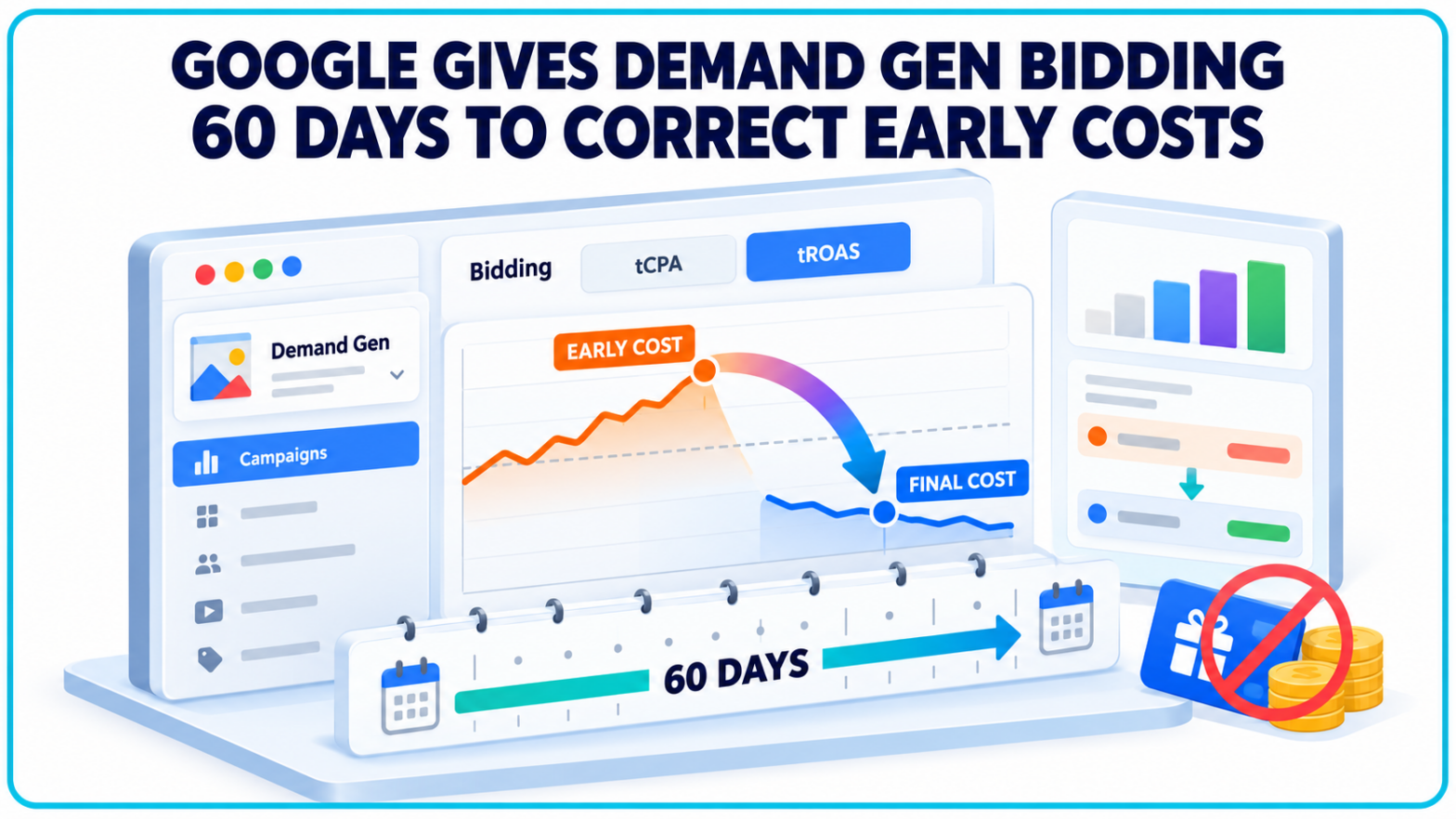
Google is giving some underperforming Demand Gen campaigns more time to become less expensive after the fact. Its cost adjustment beta can now operate for up to 60 days, although advertisers will not receive a separate credit or notification when an adjustment occurs.
The longer window expands a system designed to absorb some of the performance volatility that can appear while automated bidding is still learning.
Google Is Extending a Correction Window, Not Promising Refunds
Google’s performance-based cost adjustment beta applies to eligible Demand Gen campaigns using Target CPA or Target ROAS bidding.
During the learning phase, Google’s systems predict how likely different ad interactions are to produce conversions. Those predictions can be less reliable when a campaign has limited conversion data. If actual conversion performance falls below the predicted value, Google may retroactively reduce the campaign’s cost.
The beta previously allowed adjustments to remain active for up to three weeks. Google’s current documentation extends that maximum to 60 days, or until the campaign or account reaches a separate duration or adjustment limit.
That is a substantial increase, but it is not a general reimbursement programme.
Google does not promise to compensate advertisers whenever a campaign misses its target. It says costs may be adjusted when conversion performance is lower than predicted and an adjustment would help bring delivered campaign metrics closer to the advertiser’s target.
Individual conversions can still cost more or less than the stated CPA goal. A campaign’s ROAS can also move above or below its target as market conditions, creative, landing pages and customer behaviour change.
Eligibility Depends on More Than the Bid Strategy
Using the right bidding strategy is only the first gate.
Google says eligibility can depend on account age, the authenticity of account activity and whether the advertiser consistently follows recommended practices for conversion tracking, bids and budgets. Those factors may change, and meeting the baseline conditions does not guarantee access.
Even an eligible advertiser may receive adjustments only for particular campaigns or on certain days.
The system is automatic. Google says it will activate the feature for an eligible campaign no more than five days after the campaign starts. Advertisers cannot manually switch it on, request a reduction or choose how large an adjustment should be.
The limited scope matters because Demand Gen campaigns support several bidding strategies, including Maximize Clicks, Maximize Conversions and Target CPC. The cost adjustment documentation specifically covers eligible campaigns using target-based CPA or ROAS strategies.
Google’s Demand Gen guidance recommends that advertisers without a clear efficiency goal consider starting with Maximize Conversions, then moving to a target-based strategy after the campaign has accumulated sufficient conversion data. The company’s FAQ cites at least 50 conversions as a reference point for that transition.
Campaigns already using Target CPA bidding are asking the system to pursue an average acquisition cost. Target ROAS campaigns instead optimize around the relationship between reported conversion value and advertising spend. Neither strategy guarantees that every individual conversion will meet the target.
The Adjustment Is Buried Inside Final Cost Reporting
Advertisers should not expect a credit labelled “performance adjustment” to appear in the account.
Google says the correction works in the background. Campaign reporting reflects the final amount the advertiser is responsible for after any automatic reduction has been applied, but there are no separate line items, credits or notifications identifying the adjustment.
That makes the feature difficult to audit independently.
An advertiser may observe that campaign cost has settled below the initially served amount, but Google does not provide a dedicated adjustment log explaining which days were changed, how the reduction was calculated or which conversion prediction triggered it.
The reporting language also separates these Demand Gen cost adjustments from a promotional credit. The advertiser does not receive funds to spend later. Google changes the final campaign cost associated with the performance already delivered.
Adjustments can take up to five days to appear in reporting after a campaign begins. Agencies and in-house teams reviewing a launch in real time may therefore see early figures that do not yet represent the final payable cost.
That delay is especially relevant for automated alerts, pacing dashboards and client reports that pull campaign data frequently. A system treating each day’s initial cost as immutable could preserve a different figure from the final amount shown by Google Ads.
A 60-Day Window Is Not a 60-Day Learning Status
The expanded adjustment period can easily be confused with Google’s standard Smart Bidding learning period. They are related, but they are not interchangeable.
Google’s learning-period documentation says calibration is affected by conversion volume, the length of the conversion cycle and the bid strategy being used. A strategy may need one or two conversion cycles to calibrate, although previous campaign data can shorten that process.
The visible “Learning” status can disappear while Google’s algorithms continue to learn in the background. The cost adjustment beta can remain active for up to 60 days, but Google does not say every eligible campaign will display a learning status for that entire period.
A longer correction window is likely to be most relevant for campaigns with sparse data or longer conversion delays. That is an inference from Google’s explanation of learning factors, not a separate eligibility promise. Google does not publish a conversion-volume threshold that guarantees a cost adjustment.
Advertisers also should not interpret an adjustment as proof that the campaign is commercially successful. Reducing reported advertising cost may pull CPA or Target ROAS closer to the selected goal, but the underlying conversions still depend on accurate values, valid tracking and real business outcomes.
Cost Protection Does Not Replace Campaign Diagnosis
For paid media teams, the practical implication is a change in how early Demand Gen performance is read. Reports should allow enough time for conversion delays and automatic cost corrections to settle, while campaign managers continue checking conversion actions, assigned values, budgets, targets and creative performance. The possible adjustment should not be entered into forecasts as guaranteed savings because Google controls eligibility, timing and the amount applied.
A campaign can miss its target because predictions were temporarily inaccurate. It can also struggle because the audience, offer, landing page, tracking setup or bid target is weak. The beta addresses the first problem by changing cost; it does not diagnose the others.
The additional time gives Google more room to reconcile predicted and observed performance during a new campaign’s early life. It also places more weight on a reporting process advertisers cannot see in detail.
Google’s current help page does not disclose the adjustment formula, publish a maximum reduction or provide a campaign-level record of when the beta changes a cost. It continues to label the feature as a beta.