

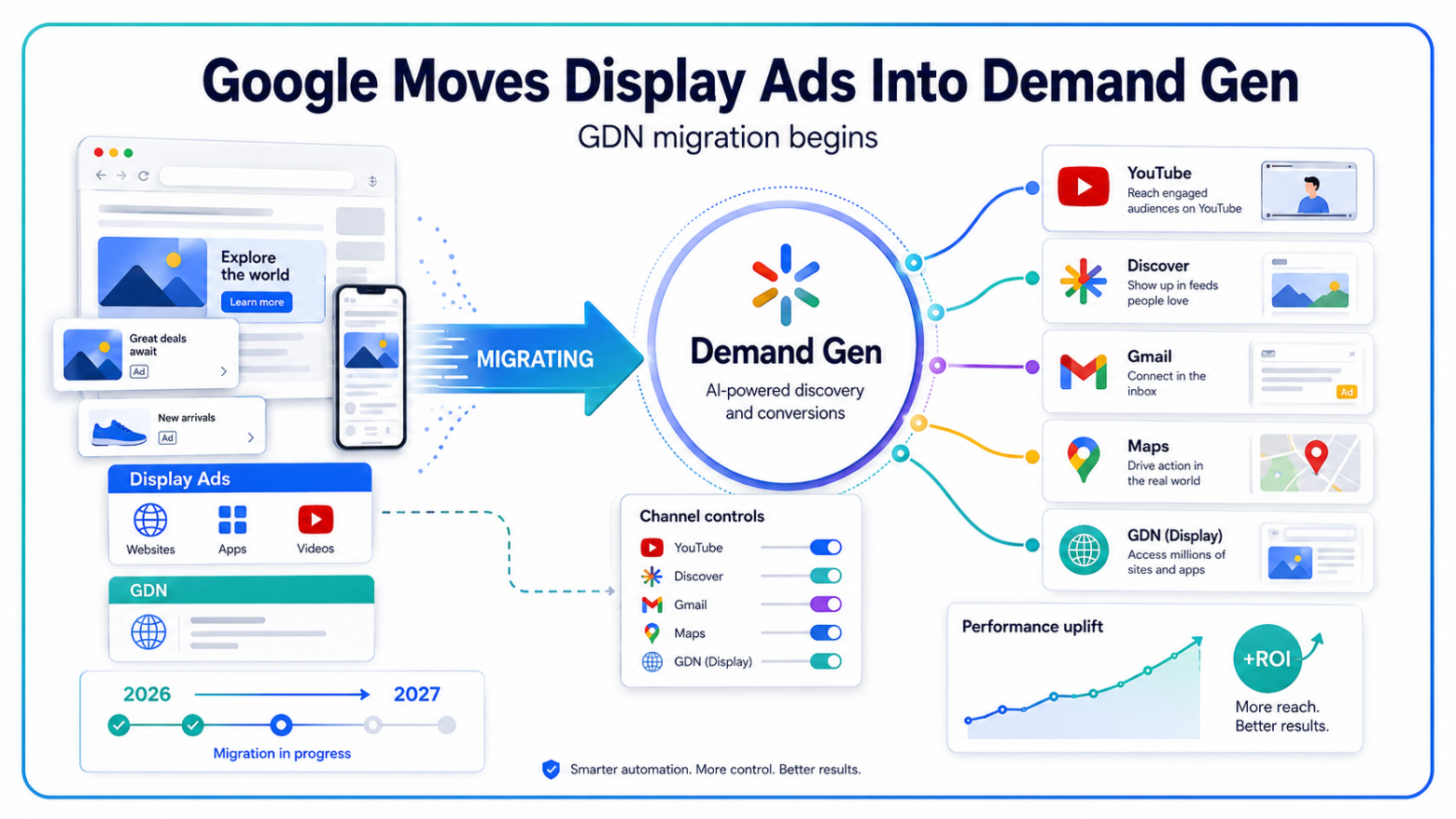
Google Display Ads are no longer being treated as a separate corner of the ad stack.
They are being pulled into Demand Gen, where Google wants more visual, upper-funnel, and conversion-oriented advertising to live under one campaign environment.
Google confirmed on May 26, 2026, that advertisers can now manage their Google Display Network presence directly through Demand Gen campaigns. The shift does not immediately remove the ability to run display ads on GDN alone, but it does set a clear direction: Display campaign management is moving closer to the same system Google uses for YouTube, Discover, Gmail, Google Maps, and other visual surfaces.
According to Google’s Ads & Commerce Blog, the transition is expected to continue through 2027, with Google planning to provide updates and a migration tool to guide advertisers through the process.
Display Is Being Pulled Into Google’s Visual Ad Engine
The practical change is straightforward. Google Display Ads campaigns are moving into Demand Gen as part of a broader effort to make campaign setup, channel control, creative management, and reporting less fragmented.
Demand Gen already operates across some of Google’s most visual ad placements, including YouTube, Discover, Gmail, and Google Maps. With this update, advertisers can also manage GDN activity inside Demand Gen while continuing to reach audiences across what Google describes as more than 2 million sites, videos, and apps.
That makes the update important for advertisers who have historically treated Google Ads campaign types as separate planning lanes: Search for intent, Display for reach, YouTube for video, and Performance Max for automated cross-channel coverage.
Demand Gen now sits closer to the centre of that visual advertising mix.
Google’s framing is not just about inventory expansion. It is about workflow. Advertisers can manage GDN presence through Demand Gen, use channel controls to adjust where ads appear, and access newer campaign features announced around Google Marketing Live without treating Display as a detached buy.
The 2027 Timeline Gives Advertisers Room, Not a Pass
Google’s Help Center states that eligible advertisers can begin voluntarily moving existing campaigns with the migration tool in June 2026. It also says that, at a later point, new campaigns will only be created within Demand Gen and remaining eligible campaigns will be automatically migrated.
That final automatic migration is expected to complete by 2027.
The timeline matters because it gives advertisers time to audit account structure before the platform forces the issue. Display campaigns often carry years of accumulated decisions: audience exclusions, creative variations, placement settings, conversion goals, remarketing lists, and budget splits that were built for older workflows.
Moving those campaigns into Demand Gen may be simple from a product standpoint. Operationally, it is a chance to catch settings that should not be blindly carried forward.
Google says Display advertisers can still serve ads exclusively on the Google Display Network. That point is important. The update does not require every advertiser to expand across every available Demand Gen surface immediately.
It does, however, change where those decisions may increasingly be made.
For teams managing Google Display Network campaigns, the migration window should be treated as an account-structure review, not just a technical transfer. The core questions are whether Display-only campaigns should stay tightly controlled, whether some budgets should test broader Demand Gen placements, and whether creative assets are strong enough for a more visual, mixed-surface environment.
Channel Controls Are the Safety Valve
The biggest concern for many advertisers will be control.
Google has spent the past several years combining more inventory, automation, and AI-assisted creative into fewer campaign types. That has made campaign management faster in some cases, but it has also increased pressure on advertisers to understand where ads are actually serving.
Demand Gen’s channel controls are meant to address that tension.
Google’s Help Center says channel controls allow advertisers to choose where ads appear across YouTube, Discover, Gmail, and the Google Display Network. Earlier Demand Gen updates also renamed Google Video Partners inside Demand Gen to Google Display Network, reflecting the expansion of supported inventory.
That distinction matters because GDN inside Demand Gen is not only a naming update. It changes how advertisers think about creative format, placement mix, and performance comparison.
A static image ad that once lived in a relatively familiar Display campaign may now be reviewed alongside video, Shorts-oriented creative, Gmail placements, Discover placements, and Maps visibility depending on how the campaign is configured.
The control layer gives advertisers a way to keep GDN-only buying intact while still managing it from Demand Gen. That is likely to be the bridge Google wants advertisers to cross first: move the workflow, then decide how much additional inventory makes sense.
Google Is Pitching Performance, But Results Will Vary
Google says advertisers adding GDN in Demand Gen campaigns saw, on average, a 9.5% increase in ROI, based on internal global data from August 2025. It also cited GoFood, the food delivery platform, as seeing a 24% decrease in CPA and 19% higher conversion volume after adding GDN.
Those numbers will get attention.
They should also be read carefully. Google’s figures point to measured upside in the accounts it analyzed, but they do not mean every Display advertiser will see the same lift after migration. Performance will still depend on audience quality, conversion tracking, creative fit, bidding strategy, budget, and whether the campaign is built for reach, demand creation, or direct response.
For advertisers already testing Performance Max campaigns, the comparison may become more strategic. Performance Max is built for goal-based automation across Google’s full inventory. Demand Gen is more focused on visual discovery and demand creation, with more explicit channel controls across YouTube, Discover, Gmail, Maps, and GDN.
That distinction gives advertisers another lever, but also another planning decision.
A brand trying to create demand before a customer starts searching may evaluate Demand Gen differently from an ecommerce advertiser trying to maximize conversion value across all available Google inventory. A local service advertiser may care less about broad visual reach and more about whether GDN exposure supports remarketing or lead generation without inflating cost per acquisition.
The update expands the operating room. It does not remove the need for diagnosis.
Creative Standards Will Become Harder to Ignore
Display advertising has always been visual. Demand Gen raises the bar because the same campaign environment is tied to surfaces where creative quality is more exposed.
A banner that performs acceptably on a website placement may not carry the same weight in a feed, inbox, short-form video environment, or map-based discovery moment. The more Google consolidates visual inventory into Demand Gen, the more advertisers will need creative assets that can survive multiple contexts.
That includes image quality, aspect ratios, brand consistency, calls to action, and landing page alignment. Google’s broader Display updates have also emphasized AI-assisted creative workflows, preview tools, and asset generation, which signals where the platform expects advertiser behaviour to move next.
For PPC teams, the near-term task is practical: review current Display assets before migration rather than after. Weak creative, dated messaging, poor mobile formatting, and thin landing-page continuity will not become stronger simply because the campaign moves into a newer container.
A Demand Gen migration may make those weaknesses easier to spot.
What Marketers Should Do With This Now
In practice, marketers should use the migration period to map current Display campaigns against business goals, creative assets, placement preferences, and conversion tracking. Campaigns that rely on strict GDN-only delivery should be checked against Demand Gen channel controls. Campaigns built for prospecting or visual discovery may be candidates for controlled testing across additional Demand Gen surfaces. Budget comparisons should be measured against CPA, ROI, conversion volume, and assisted demand indicators, not just impressions or clicks.
The same caution applies to PPC marketing reporting. Once campaign types and inventory sources become more unified, marketers need clean naming conventions, audience documentation, and channel-level performance reviews to avoid losing visibility inside a simpler interface.
Google’s direction is clear. Display is not disappearing, but its old operating model is being folded into a wider Demand Gen system.
Advertisers have until 2027 before the transition is expected to be complete. The useful work starts earlier: deciding which Display campaigns should remain tightly controlled, which ones deserve broader testing, and which ones should be rebuilt before they are moved.