
Google Ads is cleaning up one of the more confusing corners of Smart Bidding.
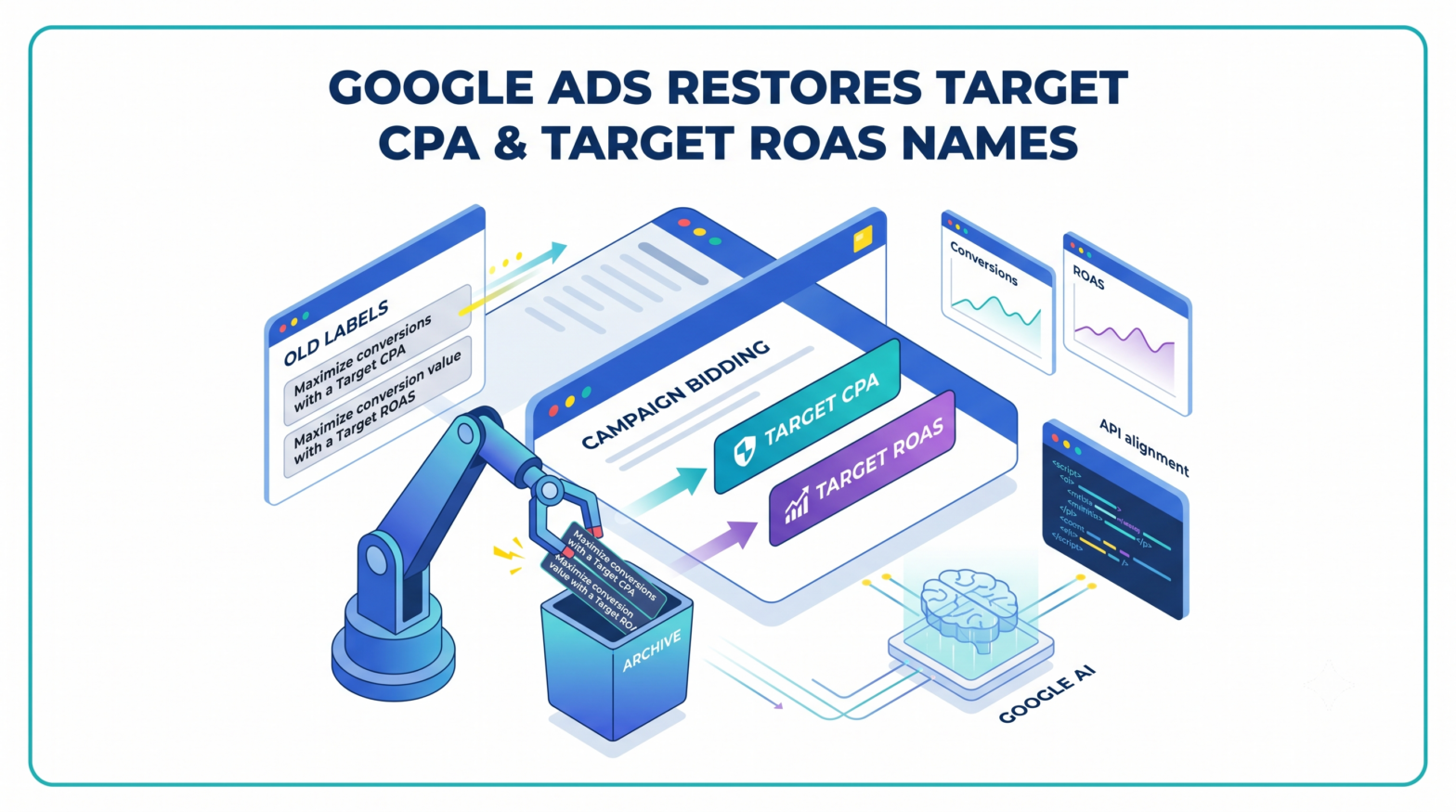
Starting in June 2026, the platform is restoring Target CPA and Target ROAS as standalone bidding strategy names, separating them from the longer “Maximize” labels that had blurred the line between target-based and volume-based bidding.
The change is not a performance update. It is a naming and organization update. But in a platform where automation increasingly controls campaign delivery, naming matters more than it used to.
Google Is Separating Targets From Volume Again
The two labels changing in the Google Ads interface are straightforward.
“Maximize conversions with a Target CPA” is changing back to “Target CPA.” “Maximize conversion value with a Target ROAS” is changing back to “Target ROAS.”
That restores the older distinction between campaigns designed to hit a specific efficiency target and campaigns designed to capture as much volume as possible within a budget.
Google says Maximize conversions and Maximize conversion value will remain available as separate options. The distinction is the goal. Maximize conversions is for advertisers trying to get the most conversions possible from a set budget. Maximize conversion value is for advertisers trying to generate the highest conversion value possible from a set budget.
Target CPA and Target ROAS sit in a different lane. They are still Smart Bidding strategies, but their labels now make the target explicit again.
That matters for advertisers managing accounts across multiple campaign types, shared budgets, portfolio strategies, or internal reporting layers. A campaign using a target cost per acquisition is not being described the same way as a campaign trying to maximize total conversion volume.
Same machine. Clearer label.
Google Ads Help documentation says Smart Bidding uses Google AI to optimize for conversions or conversion value in every auction through auction-time bidding. Target CPA, Target ROAS, Maximize conversions, and Maximize conversion value all remain part of that Smart Bidding system.
The naming change does not remove the automation. It gives the automation a cleaner front-end label.
The Bidding Logic Is Not Changing
Advertisers do not need to rebuild campaigns because of this update.
Google’s Help Center language is direct: the underlying bidding behavior remains the same, and advertisers do not need to take action in their accounts because of the naming transition. Campaigns may show slightly different labels during the rollout, but the strategy itself is not being reset.
That is the critical point for teams watching performance dashboards this month.
A campaign previously labelled “Maximize conversions with a Target CPA” should not suddenly behave like a new bid strategy because the interface now says Target CPA. The same applies to “Maximize conversion value with a Target ROAS,” which will appear as Target ROAS.
For marketers, the practical reading is simple: do not treat the label update as a reason to change targets, budgets, attribution settings, or conversion actions on its own. Performance analysis should still focus on the usual inputs: conversion volume, lag time, budget limits, learning periods, value rules, and whether the campaign has enough reliable conversion data for the selected bid strategy.
Google separately notes that Target ROAS bidding tries to keep conversion value per cost aligned with the advertiser’s chosen ROAS target. A higher target can limit traffic if Google’s system determines fewer auctions are likely to meet that threshold.
That has not changed.
What has changed is the way the account interface names the choice. In a busy Google Ads account, that could reduce one source of avoidable confusion for advertisers comparing Google Ads Smart Bidding Exploration, Search automation, Performance Max bidding, and newer AI-led campaign controls.
Developers Get the Cleaner Signal First
The most technical part of the update may be the most important for larger advertisers.
Google says the revised naming better aligns the Google Ads interface with the way bidding strategies are represented in the Google Ads API. For developers managing accounts programmatically, Google is prioritizing standalone TARGET_CPA and TARGET_ROAS concepts over bundled Maximize strategy labels with optional targets for applicable campaign types, including Search campaigns.
That affects more than naming in a dropdown.
Custom dashboards, budget pacing tools, bid strategy audits, automated campaign creation workflows, and reporting scripts often depend on strategy type fields. If those systems were built around the bundled Maximize conversions or Maximize conversion value labels, the transition is a prompt to check whether campaign data is being parsed and displayed correctly.
Google’s developer guidance points API users toward three areas: integrations and custom dashboards, campaign creation logic, and future release notes tied to BiddingStrategyType enums, standalone TargetCpa and TargetRoas messages, and optional target fields inside MaximizeConversions and MaximizeConversionValue.
That is not a consumer-facing change, but it does affect how agencies and in-house teams see bid strategies in reporting systems.
A mismatch between the UI and a dashboard can create bad reads fast. One report may show Target CPA. Another may still show Maximize conversions with a target. Someone assumes the campaign changed.
It did not.
For performance teams already managing account complexity around AI Max eligibility and AI Search reporting gaps, cleaner bid strategy naming reduces one small but recurring source of operational friction.
A Small UI Change Lands During a Bigger Bidding Shift
The timing is not isolated.
Google has been tightening how advertisers think about target-based bidding, volume-based bidding, AI-led expansion, and budget constraints across its ad products. The return of standalone Target CPA and Target ROAS labels sits inside that broader movement.
Target-based campaigns are judged against a defined efficiency goal. Volume-based campaigns are judged by how much conversion volume or conversion value they can capture within the available budget. Those are different operating modes, even when both depend on Google AI and auction-time bidding.
The label update makes that distinction harder to miss.
For small and mid-sized advertisers, that clarity may matter most during campaign setup. A business trying to maintain a defined acquisition cost should see Target CPA without having to interpret a longer Maximize conversions label. An ecommerce advertiser working against a revenue efficiency threshold should see Target ROAS without wondering whether the campaign is primarily designed to spend the full budget.
For agencies, the bigger benefit may be communication. Reports and client-facing explanations can now use the same plain-language labels that many advertisers already use internally.
There is still room for misreading. Target CPA does not guarantee every conversion lands at the target cost. Target ROAS does not guarantee every order reaches the exact return target. These are average targets that guide Google’s bidding system across auctions and over time.
But at least the label now says what the advertiser is trying to control.
The change also lands as Google expands AI-driven campaign capabilities across paid search, Shopping, Performance Max, and Demand Gen. Recent updates around Smart Bidding Exploration and Promotion Mode show Google giving advertisers more ways to loosen or adjust automation in specific contexts. The restored labels move in the opposite direction: less novelty, more clarity.
Both are part of the same platform direction.
Google Ads is becoming more automated, not less. The pressure is shifting from manual bid control to goal selection, measurement quality, target setting, and knowing what the machine is actually being asked to optimize.
What Marketers Should Do With the Naming Update
In practice, marketers should treat this as an account hygiene and reporting alignment update, not a campaign optimization trigger.
Teams should check that Google Ads dashboards, third-party reporting tools, scripts, Looker Studio connectors, and internal naming conventions display Target CPA and Target ROAS consistently once the transition appears in their accounts. Campaign performance should be evaluated against existing targets and historical context, not against the label change itself.
The update may also be a useful moment to review whether each campaign’s bid strategy still matches its business goal. Lead generation campaigns with firm acquisition economics typically fit Target CPA better than pure volume bidding. Ecommerce campaigns with reliable conversion values and margin-aware goals often fit Target ROAS better than Maximize conversion value without a target. Campaigns still in data-building phases may require a different setup depending on conversion volume and budget stability.
That is standard Smart Bidding discipline.
No emergency rebuild. No rushed target edits. No assumption that the algorithm changed because the label did.
The Interface Is Catching Up to How Advertisers Talk
The return of Target CPA and Target ROAS is a rare Google Ads change that makes the platform feel less abstract.
For years, advertisers have used those names because they describe the actual goal: a target cost per action or a target return on ad spend. The bundled Maximize labels were technically accurate, but they made routine conversations heavier than they needed to be.
Google is now restoring the simpler vocabulary.
The rollout begins in June 2026, with Google warning that account labels may differ slightly during the transition. Smart Bidding will continue operating through the same auction-time automation underneath, while the interface gives target-based strategies their own names again.