

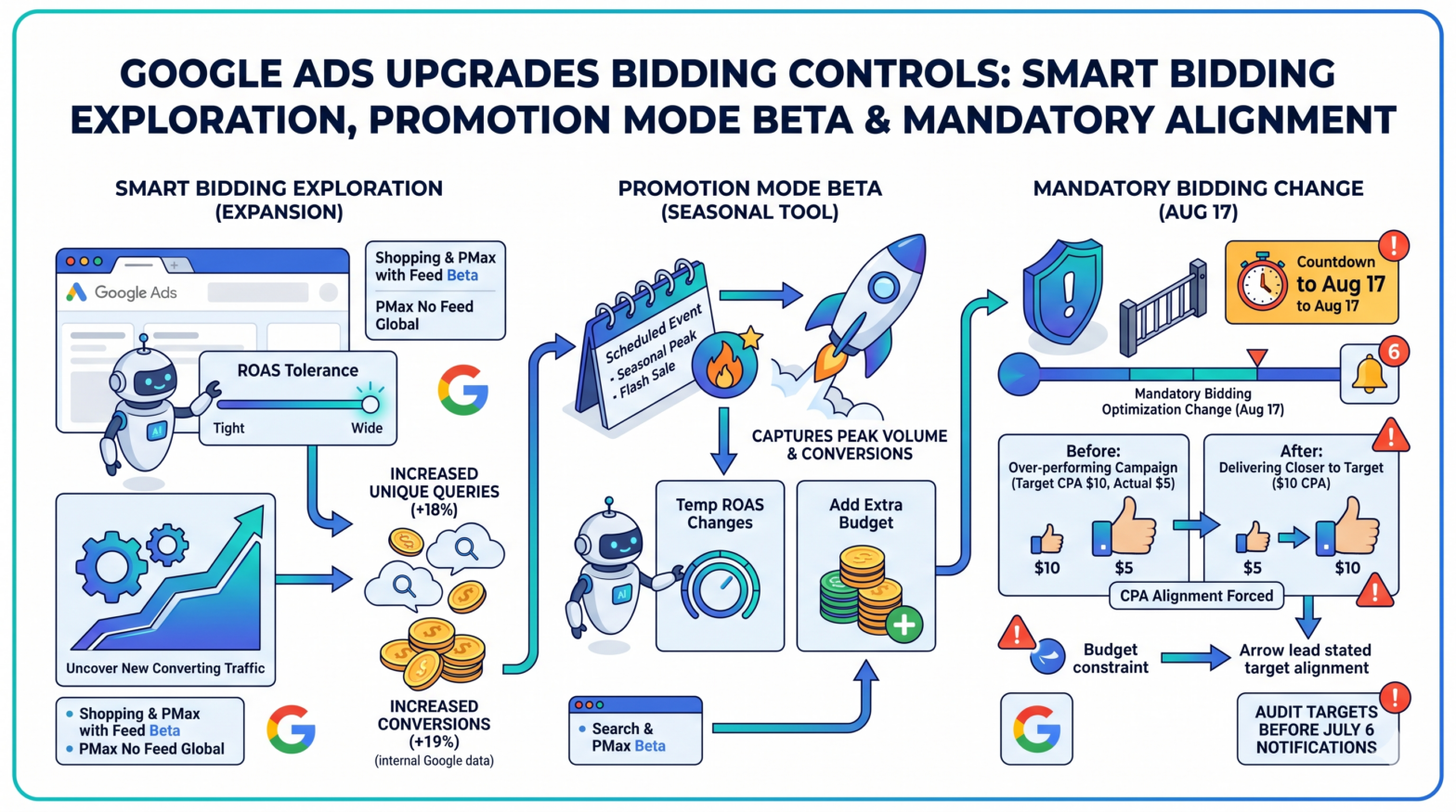
Google Ads advertisers running Shopping and Performance Max campaigns now have access to expanded Smart Bidding controls, including a dedicated seasonal bidding tool designed for peak-demand periods. Google confirmed the updates in a June 2026 post on the Google Accelerate announcements page, outlining three changes to its bidding and budgeting infrastructure.
Smart Bidding Exploration Reaches Performance Max and Shopping
Smart Bidding Exploration is designed to help campaigns find additional converting traffic beyond the queries they would normally pursue under existing bidding targets. The mechanism works through a ROAS tolerance setting; the advertiser widens the acceptable range of return on ad spend, and the system uses that additional headroom to bid on queries with plausible but unproven conversion histories.
Google first introduced Smart Bidding Exploration ahead of Google Marketing Live 2025 as a way to help advertisers uncover additional conversion opportunities without significantly loosening bidding targets. The feature has since expanded steadily across campaign types. Google Ads Editor 2.11, released in November 2025, introduced Smart Bidding Exploration as an opt-in feature for Search campaigns, marking the first time it appeared in a desktop management interface.
The June announcement marks its most significant expansion to date. Smart Bidding Exploration is now available globally in all languages for all Performance Max campaigns without a product feed, graduating from its earlier beta status at Google Marketing Live. A new beta is also opening for Shopping ads, specifically on both Performance Max campaigns with a product feed and on standard Shopping campaigns.
According to Google, campaigns using Smart Bidding Exploration see, on average, an 18% increase in unique search query categories with conversions and a 19% increase in conversions overall. Those figures come from Google's internal data covering March 11 to April 11, 2025, and Google notes that actual results will vary by advertiser.
Advertisers interested in the Smart Bidding Exploration beta for Shopping and Performance Max campaigns with product feeds are directed to contact their Google account team.
Promotion Mode Gives Seasonal Advertisers a Dedicated Bidding Tool
Google is launching Promotion Mode in beta to help advertisers capture more queries and conversions during demand spikes. The feature lets advertisers schedule temporary changes to their ROAS tolerance and add extra daily budget during peak periods, covering seasonal events, flash sales, product launches, and more.
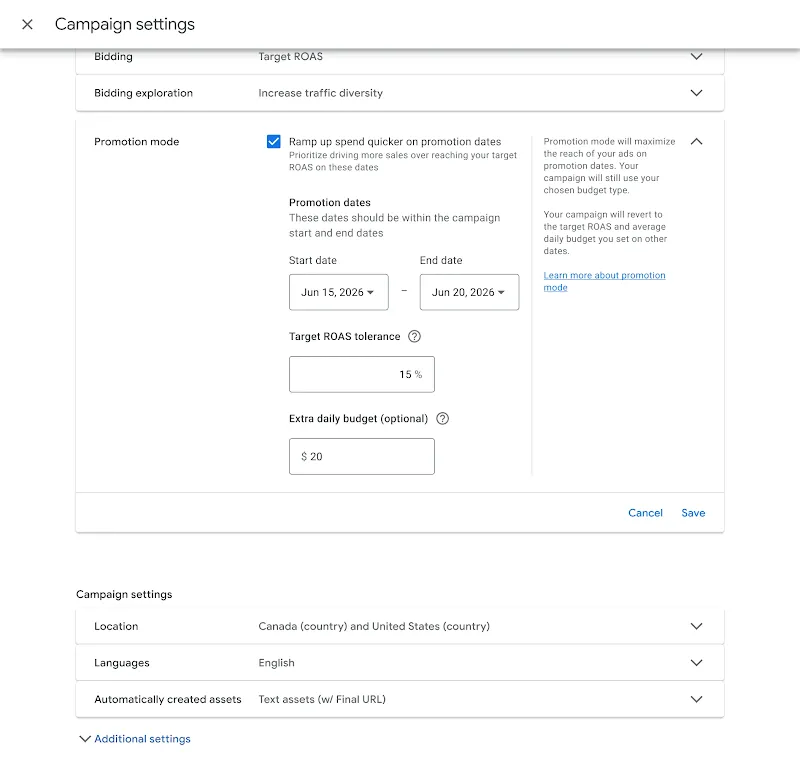
Introduced last September for select users, Promotion Mode helps capture increased query volume and boost conversions during high-demand periods. The beta is currently available for Search and Performance Max campaigns.
For e-commerce and retail advertisers, the feature addresses a long-standing operational challenge. Many advertisers adjust budgets and bidding targets manually around launches, seasonal promotions, and peak demand periods, and if the feature performs as advertised, it could reduce some of that management overhead.
A Mandatory Bidding Change Takes Effect August 17
Separate from the two opt-in features, Google has announced a backend change that will affect budget-constrained campaigns, whether or not advertisers take any action.
Starting August 17, rolling out over a few weeks, Google is updating bidding target optimization to help campaigns limited by budget deliver more predictable performance in line with their bidding targets, especially as campaigns scale.
The practical effect of this change is significant for any campaign currently over-performing its stated target. For example, if a campaign's Target CPA is $10 but recent actual CPA performance is $5, the campaign will deliver more closely to a $10 actual CPA starting August 17. Advertisers wishing to maintain current performance should update their target to $5, or to a target CPA that reflects their business goals.
For multi-channel campaigns like Performance Max and Demand Gen, advertisers may also see shifts in how traffic is distributed across different channels.
To give advertisers lead time, Google will begin showing notifications in Google Ads accounts starting July 6. Those notifications will include historical campaign performance data and recommendations related to the upcoming changes.
What This Means for Advertisers in Practice
For advertisers managing e-commerce or retail accounts, Promotion Mode has the potential to replace manual bid and budget adjustments that are typically made around sales events and seasonal peaks, consolidating those changes into a single scheduled tool within Google Ads. Smart Bidding Exploration's expansion into Shopping campaigns opens an additional lever for advertisers looking to grow conversion volume without restructuring existing targeting. The August 17 bidding optimization change, however, requires attention regardless of whether either new feature is adopted: any budget-constrained campaign that has historically over-achieved its CPA or ROAS target may see performance shift toward its stated target after the rollout date, and advertisers should audit those targets before July 6 notifications arrive.
Google has stated that advertisers may need to adjust their campaigns' CPA or ROAS targets to ensure they reflect current business goals ahead of the August 17 change.