
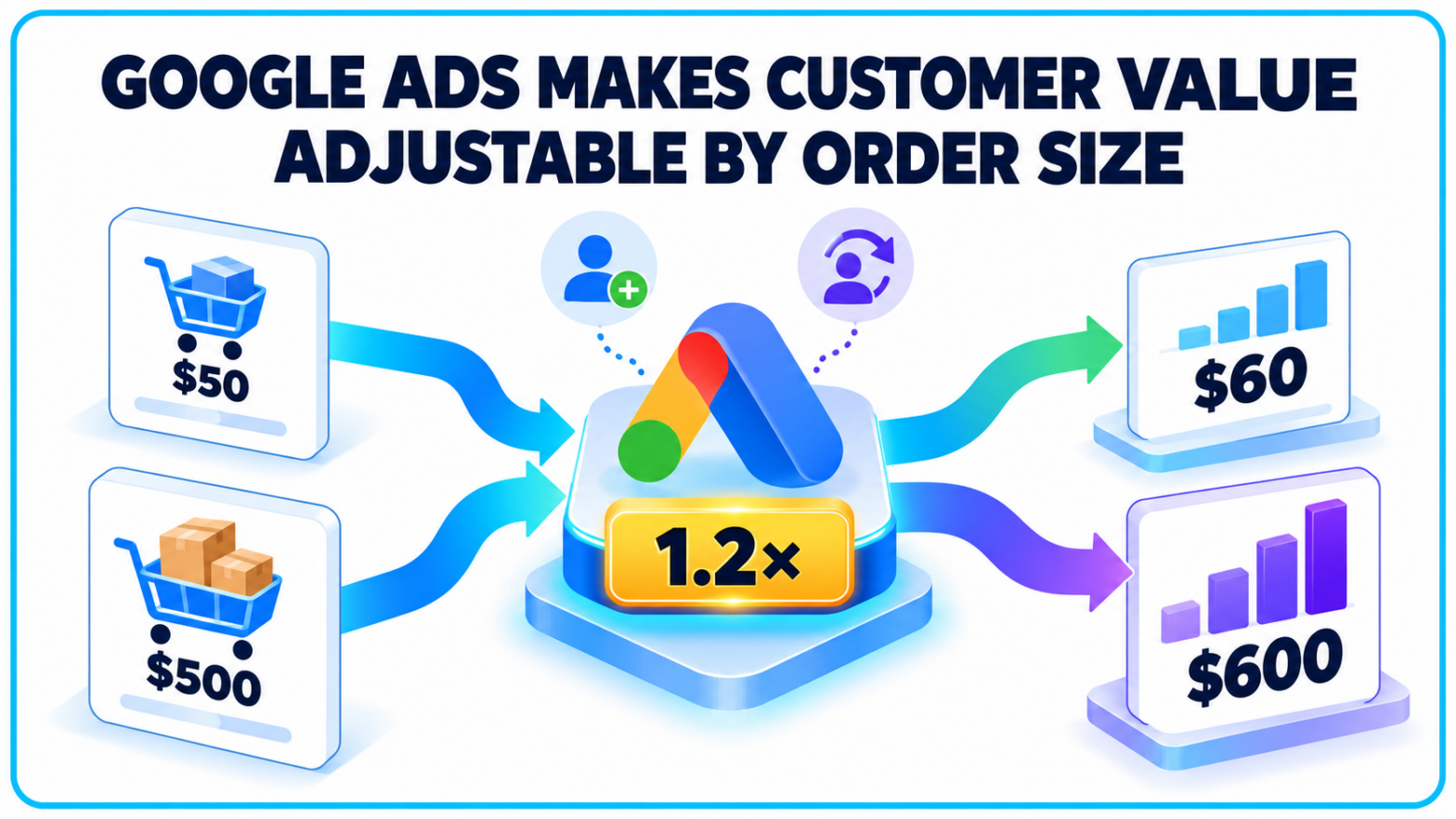
Customer value is no longer limited to a flat dollar adjustment in Google Ads. New percentage multipliers will let advertisers scale acquisition and retention signals with each order, while expanded campaign modes offer tighter control over which customers receive priority.
The October rollout arrives as retailers move deeper into holiday bidding, when differences in order value, repeat-purchase behaviour and customer lifetime value can quickly distort a campaign’s performance signals.
A $50 Cart and a $500 Cart No Longer Need the Same Adjustment
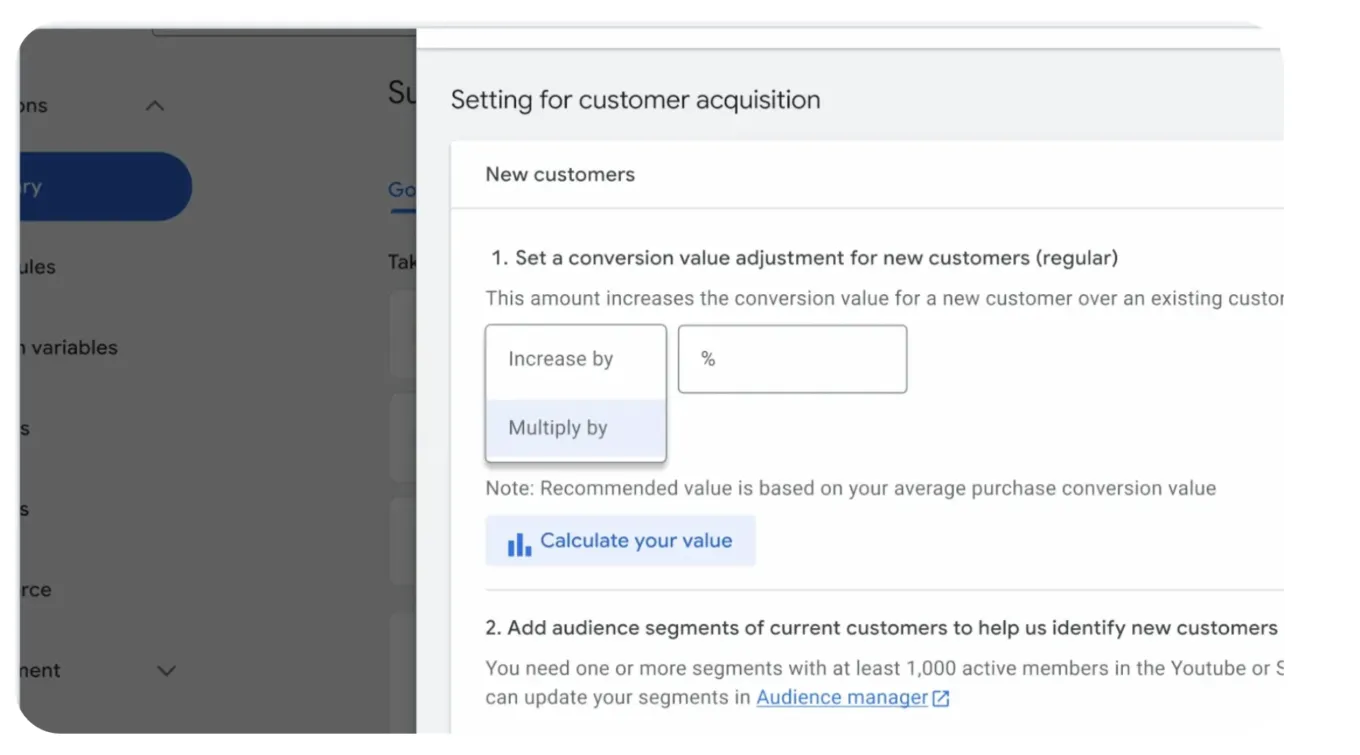
Google is introducing percentage multipliers as an alternative to the fixed monetary adjustments previously used in its customer lifecycle bidding tools.
Under the flat-value model, an advertiser might assign the same additional value to every new customer conversion. That adjustment does not change when one customer places a relatively small order, and another completes a much larger purchase.
Percentage multipliers respond to that variation. Google’s example uses a 20 percent, or 1.2x, multiplier that scales proportionally whether the customer has a $50 cart or a $500 cart. The larger order therefore produces a larger value signal for the bidding system.
The feature is moving out of beta and rolling out during October for Search, Shopping, Performance Max and Demand Gen campaigns in both Google Ads and Search Ads 360, according to Google’s customer lifecycle announcement.
Percentage multipliers should not be read as a guaranteed 20 percent increase in every auction bid. They change the customer value supplied to Google’s automated bidding system, which then weighs that information alongside the campaign’s conversion data, budget, return target and auction conditions.
That distinction matters. Advertisers are gaining a more flexible input, not direct control over the final bid or a guaranteed acquisition cost.
Shopping Campaigns Can Prioritize Higher-Value New Buyers
Google is also bringing New Customer High Value Mode to Shopping campaigns. The option was previously introduced for Search and Performance Max.
The mode is designed for high-value customer acquisition rather than simply maximizing the number of first-time buyers. Advertisers provide lists representing their most valuable existing customers, and Google uses those signals to predict which new prospects are more likely to deliver stronger lifetime value.
Campaigns can bid more competitively for those predicted high-value prospects while continuing to reach regular new customers and existing customers. That separates the setting from New Customer Only Mode, which restricts campaign bidding to new customers.
Google’s existing acquisition guidance says high-value customer modes rely on value-based bid strategies, including Target ROAS and Maximize Conversion Value. A purchase conversion goal is also required. Google’s current help table still lists the high-value mode for Search and Performance Max, reflecting the pre-rollout availability, while its October announcement confirms that Shopping support is rolling out this month.
The expansion adds another customer acquisition option to Shopping campaigns, which have already been absorbing more automated targeting, creative and landing-page capabilities.
It also places more weight on how advertisers define “high value.” Frequent purchasers, customers with larger baskets and buyers with stronger margins may all qualify, but those definitions belong to the business. Google cannot infer the correct commercial threshold without dependable customer data.
Retention Moves Beyond a Single Win-Back Setting
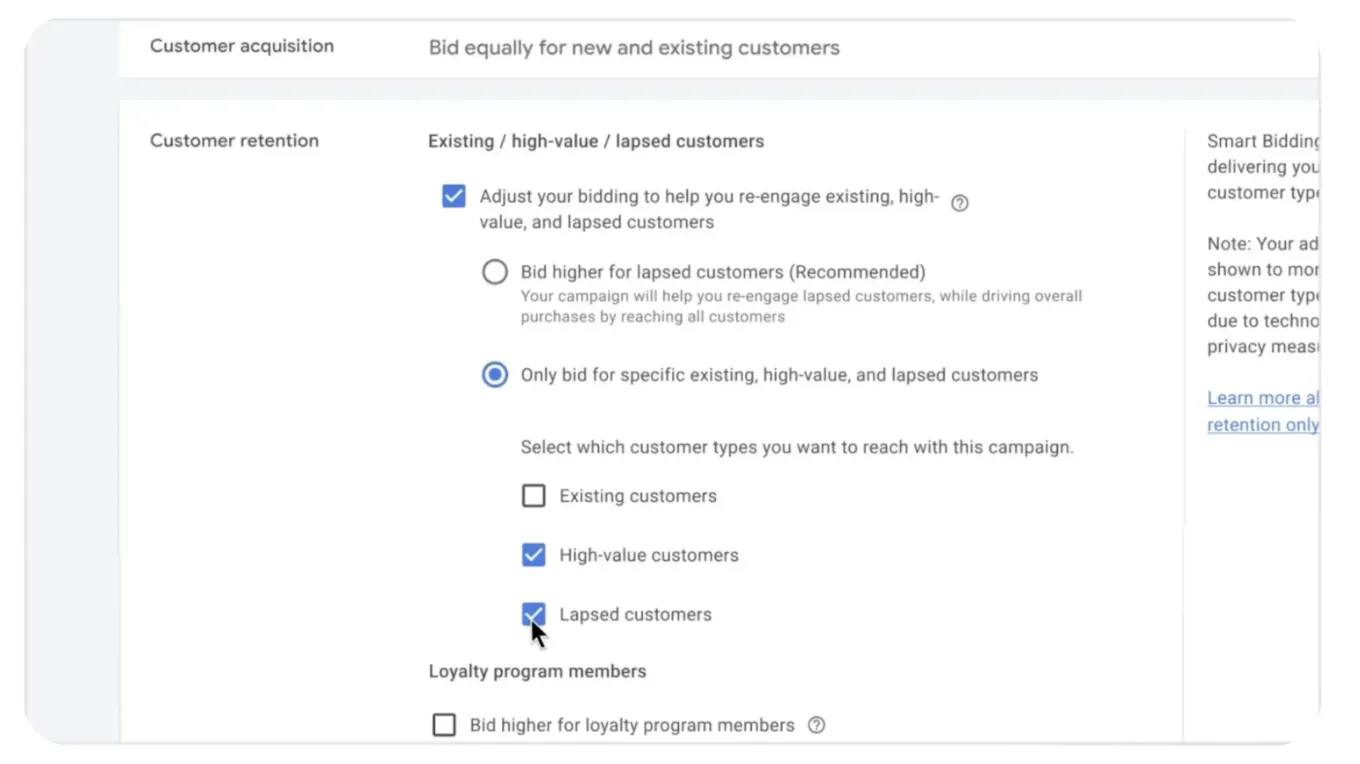
The customer retention goals rolling out across Performance Max, Search and Shopping campaigns divide existing customers into three strategic groups.
Re-engagement Mode prioritizes people who have not purchased within a period defined by the advertiser. Campaigns can bid more aggressively for those lapsed customers without abandoning their broader eligible audience.
Loyalty Mode is built for recognized loyalty program members. Advertisers can use it to support member-specific messages, pricing or other benefits associated with their loyalty setup.
Retention Only Mode draws the hardest boundary. It allows a campaign to focus exclusively on the existing-customer segments selected by the advertiser instead of maintaining normal reach across a wider audience.
That creates a meaningful separation between prioritization and restriction. Re-engagement and loyalty settings can add value to selected audiences while a campaign continues serving more broadly. Retention Only Mode is intended for budgets dedicated to specified existing customers.
Google began making Performance Max retention goals generally available in 2025 after an earlier beta. The October 2026 rollout broadens the available customer retention goals and extends them across additional campaign types.
These settings also build on Google’s expanding customer acquisition framework, which now distinguishes among existing customers, regular new customers, predicted high-value newcomers and prospects with no recognized prior brand interaction.
First-Party Data Determines Who Google Sees
More customer modes create more ways for poor audience classification to affect campaign delivery.
Google Ads customer lifecycle goals depend on advertisers identifying purchasers, high-value customers, disengaged customers and loyalty members correctly. Google’s setup documentation supports Customer Match lists, website visitor lists, app user lists, Google Analytics audiences and YouTube user lists, depending on the selected goal.
Eligible customer lists must contain at least 100 active members on one Google network. Accounts using cross-account conversion tracking must configure their lifecycle goals and lists within the manager account, with continuous audience sharing enabled.
Google can automatically help distinguish new customers when an advertiser is tracking purchase conversions. Its autodetection can use up to 540 days of campaign activity and tracked purchases, although Google recommends supplementing that signal with first-party lists for better coverage.
Retention is different. Google’s documentation shows that bidding for lapsed or high-value lapsed customers does not use the same autodetection. Advertisers must supply and maintain the audience information that tells the platform which customers have disengaged and which of them remain commercially valuable.
For marketers, the immediate practical task is to examine the definitions behind each list before changing campaign values. A stale lapsed-customer segment, incomplete Customer Match coverage or an overly broad high-value label can teach Smart Bidding to pursue the wrong audience more aggressively.
More Precision Does Not Make Performance Automatic
The new controls let advertisers express a customer strategy with greater detail inside Google Ads. They do not determine whether the strategy is commercially sound.
A percentage multiplier still needs to reflect credible differences in customer value. Retention Only Mode still needs enough eligible customers and conversion activity to support delivery. High Value Mode still depends on historical lists that accurately represent the traits a business wants Google to find in new buyers.
Campaign comparisons may also become harder if teams change audience definitions, value settings and bidding modes at the same time. Google’s reporting includes customer acquisition and lifecycle measurements, but the conversion value shown in campaign reports can include both the original purchase amount and the additional value assigned to a customer segment.
The rollout boundaries remain uneven. High Value Mode is being added to Shopping campaigns; retention goals are expanding across Performance Max, Search and Shopping; and percentage multipliers are reaching those campaign types plus Demand Gen, with support in both Google Ads and Search Ads 360.