
Google Ads is tightening the link between first-party data and automated campaign decisions.
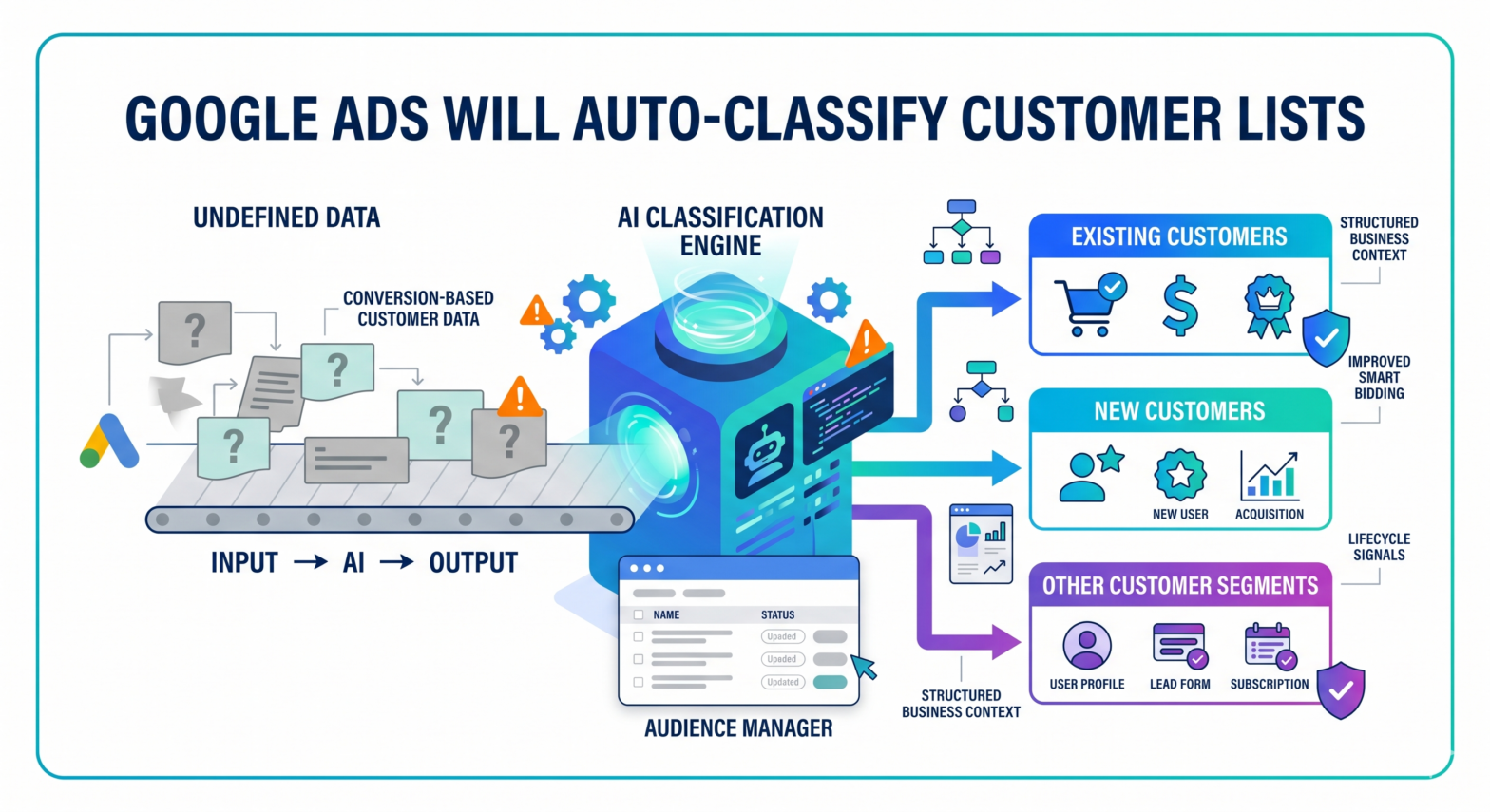
Beginning in August 2026, Google Ads will automatically assign customer types to eligible conversion-based customer lists, removing the option for advertisers to leave those audiences unclassified. The change affects Customer Match lists created from conversion data and pushes advertisers to define where users sit in the customer lifecycle before Google’s systems do it for them.
That is a small settings change with a much bigger message behind it.
Google’s ad platform is asking for cleaner business context. Not just conversions. Not just hashed customer data. It wants to know whether an audience represents existing customers, new customers, or another segment that should be treated differently by bidding and targeting systems.
The Audience Label Is Becoming A Campaign Signal
Conversion-based customer lists are not manually uploaded spreadsheets in the traditional sense. They are automatically generated Customer Match lists built from user-provided data tied to enhanced conversions.
Google explains in its Help documentation that once advertisers opt in, hashed first-party data provided for enhanced conversions can also be used to build customer lists. Those lists are then made available in Audience Manager and automatically updated as conversions are captured.
The August change adds another layer: classification.
Instead of leaving an eligible conversion-based list without a customer type, Google Ads will categorize it into groups such as existing customers, new customers, or other customer segments. Advertisers can review and update these classifications in Audience Manager before automatic classification begins.
This matters because audience labels are no longer passive organization tools. In an automated ad environment, they can influence how systems understand acquisition, retention, and lifecycle value.
A list marked as existing customers is not interpreted the same way as a list meant for new-customer acquisition. That distinction becomes especially important for advertisers using Customer Match, Performance Max, Smart Bidding, new customer acquisition goals, or retention-focused campaign structures.
Google has been moving in this direction for years. Campaign setup is becoming less about manually controlling every lever and more about feeding the machine better source data. TechWyse recently covered that same pattern in Google Marketing Live 2026, where Google pushed deeper AI assistance across ads, analytics, and commerce workflows.
The new classification requirement fits neatly into that roadmap.
Enhanced Conversions Are Doing More Than Measurement
Enhanced conversions were originally framed around measurement accuracy.
The basic idea is straightforward: advertisers send hashed first-party customer data, such as email addresses, alongside conversion events so Google can improve attribution in a privacy-safe way. Google says enhanced conversions can improve conversion measurement accuracy and help optimize bidding.
That role is expanding.
Google’s own setup instructions now connect enhanced conversions directly to conversion-based customer lists. In account-level settings, advertisers can turn on enhanced conversions and also check the option to let Google use user-provided data to create customer lists based on conversions.
That creates a bridge between measurement and activation.
The same data used to improve conversion tracking can also populate audiences for Customer Match. Once those audiences exist, Google’s bidding and targeting systems can use them across campaign types, including Performance Max.
The practical shift is hard to miss. First-party data is becoming operational infrastructure inside Google Ads, not a side input for occasional remarketing.
TechWyse has reported on related changes in Google Ads consent controls, where Google moved ad-related consent handling closer to Ads-side settings. The conversion-based list update sits in the same neighbourhood: cleaner consent, cleaner data ingestion, cleaner audience classification.
Less room for ambiguity.
Customer Match Is Being Pulled Into The AI Stack
Customer Match lets advertisers use online and offline customer data to reach or re-engage users across Google surfaces, including Search, Shopping, YouTube, Gmail, and Display. That has always made it valuable for advertisers with strong CRM, ecommerce, lead, or subscription data.
What is changing is the degree to which Customer Match now feeds automated decision-making.
Google’s documentation says Customer Match lists are automatically used in Smart Bidding. It also says conversion-based customer lists can help advertisers save time by automatically building lists using data provided for enhanced conversions. The August classification change adds lifecycle meaning to those lists.
That lifecycle layer is where the stakes rise.
If a purchase-based list is treated as existing customers, Google’s systems may evaluate it differently from a lead-based list, a trial-start list, or a new customer list. If classifications are inaccurate, campaign logic can drift. Acquisition campaigns may receive retention signals. Retention campaigns may treat prospects like customers. Exclusions and value-based bidding strategies can become less reliable.
The change does not mean advertisers lose all control. They can review and adjust audience classifications before Google’s automatic assignments begin. But the default state is changing. Leaving lists undefined will no longer be a viable long-term configuration.
That is consistent with Google’s broader automation pattern. TechWyse recently covered AI Max changes in Google Ads, where legacy campaign controls are being absorbed into more automated search frameworks. Audience management is now following the same logic.
Google is not only automating where ads appear. It is standardizing how advertiser data is interpreted.
August Gives Advertisers A Narrow Audit Window
The immediate work sits in Audience Manager.
Advertisers using conversion-based customer lists should review whether those audiences accurately reflect customer status before August 2026. That includes lists generated from purchase events, qualified leads, form submissions, subscriptions, account creations, quote requests, and other conversion goals.
The review should focus on business meaning, not just Google Ads naming conventions.
A “purchase” list may clearly represent existing customers for an ecommerce retailer. A “lead form submit” list may not. In B2B, a conversion could represent a prospect, an existing account expansion, a demo request, or a partner inquiry depending on the site structure and CRM logic behind it.
The classification should match how the business actually defines the user.
For agencies and in-house teams, this creates a measurement-governance task. The person managing Google Ads may need input from CRM owners, sales operations, ecommerce managers, or analytics teams to determine whether specific conversion actions represent acquisition or retention.
That is not busywork. Automated bidding increasingly depends on accurate business signals. If the platform is being asked to optimize toward new customers, repeat buyers, or high-value segments, the audience data behind those labels needs to be clean.
Practical implication for marketers: review conversion actions, enhanced conversions settings, consent configuration, and Customer Match audience labels together rather than as separate tasks. A clean Google Ads setup now depends on the full chain: what data is collected, whether it can be used, which conversions create lists, and how those lists are classified inside campaign workflows.
Google Ads Wants Fewer Grey Areas In First-Party Data
The automatic classification update is not an isolated interface tweak.
Google is consolidating enhanced conversions, encouraging first-party data activation, building more AI-assisted campaign tools, and reducing undefined states inside account setup. Recent platform changes around reporting, consent, Data Manager, AI Max, and lead management all point in the same direction: Google Ads wants structured inputs that its automated systems can use without constant manual interpretation.
That creates a new responsibility for advertisers.
The task is no longer only to upload data or enable a feature. It is to make sure the data carries the right meaning once Google’s systems start acting on it.
Conversion-based customer lists give Google Ads a more direct view of the customer journey. Starting in August 2026, those lists will also need a clearer identity.