
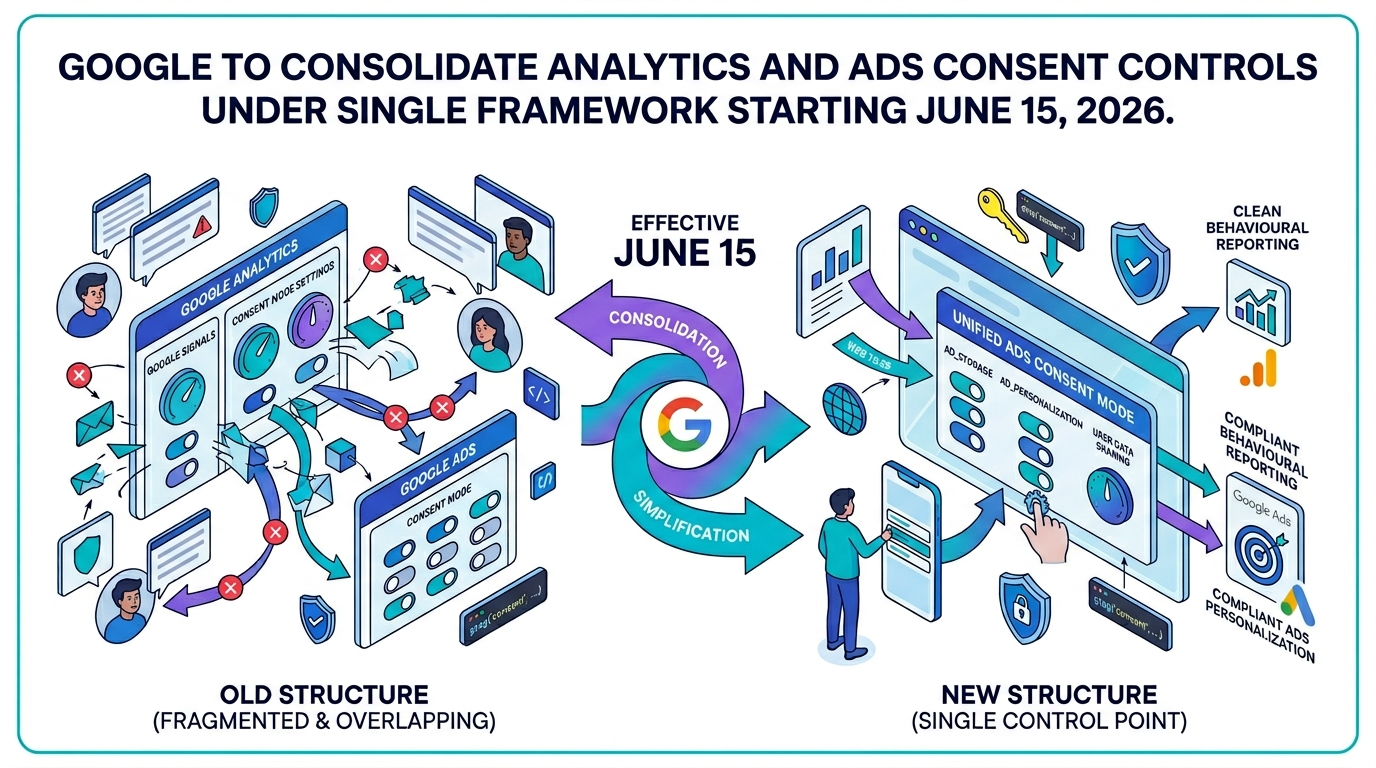
Advertisers who run Google Analytics alongside Google Ads will face a restructured consent framework beginning this summer, with a single setting replacing the overlapping controls that have long complicated campaign tracking setups. Google confirmed the change in its Analytics Help Centre documentation published April 11, 2026, outlining a multi-phase consolidation of data governance across both platforms.
What Google Is Changing and When
The collection of Google Ads cookies and IDs from the Google Analytics tag and SDK is currently controlled by both the Google Signals setting in Google Analytics and Consent Mode Ads settings. That dual-control structure has been a source of implementation friction for advertisers, particularly because consent logic was spread across platforms.
Starting June 15, 2026, Google Analytics will transition to using Consent Mode within Google Ads as the single control for data. The change means users' privacy selections, managed via Ads Consent Mode settings, will exclusively govern how data is collected and used.
The broader intent is to eliminate redundancy. Google has confirmed it is planning to consolidate controls based on where data is used, with Google Ads settings exclusively controlling Google Ads data, including data shared by Google Analytics, and Google Analytics settings exclusively controlling data used within Google Analytics for behavioural reporting.
The Narrowed Role of Google Signals
The June 15 change redefines what Google Signals actually governs. Starting that date, the Google Signals setting in Google Analytics admin and the Google Signals API will only control the association of Google Analytics-sourced data with signed-in user information for behavioural reporting. It will no longer influence how Google Ads collects or uses advertising identifiers.
This is a meaningful structural shift for advertisers who have relied on Google Signals to manage the flow of ad data from Analytics into Ads. Under the new framework, that responsibility moves entirely to Consent Mode on the Ads side.
Ads Personalization Controls Moving Later in 2026
A second, related change is also in progress, though on a later timeline. Google confirmed it will update how Analytics data is managed for ads personalization later in 2026, simplifying the current structure in which personalization is controlled through a layer of settings at the account, property, Ads link, and event levels within Google Analytics, to ensure that Ads data usage is exclusively controlled by Ads settings.
When a Google Analytics property is linked to a Google Ads account, establishing the flow of data to Ads, the Consent Mode `ad_personalization` setting will exclusively control whether that data is used for personalization in the Ads account. Exact dates for this phase have not yet been published.
IP Address Handling Under the New Structure
IP addresses automatically collected by the Google Tag and SDK will be encrypted and flow to linked Google Ads accounts, where they will be controlled by Google Ads and used in accordance with Google Ads settings, configurations, and relevant terms of service. Google noted in its Help Centre documentation that additional guidance on IP address handling for users outside the European Economic Area, the UK, and Switzerland is available in a separate Help Centre article.
What This Means for Advertisers in Practice
The June 15 change reduces the number of places where consent logic must be configured and maintained, but it also removes a layer of flexibility. If `ad_storage` is granted, Google Ads may use all available advertising signals, including linking activity to a user's signed-in Google account when possible; if `ad_storage` is denied, Google will be limited to less persistent signals, such as URL parameters like `gclid`.
For advertising clients with properly implemented Consent Mode, the update consolidates what was previously a multi-platform configuration task into a single point of control managed from within Google Ads. Accounts currently managing consent logic through Google Signals alone, rather than through Consent Mode, will need to verify their Ads-side configuration is in place before the June deadline.
Brands with Google Signals turned off should pay particular attention, as under the new setup, they could see more Ad-linked data than before if users grant ad consent. Teams should confirm that Consent Mode update calls are firing correctly and that `ad_storage` settings accurately reflect user choices ahead of the June 15 implementation date.
Google stated in its Help Centre documentation that customers remain in control of whether and how their data is collected, and can change their settings at any time. More details on the ad's personalization and IP address control changes will be shared later in 2026.