
Google Ads is tightening the definition of a new customer.
Not every non-buyer is a fresh prospect anymore. In Google’s 2026 acquisition setup, advertisers can now separate people who have never purchased from people who appear to have never meaningfully encountered the brand at all.
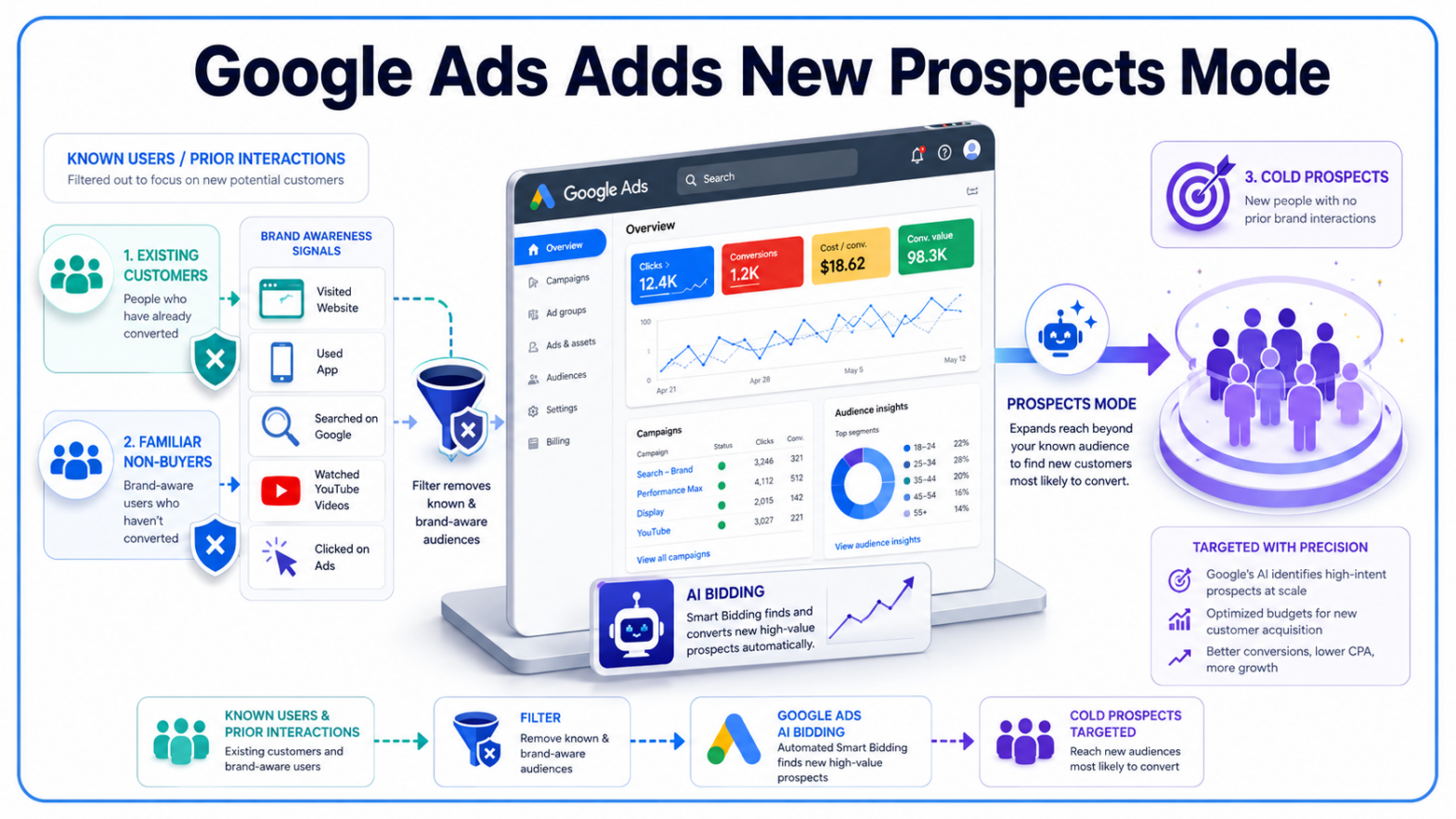
That distinction sits behind Google’s new prospects mode, a newly added option in its New Customer Acquisition framework. The mode is designed to help advertisers focus campaign delivery on users who are still in the discovery phase and have not purchased, searched for the brand, visited the advertiser’s site or app, or engaged with its content across Google and YouTube.
Google’s own Ads Help documentation already describes New Customer Acquisition as a customer lifecycle goal for Performance Max, Search, Shopping, and Demand Gen campaigns. The existing setup includes New Customer Value mode, which bids higher for new customers while keeping existing customers in reach, and New Customer Only mode, which optimizes campaigns to bid exclusively for new customers. The new prospects mode adds another layer: brand-unaware users.
Google Is Drawing A Harder Line Around “New”
For years, new customer acquisition in paid media has usually meant one thing: someone who has not bought before.
That definition works well enough for purchase reporting. It is less precise for growth campaigns. A person may not have purchased, but they may have visited the site five times, watched a YouTube ad, searched the brand name, abandoned a cart, or clicked a shopping result last week. They are technically a new customer. They are not cold.
Google’s new prospects mode is aimed at that gap.
The mode uses automated exclusions to filter out people with previous signals of brand familiarity. Based on Google’s description, that includes users who have purchased through signals such as Customer Match and tags, searched for brand terms, visited the advertiser’s website or app, or engaged with ads and content across Google and YouTube.
The effect is simple: acquisition bidding becomes less about finding another non-buyer and more about finding people outside the brand’s known orbit.
That matters because automated campaign systems have become increasingly skilled at finding the closest available conversion path. Without guardrails, that can pull spend toward people who are already familiar with the business. Those users may convert efficiently, but they do not always represent incremental audience growth.
For advertisers managing Google Ads automation, the new mode gives Google’s bidding system a stricter audience boundary. The campaign is not only asked to acquire. It is asked to avoid users with prior brand contact.
The Existing Modes Still Serve Different Growth Jobs
Google’s acquisition framework now has a clearer spread of bidding choices.
New Customer Value mode is the broader option. It allows campaigns to reach everyone, while assigning extra value to conversions from new buyers. Google says advertisers using this mode and valuing customer acquisitions at twice their average order value can see a 9% improvement in ROAS, based on internal A/B testing across global campaigns from September 2024 through January 2025.
That mode is built for advertisers that still want returning customers in the mix. It is especially relevant when existing-customer demand remains valuable, but the business wants Smart Bidding to favour new buyers when the system finds them.
New Customer Only mode is narrower. Google’s Ads Help documentation says this mode optimizes campaigns to bid exclusively for new customers and is recommended when advertisers have strict acquisition budgets or non-purchase conversion goals, such as lead generation. Google says advertisers using New Customer Only mode have, on average, improved their new customer ratio by 11.5% while reducing acquisition cost for new customers by 3%, again based on internal studies.
New prospects mode goes colder than both.
It is not just excluding purchasers. It is excluding signals of prior awareness. That makes it a different tool from standard new-customer bidding, because it tries to separate genuine market expansion from demand that may already be close to conversion.
For teams already running Performance Max campaigns, the difference will come down to intent. A campaign built to maximize near-term conversion value may still favour New Customer Value mode. A campaign built to protect a prospecting budget from warm traffic leakage may be a better fit for the colder audience logic.
Cold Reach Comes With A Measurement Trade-Off
The promise of new prospects mode is cleaner acquisition spend.
The trade-off is that cleaner does not always mean easier.
Cold users are less likely to convert immediately. They may need more touches, more information, and more time before they become customers. A campaign that removes prior visitors, brand searchers, engaged YouTube viewers, and existing customers may produce a cleaner prospecting pool, but it can also shrink the addressable audience and change the short-term performance profile.
That is not a flaw in the mode. It is the point.
Advertisers will need to judge the campaign against the right job. If a business expects new prospects mode to behave like branded search, remarketing, or lower-funnel Performance Max, the reporting will look uncomfortable. If the goal is incremental reach into brand-unaware audiences, then performance has to be read through acquisition quality, new customer ratio, audience reach, and downstream conversion behaviour.
Google’s existing customer lifecycle documentation also shows why first-party data still matters. Customer Match lists, tag-based remarketing lists, GA4 audiences, direct uploads, and Google auto-detection all play roles in how Google identifies customer segments for bidding and targeting. In New Customer Acquisition campaigns, Google says auto-detection is used by default when advertisers are tracking Google Ads purchase conversions.
That puts data hygiene back at the centre of the setup.
A cold-audience campaign is only as clean as the signals used to exclude warm and existing users. Customer lists need to be current. Website and app tagging need to be reliable. Brand-term logic has to reflect how people actually search for the business, including misspellings, product names, and local variations where relevant.
For advertisers applying Smart Bidding strategies, the new mode adds another strategic input. The machine can optimize only within the boundaries it is given.
Brand-Awareness Signals Are Becoming Bidding Inputs
The most interesting part of new prospects mode is not the exclusion of past purchasers. That is already familiar.
The bigger shift is Google treating brand engagement signals as part of acquisition eligibility.
A website visit, app use, brand search, YouTube engagement, or ad interaction can now place a user outside the cold-prospect pool. That pushes paid acquisition closer to lifecycle segmentation, where each audience state carries a different media role.
Cold prospects sit at the top of that structure. New non-buyers with prior brand exposure sit somewhere below them. Existing customers belong somewhere else entirely. Lapsed or high-value customers may need their own lifecycle treatment.
Google has been moving in this direction across its Ads products. Its customer lifecycle goals already include acquisition and retention modes. Its 2026 Marketing Live announcements also framed AI-powered ads and bidding around changing consumer journeys, faster discovery, and more automated campaign management.
New prospects mode fits that broader pattern.
It gives advertisers a way to tell Google that some users are too familiar for true prospecting, even if they have not purchased. In practical campaign terms, that may reduce the tendency for acquisition budgets to absorb warm audiences that should be handled by separate remarketing, retention, or branded demand campaigns.
The practical implication for marketers is straightforward: prospecting budgets will need cleaner audience architecture. Teams should audit Customer Match coverage, conversion tagging, GA4 audience quality, brand search exclusions, and campaign overlap before relying on the mode for budget decisions. The change also makes customer lifecycle marketing more relevant inside paid search and Performance Max planning, because acquisition, re-engagement, and retention are increasingly handled through bidding logic rather than separate manual audience stacks alone.
The Budget Question Moves From Efficiency To Incrementality
The old acquisition question was usually whether a campaign could find new buyers at an acceptable cost.
The new question is sharper: did the campaign reach people who would not have reached the brand otherwise?
That is harder to answer, but new prospects mode gives advertisers a more disciplined starting point. By filtering out prior purchasers, brand searchers, site and app visitors, and users who engaged with content or ads, Google is making a stronger attempt to isolate cold demand before the campaign starts optimizing.
The mode will not remove the need for testing. Advertisers still have to compare performance against business goals, sales cycles, margin, repeat-purchase behaviour, and the quality of first-party data. A high-consideration B2B advertiser may read the results differently from a retailer with frequent repeat purchases. A local services business may care more about lead quality than same-week conversions.
There is also a channel-planning implication. If new prospects mode becomes the colder acquisition layer, then New Customer Value mode and New Customer Only mode may sit closer to mid-funnel and lower-funnel acquisition, depending on the advertiser’s account structure. Existing-customer campaigns, retention goals, and lapsed-customer strategies need to be kept distinct enough that Google’s automation is not being asked to solve conflicting jobs with the same budget.
Google is not positioning new prospects mode as a replacement for its existing New Customer Acquisition modes. It expands the set of choices advertisers have when deciding how aggressively they want to separate cold prospects from familiar users.
That separation is now becoming part of the bidding system itself.