

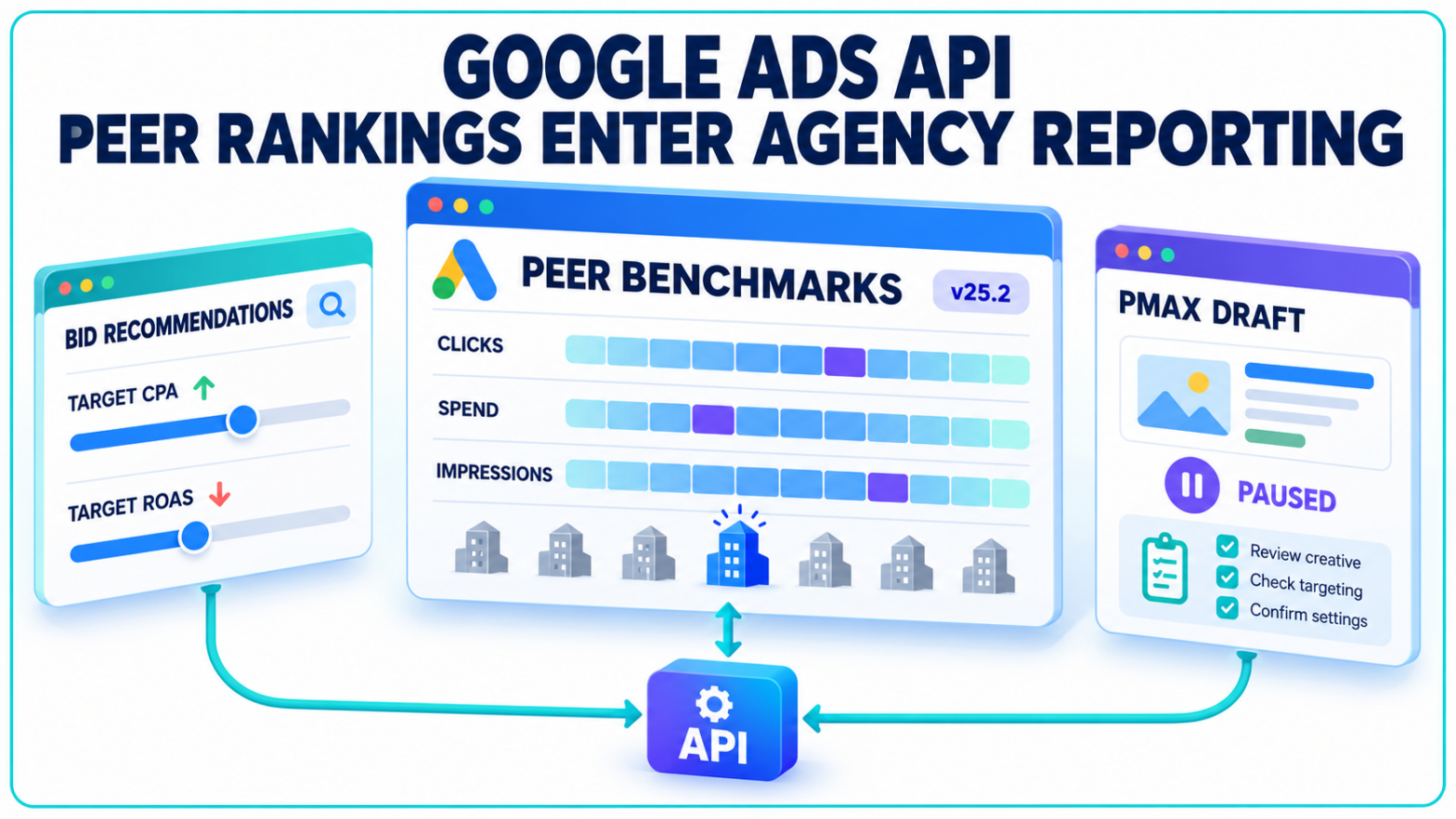
Google is giving advertisers a clearer position among their peers. The new rankings measure spending and advertising activity, leaving profitability to a separate analysis.
Released on September 23, Google Ads API v25.2 adds competitive percentile tiers alongside Search bid recommendations, Performance Max campaign tools and expanded creator and travel insights. Agencies and software providers can bring those capabilities into the systems they use to manage accounts.
Google’s developer announcement describes the release as a drop-in upgrade for v25. Its significance for advertisers lies in the decisions those integrations support: comparing market activity, identifying restrictive bidding targets and preparing campaign changes for review.
Google Ads Benchmarks Put Scale Into Categories
The update extends Google’s existing BenchmarksService with percentile tiers showing an advertiser’s standing within the group being analysed.
The documented percentile fields cover clicks, cost, engagements, impressions, interactions, TrueView video views and viewable impressions. They do not include conversion volume, acquisition cost or return on ad spend.
That distinction gives Google Ads benchmarks a specific role in reporting. They describe relative activity. A high cost percentile establishes that an advertiser spends more than much of the comparison group; it does not establish that the advertiser earns more from that spending.
Google’s tier definitions range from below the 10th percentile to at or above the 90th percentile. The ranking applies to the relevant metric among advertisers included in the analysis.
The comparison also has boundaries. Google’s request documentation describes the category filter as scoping a YouTube benchmarks analysis. Selecting a clothing category, for example, limits both the customer’s metrics and the comparison group to ads in that category.
Developers must explicitly request percentile data, select the all-advertisers source and provide the category filter.
Date selection introduces another limit. Percentile metrics support available open-quarter dates, but customer share metrics and benchmark-source rate metrics are omitted for unfinished quarters. A current-quarter response can therefore contain fewer types of comparison than a completed-period report.
Smart Bidding Recommendations Flag Restrictive Targets
Search advertisers receive two new recommendation types for cases where bids are too low to enter auctions.
One recommends raising target cost per acquisition. The other recommends lowering target return on ad spend. Both address bidding constraints, but they adjust different expressions of the advertiser’s performance goal.
Google’s target CPA recommendation supplies the current average target and a multiplier greater than one. The target ROAS recommendation supplies the current average target and a multiplier below one.
These are recommendations that software can retrieve and apply through supported operations. Their introduction does not itself change an advertiser’s targets.
For teams managing Smart Bidding, the practical distinction is between identifying an auction constraint and deciding whether the business can accept a different acquisition cost or return target. Competitive rankings provide market context; conversion quality, margins and the advertiser’s own results remain necessary when assessing a proposed change.
Performance Max Drafts Start With a Review Stage
The release also provides a programmatic route from an existing Smart campaign to a Performance Max draft.
Google’s campaign-conversion guide says the generated campaign starts paused, with its creation status marked incomplete. Developers receive references to the campaign, budget, asset group and assets so those elements can be inspected and adjusted before advertising begins.
Creating the draft does not launch it.
A validation-only option checks the conversion request and returns warnings or possible issues without creating the draft. That gives software providers a separate check before adding campaign entities to an account.
There are also unfinished parts of the conversion feature. The options to transfer and link an associated Google Business Profile location and automatically generate required images are not implemented yet. Setting either option to true returns an error.
For agencies working with Performance Max, the draft establishes a concrete review point. Google’s documented workflow calls for configuring the generated campaign and then changing its status to enabled and its creation status to complete when it is ready to serve.
Tracking Settings Reach Individual Asset Groups
Existing Performance Max campaigns gain more specific URL configuration through the API.
Tracking templates, custom URL parameters and final URL suffixes can now be set at the asset-group level. Google’s AssetGroup reference defines the tracking template as the structure used to construct a tracking URL, while the suffix appends parameters to landing-page URLs served with parallel tracking.
The change gives integrations a more granular place to maintain tracking information within a campaign. It does not introduce a new attribution model; it changes where those URL settings can be configured.
Google also adds automated video-crawl settings for Performance Max. Each entry specifies a crawl URL, a source platform and an enabled status. Supported source categories include landing pages, social platforms and YouTube.
Those settings concern the sources used for video crawling. They are separate from the asset-group parameters used to track traffic.
Creator and Travel Tools Add More Specific Inputs
Creator research receives a smaller workflow change: GenerateCreatorInsights now accepts YouTube channel handles as well as channel IDs. Valid handles must begin with an @ symbol, giving developers another way to identify the creators whose insights they want to retrieve.
Hotel and travel reporting gains booking details such as advance-booking window, length of stay, start date and whether users selected their own dates. New price information includes the percentage difference between an advertiser’s offer and the lowest competing price for the same property, alongside auction price tiers and potential impressions.
These additions serve different reporting needs. Creator handles simplify identification; itinerary and price fields add context to travel advertising performance.
Google’s release notes classify v25.2 as a minor release without breaking changes. Updated client libraries and code examples have been published. Developers using those libraries must update them and their client code to access the new capabilities.