
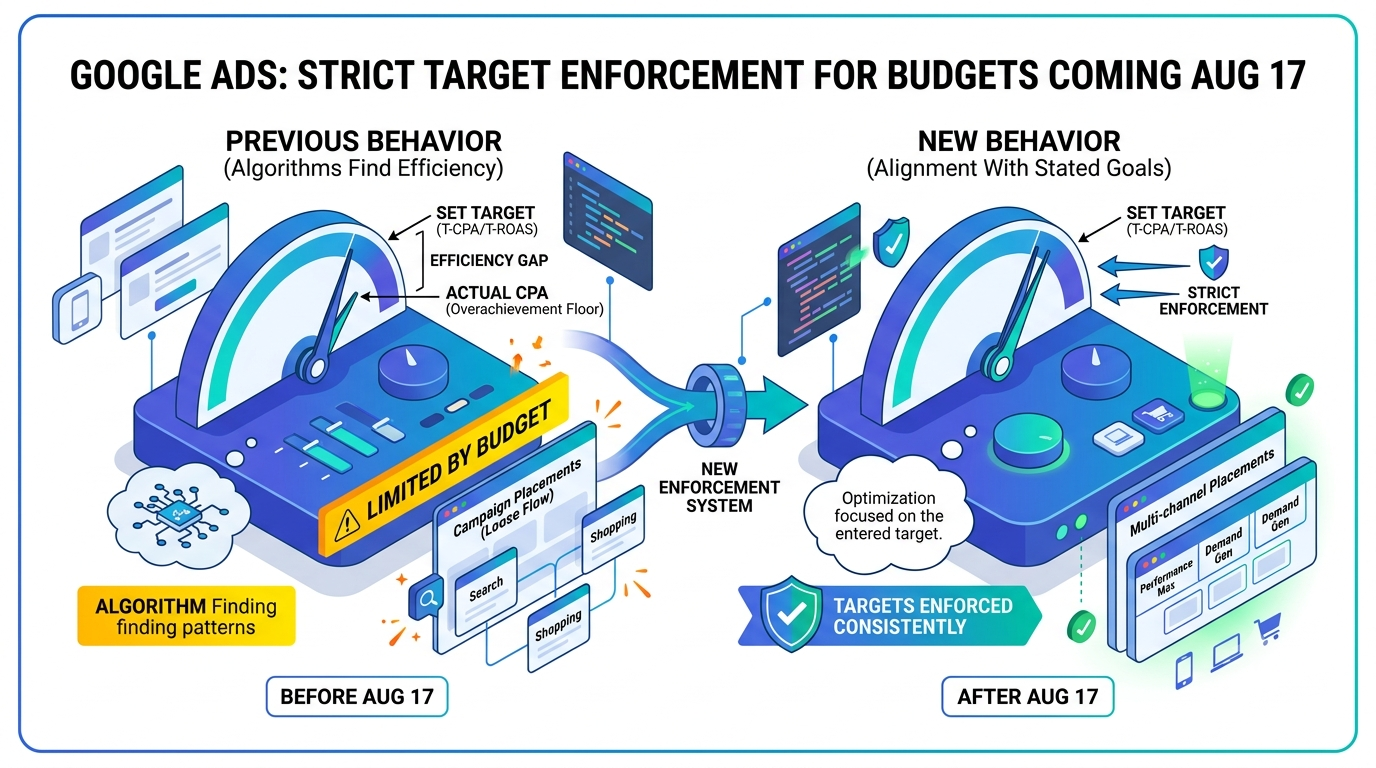
For years, budget-constrained campaigns quietly did advertisers a favour. A Target CPA set at $10 would often deliver at $5. The system overperformed, nobody complained, and targets sat untouched.
That's about to end.
Starting August 17, 2026, Google is rolling out a fundamental change to how target-based bid strategies behave when campaigns are marked "Limited by budget." The platform will begin enforcing targets more strictly, meaning campaigns that have historically outperformed their stated goals may see performance shift back toward those goals, not away from them.
Google isn't resetting targets automatically. It isn't raising bids. It's just holding campaigns to the number of advertisers entered. The problem is, many of those numbers are months or years out of date.
The Gap Between What You Set and What You're Actually Getting
The core issue is simple: when a campaign is constrained by budget, Google's bidding system has historically found extra efficiency. An advertiser running a Target CPA campaign at $10 might achieve a $5 actual cost per acquisition because the system is optimizing around a hard budget ceiling.
After August 17, that gap closes. Google's updated bidding system will optimize more consistently toward the target you set, not the efficiency floor the algorithm found on its own. If your target is $10 and the system now adheres to it, your actual CPA moves toward $10.
For Performance Max and Demand Gen campaigns specifically, the shift goes further. Multi-channel campaigns may see changes in how traffic is distributed across different placements, not just a CPA shift, but a structural reallocation of spend across channels.
App Campaigns, Video reach campaigns, and Video view campaigns are excluded from the update and will continue using the previous bidding behaviour. Hotel and Display campaigns already operate under the new behaviour and won't be affected.
A New Tool Arrives July 6, Before the Change Takes Effect
Google is giving advertisers a six-week runway. Starting July 6, a Bid Target Adjustment Tool will appear inside Google Ads accounts that are affected by the upcoming changes. The tool surfaces historical campaign performance data and allows advertisers to review and update targets before the August 17 enforcement date.
Notifications will be sent to advertisers with campaigns that were limited by budget at any point during the last 12 months and use a target-based bid strategy covered by the update. That's a broad trigger; accounts that haven't been actively managed may surface campaigns they forgot were even running.
The tool offers three paths. Advertisers can apply a suggested update that aligns targets with recent actual performance, enter a custom target that better reflects current business goals, or leave targets unchanged and accept that performance will shift toward the original number. There's also the option to switch to a Maximize Conversions or Maximize Conversion Value strategy altogether, though Google notes those strategies will cause CPA and ROAS to fluctuate as budgets are adjusted, since they optimize to spend the full budget rather than hit a specific efficiency target.
Google has confirmed it will not automatically adjust bidding targets or budgets on behalf of advertisers. The changes are coming regardless, and what an advertiser does between now and August 17 determines what happens next.
What This Means for Smart Bidding Strategy
The practical implication is straightforward. Any campaign that is budget-limited and using Target CPA or Target ROAS should be reviewed against its actual recent performance. If historical targets no longer reflect real business economics, or were set conservatively during a testing phase and never revisited, those campaigns are candidates for a performance shift on August 17.
Advertisers who want to maintain current efficiency levels have a clear option: lower the target in the Bid Target Adjustment Tool to match actual performance before the deadline. Those who want to scale after the change takes effect can do so more predictably. Google notes that budget increases on previously constrained campaigns will now deliver closer to stated targets rather than causing the volatility that budget adjustments have historically triggered under the old system.
The change applies across Google Ads, Search Ads 360, Display & Video 360, Google Ads Editor, and the Google Ads API.
The Campaigns Most Likely to Be Affected
Accounts running long-standing Search and Shopping campaigns with targets that were set at launch and haven't been revisited are the most exposed. The same applies to Performance Max campaigns where efficiency metrics have drifted significantly below target over time, and any Demand Gen campaign running in a budget-limited state with over-achieved ROAS targets.
Multi-account managers running campaigns across many clients should audit the "Limited by budget" status filter account-wide. Google's notification system may not catch every scenario, and the tool's July 6 availability window gives roughly six weeks before enforcement begins.
Google has made the full details of the change, including a FAQ document, available directly in the Google Ads Help Center.