Google is closing another door on lightweight campaign automation.
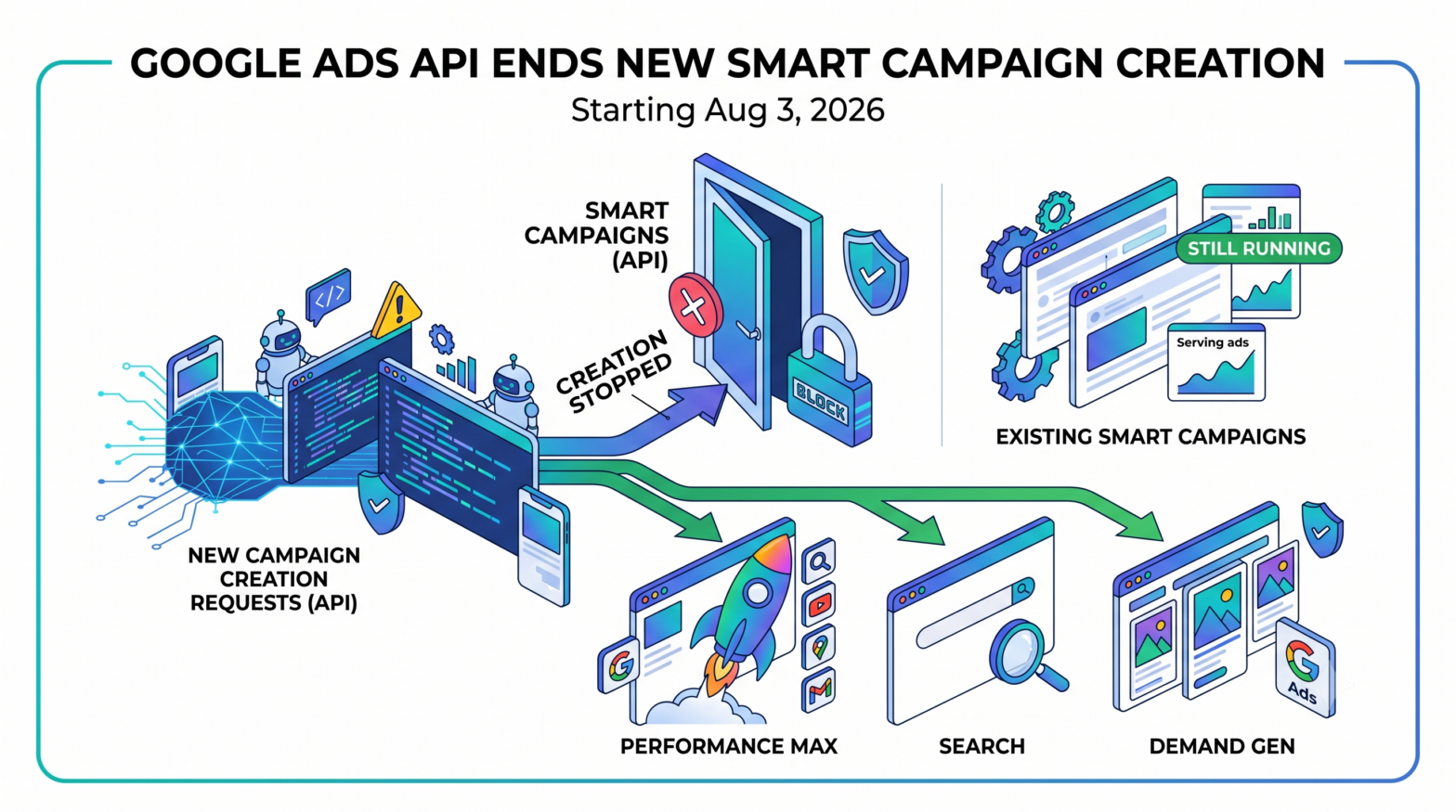
Starting August 3, 2026, advertisers and developers will no longer be able to create new Smart Campaigns through the Google Ads API. Existing Smart Campaigns will continue running, but the creation path is being cut off for tools, platforms, and agency systems that still rely on the format.
Smart Campaigns Stay Live, But The API Door Closes
Google confirmed that new Smart Campaign creation through the Google Ads API will stop on August 3, 2026. The change does not pause or remove existing campaigns. Advertisers will still be able to update Smart Campaigns already in place, and those campaigns will continue serving ads.
That distinction matters.
This is not a full product shutdown. It is a creation cutoff inside the API. For advertisers managing campaigns directly in Google Ads, the immediate disruption may be limited. For software platforms, resellers, franchise marketing systems, local business tools, and agencies using automated campaign-build workflows, the change is more concrete.
Any system still generating Smart Campaigns programmatically needs to be checked before the August deadline.
Smart Campaigns were built around simplified setup and automated management for small businesses. They reduced campaign-building complexity by abstracting away many of the controls used in standard Search, Display, or Performance Max campaigns. That simplicity made them useful for businesses that did not want to manage keywords, bids, targeting layers, or creative testing manually.
But Google Ads has been moving in a different direction.
Automation is no longer confined to beginner-friendly campaign types. It now sits inside broader, more powerful formats with more inventory access, more measurement dependencies, and more strategic setup choices. That shift is visible across Performance Max campaigns, Demand Gen, AI Max, Smart Bidding, and new Gemini-assisted campaign tools.
Smart Campaigns are not disappearing on August 3.
They are becoming legacy infrastructure.
Developers Get A Specific Failure Path
The change is technical, and Google has laid out exactly what developers should look for.
Applications creating Smart Campaigns through the Google Ads API should inspect campaign mutate requests with create operations where the campaign advertising channel type is set to SMART and the advertising channel subtype is set to SMART_CAMPAIGN.
Once the cutoff takes effect, those requests will fail.
In version 24 of the Google Ads API, attempts to create a new Smart Campaign will return a SmartCampaignError.CREATION_FAILED error. In version 23 and earlier, the API will return OperationAccessDeniedError.CREATE_OPERATION_NOT_PERMITTED.
That makes the migration issue easy to identify but not necessarily easy to solve.
For platforms that generate campaign templates at scale, Smart Campaign creation may be embedded in onboarding flows, self-serve dashboards, bulk account setup tools, franchise location campaigns, or local service advertiser packages. The campaign type may not be visible to the end advertiser, especially if a platform handles setup behind the scenes.
Those systems need more than a surface-level account audit. They need API request auditing.
The practical question is whether campaign creation logic still points to SMART_CAMPAIGN. If it does, that workflow has a deadline.
Google Is Pointing Advertisers Toward Broader Campaign Types
Google’s recommended alternatives are Performance Max, Search, and Demand Gen, depending on business goals.
That is a notable set of options because each one requires a different operating model.
Performance Max is the most obvious successor for many simplified automation use cases. It gives advertisers access across Google’s advertising channels from a single goal-based campaign, but it also depends heavily on conversion tracking quality, asset groups, audience signals, feed structure where relevant, and strong creative inputs.
Search campaigns offer more direct control over query matching, ad copy, bidding strategies, and landing page selection. They remain more suitable when advertisers want clear search intent coverage and tighter visibility into campaign structure.
Demand Gen serves a different purpose. It is built around visual, discovery-driven placements across surfaces such as YouTube, Discover, Gmail, and other Google inventory. It is not a one-to-one replacement for Smart Campaigns, but it may fit advertisers trying to build demand rather than capture existing search intent.
The broader pattern is clear. Google is not replacing Smart Campaign simplicity with another single lightweight format. It is pushing advertisers toward campaign types that sit inside the current Google Ads automation stack.
TechWyse has already reported on Google’s continued expansion of Demand Gen campaigns, including the movement of Google Display Ads inventory into Demand Gen. That shift gives advertisers more reach inside a campaign type with stronger visual and audience-led planning requirements.
For smaller advertisers, the challenge is not just picking a replacement campaign type.
It is understanding what the replacement now expects from the account.
The Small-Business Layer Is Where The Change Lands Hardest
Smart Campaigns were always tied to the small-business end of Google Ads.
They reduced friction for advertisers that had a limited budget, limited time, and limited paid media expertise. That made them especially relevant for local service providers, single-location retailers, appointment-based businesses, and companies using third-party software to get ads live quickly.
The August API cutoff does not remove those existing campaigns. But it does make new automated onboarding more complicated for platforms that packaged Smart Campaigns as the default entry point.
For a local marketing SaaS provider, the old model might have been simple: collect business details, location, website, budget, and basic creative inputs, then create a Smart Campaign through the API. After August 3, that workflow needs to route into another campaign type.
That replacement will likely require more structured assets, cleaner conversion goals, and stronger account configuration.
Performance Max may be the default choice in many cases, but it is not just “Smart Campaigns with a new name.” It can reach more inventory and use deeper automation, but it also gives Google’s systems more latitude. Advertisers need to know what goal the campaign is optimizing toward, whether conversion data is reliable, and whether creative assets accurately represent the business.
Search can preserve more intent control, but it requires keyword strategy, match type decisions, bidding setup, and ad group structure.
Demand Gen can support discovery and visual reach, but it is not designed to behave like a local search capture tool.
That is the real impact of the change. Google is not just closing an API endpoint. It is pushing simplified campaign creation into a more complex automation environment.
Automation Is Becoming More Capable And Less Beginner-Shaped
The Smart Campaign cutoff fits into a larger Google Ads pattern: legacy formats are being trimmed, renamed, delayed, reworked, or folded into AI-driven systems.
Google has been adjusting Dynamic Search Ads migration timelines, expanding AI Max capabilities, adding more automated reporting features, and changing how advertisers interact with Smart Bidding. Recent updates around AI Max and paid search eligibility show the same direction: more automation, more semantic matching, and more reliance on campaign goals and measurement quality.
The irony is that automation is getting more advanced while beginner workflows are getting less isolated.
Smart Campaigns served as a simplified product lane. Google’s newer automation stack does not work that way. Performance Max, AI Max, Demand Gen, and Smart Bidding all use automation, but they are built for broader campaign strategy, not just easier setup.
That creates a skills gap.
Advertisers may still see simplified interfaces, recommendations, and automated campaign creation prompts inside Google Ads. But the underlying performance depends on inputs that are not always simple: conversion hygiene, audience quality, creative coverage, landing page relevance, budget sufficiency, and realistic targets.
For marketers and agencies, the practical implication is direct. Any Google Ads API workflow that still creates Smart Campaigns should be audited before August 3, 2026. Existing Smart Campaigns can continue serving and being updated, but new automated builds need to shift into another campaign type. The right replacement depends on intent, inventory needs, creative assets, and measurement readiness rather than on a single default migration path.
August 3 Is A Build Deadline, Not A Serving Deadline
The most important date is August 3, 2026.
After that, API-based Smart Campaign creation fails. Existing Smart Campaigns keep serving. Updates remain available. Reporting and management workflows may continue to work, depending on how they are built.
That gives developers and advertisers a narrow but manageable window to review their systems.
The highest-risk accounts are not necessarily the ones with active Smart Campaigns today. They are the platforms and agency workflows that quietly create them for new advertisers, new locations, new service lines, or new local business packages.
Those workflows need a new campaign path before the API starts rejecting creation requests.