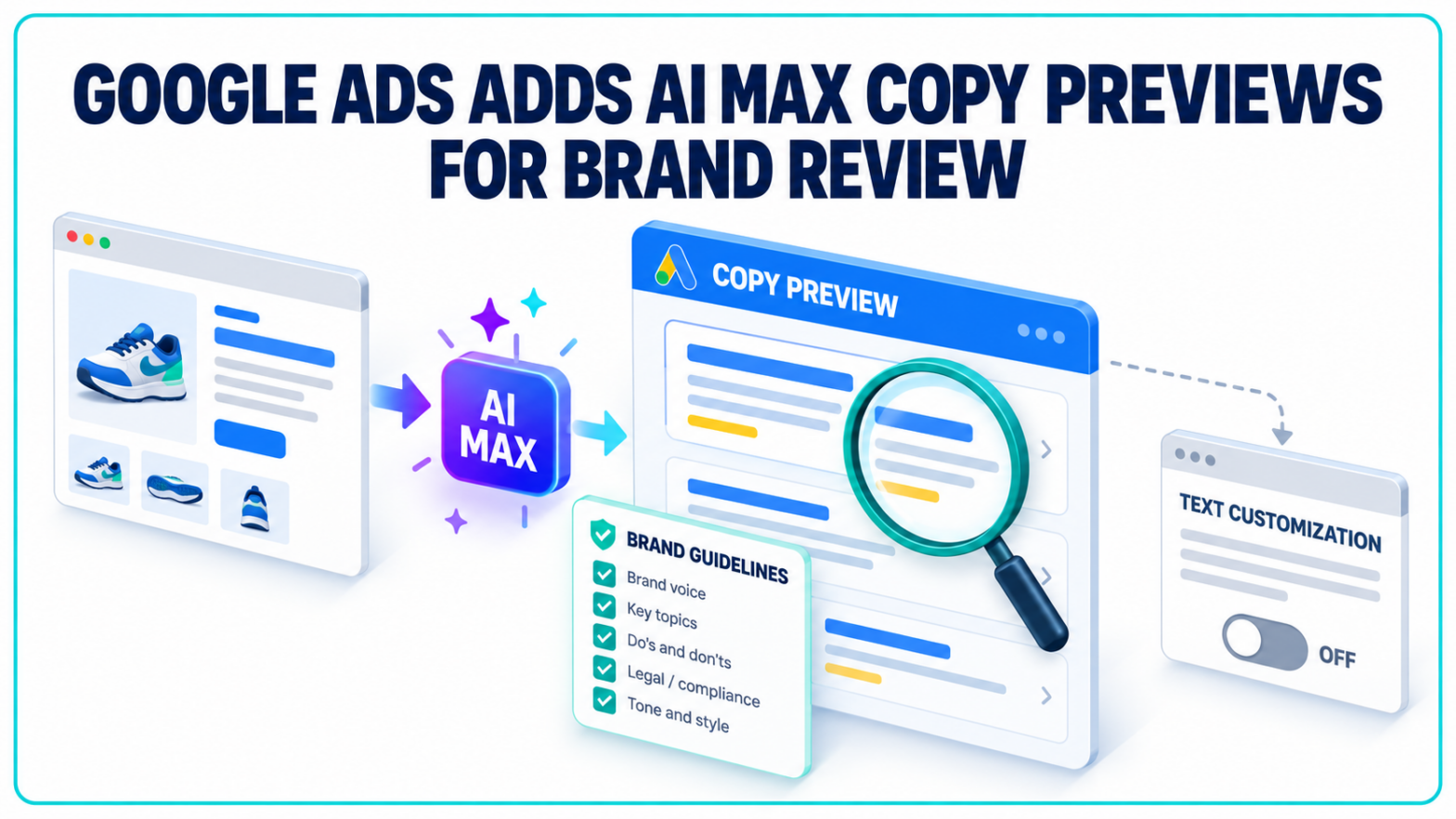
Automated ad copy can now face a brand review before it reaches a live campaign. Google Ads is giving advertisers a sample of AI-generated headlines and descriptions without requiring them to enable text customization first.
The asset preview feature brings an earlier review point to Search campaign setup. Advertisers can examine how Google interprets a landing page before deciding whether to let the system generate additional copy for their ads.
The preview concerns creative output. Campaign activation, targeting settings and live performance remain separate decisions.
AI Max Shows a Sample Before Text Customization Starts
Advertisers can access previews in the Asset optimization section during campaign creation and while editing existing campaigns.
A final landing page URL produces a representative sample of up to 10 headline and description assets. If the URL field is empty, advertisers can enter one and request examples. Google says most examples are generated in under 30 seconds.
The feature supports all languages available for text customization and almost all standard business categories, with adult content excluded. Defined text guidelines filter the preview; if restrictions block every potential asset, the panel prompts advertisers to adjust the rules.
These are sample assets. Their wording shows possible output rather than establishing which copy will appear in a served ad.
Text Guidelines Need More Than a List of Banned Words
The preview sits alongside controls that govern generated messaging.
Google’s text guidelines documentation separates those controls into term exclusions and messaging restrictions. Term exclusions block exact words or phrases, are not case sensitive and allow up to 25 entries per campaign.
Messaging restrictions address concepts, associations and styles. They can define a required tone or specify a tone to avoid, with up to 40 restrictions per campaign.
The distinction matters for multilingual advertising. A term exclusion in English does not block its equivalent in another language. Google says messaging restrictions can apply across languages, including when the instruction and generated asset use different languages.
Google also distinguishes pricing restrictions from symbol exclusions. Blocking a currency symbol does not prevent assets containing prices; pricing concepts need a messaging restriction.
The existing text guidelines workflow remains an experimental beta. Google says new rules also apply to existing Google-optimized assets: copy that fails to meet them stops serving and is marked as removed.
For marketers, the practical change is an earlier opportunity to compare generated messaging with approved product claims and brand language. That review serves a different purpose from measuring clicks or conversions after launch.
Reviewing Copy Does Not Resolve Every AI Max Setting
AI Max combines search term matching with asset optimization inside Search campaigns. Google describes it as an optimization layer rather than a separate campaign type.
Its operating documentation explains that enabling AI Max turns on search term matching, while text customization and Final URL expansion are campaign-level asset settings that can be switched off individually. Search term matching can be disabled at ad group level.
Those controls affect different parts of an ad interaction. Search term matching determines additional searches a campaign can reach. Text customization changes available messaging. Final URL expansion can select a different relevant destination within the advertiser’s website.
A favourable copy sample therefore does not settle whether the advertiser wants broader query matching or automated landing page selection.
There is also a dependency between creative and destination settings. Final URL expansion requires text customization so generated messaging can match the selected page. Google says pinned responsive search ad assets are not used when expansion chooses a more relevant URL, because those assets may not fit the customer’s intent.
The preview adds visibility into one part of that system.
September Upgrades Still Apply to Legacy Text Customization
The review feature arrives while Google is moving older Search campaign settings into AI Max.
Google’s updated migration announcement separates two schedules. Automatic upgrades for campaigns using automatically created assets and the campaign-level broad match setting begin in September 2026. Dynamic Search Ads sunset and automatic migration begin in February 2027, following an extension announced in June.
Automatically created assets is the former name for text customization. Advertisers encountering that older label are dealing with the creative feature now managed within AI Max.
Google says migrated settings are configured to reflect the legacy setup. For automatically created assets users, its announcement specifies search term matching and text customization as enabled by default.
That transition gives the preview relevance beyond new campaign launches. Existing advertisers reviewing their automation settings are also deciding how generated language fits campaigns already in operation.
The two migration dates cover different legacy features. The DSA extension does not postpone the September schedule for automatically created assets or campaign-level broad match.
Live Asset Reports Show What the Preview Cannot
Once text customization is enabled, the live asset pool can extend beyond the examples reviewed during setup.
Google’s text customization FAQ says generated headlines and descriptions supplement advertiser-provided responsive search ad assets. They do not count toward the standard limits of 15 headlines and four descriptions.
Generated assets are eligible to serve, but not every asset necessarily does. Changes to ads, keywords or landing pages can alter their usefulness, and Google can remove assets it determines will not perform.
Advertisers can inspect generated copy through text customization reporting. The Added by column identifies Google AI assets, with metrics including impressions, spending and conversions. Combination reports show common asset combinations and whether they contain customized text. Campaign-level reporting provides a way to review assets across larger campaigns.
That reporting complements the wider Google Ads effort to connect search terms, creative and landing destinations.
Google’s control instructions allow advertisers to remove individual generated assets from the ad’s asset details. Disabling text customization stops its generated assets from serving and also turns off Final URL expansion if that setting is enabled.