

Facebook is no longer treating search like a utility tucked behind the feed. It is turning it into a front door.
Meta said on June 15 that Facebook is rolling out a new AI Mode inside search, alongside a fresh batch of AI-powered creative tools for photos, videos, Stories, and profile images. The product shift matters because it pushes Facebook further into territory that looks less like classic social discovery and more like an answer engine built from public conversation.
For marketers, that changes the frame. This is not just another AI feature drop. It is a sign that Meta wants users to search, decide, and create without leaving Facebook.
Search Starts To Look A Lot More Social
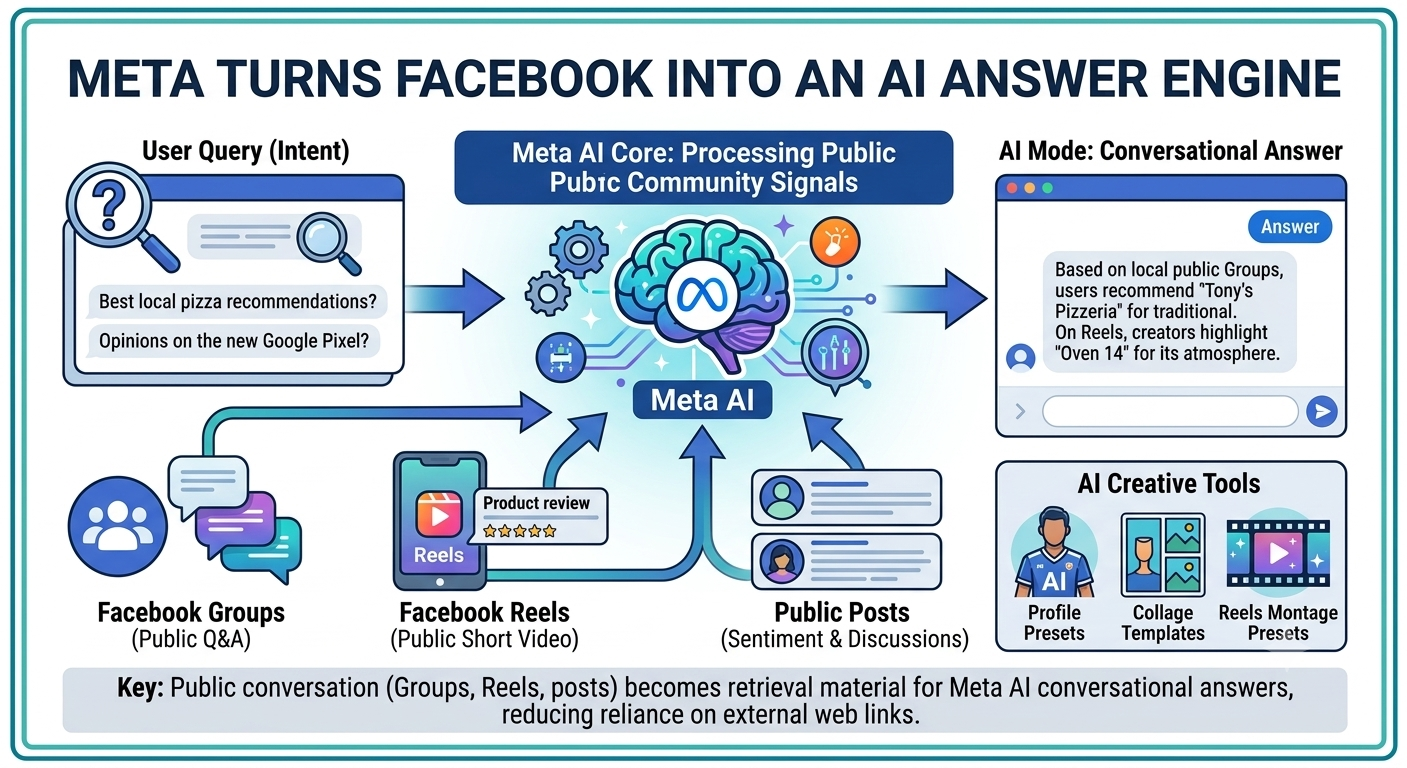
The biggest move here is AI Mode, which Meta describes as a search experience powered by Meta AI inside Facebook. Rather than returning a standard list of links, the tool is designed to answer questions using public signals from across Meta’s apps, including Groups and Reels.
That is a meaningful product choice. Search on the open web has been moving toward synthesized answers for more than a year, but Facebook’s version leans into something different: community response as the source layer.
Meta said AI Mode gives users “answers grounded in what people are saying publicly across our apps like in Groups and Reels,” positioning the feature as a way to surface lived experience, recommendations, and cultural context instead of a conventional link stack.
That could make Facebook more useful for the kinds of messy, subjective queries that already thrive on social platforms. Think local recommendations, product opinions, travel tips, hobby questions, or real-world troubleshooting. Those searches have always existed on Facebook in a scattered way. Meta is now trying to organize them.
The move also lines up with Meta’s broader AI infrastructure push. The company said Facebook’s new AI Mode is powered by Meta AI and tied to Muse Spark, the model family Meta introduced earlier this year as a system built to bring faster, more contextual AI features across its apps.
That matters because it suggests this is not a one-off interface experiment. It looks more like foundational product plumbing.
Readers who have been following broader platform shifts can see the pattern. TechWyse recently covered Meta’s Muse Spark rollout and its implications for shopping and discovery, which now looks increasingly connected to how Facebook search will evolve.
Public Conversation Becomes Retrieval Material
The strategic implication is easy to miss if the announcement is read only as a consumer feature update.
When Meta says AI Mode is built from what people share publicly, it is also saying that public posts, discussions, and creator content are becoming retrieval material. In plain terms, Facebook is treating parts of its social graph more like searchable inventory.
That has consequences for visibility. Brands that publish useful public content may find that their posts do more than generate engagement in the moment. They may also contribute to how Facebook answers later searches.
The same is true for creators, community managers, local businesses, and organizations that participate in Facebook Groups where buying questions and recommendation requests already happen every day.
The interesting wrinkle is that this does not work like SEO in the traditional sense. Facebook is not indexing the open web here. It is drawing from the public language, sentiment, and recommendations already circulating inside Meta’s ecosystem. That makes social proof more operational.
It also echoes a shift TechWyse has tracked across AI platforms more broadly: answer systems are increasingly built on distributed signals rather than a neat ranking of webpages. The same tension shows up in our recent coverage of Google’s AI search direction and the pressure it creates for publishers and brands.
For Facebook, the advantage is obvious. It already has scale, conversation, and intent. AI Mode gives Meta a way to compress those ingredients into a faster product.
The Creative Tools Are Built For Low-Friction Publishing
The second half of the rollout is less about search and more about output.
Meta is expanding AI-assisted creation across Facebook with new collage cutout templates, transition effects for video montages, and additional sharing suggestions based on users’ camera roll content. The company said those suggestions remain opt-in and can be disabled at any time.
That privacy qualifier matters because Meta first introduced camera roll-based sharing suggestions last year, framing the feature as a private prompt system that surfaces content only to the user unless they choose to share it. This new update adds more AI-generated packaging on top of that same behavior: faster edits, more stylized outputs, and less manual assembly.
Meta is also introducing photo presets that can change clothing, hair, and accessories with AI. One example highlighted by the company is a sports-themed option that lets users digitally wear a team jersey. On Facebook Stories, the feature appears under AI Edit, while profile images can be altered through a separate AI restyling flow.
None of that is aimed at professional creators first. It is aimed at regular users who want to publish something that looks finished without actually editing it.
That is the real product lesson here. Meta is reducing the number of decisions required between capture and post. Search helps users get to an answer faster. Creative presets help them turn that answer, interest, or moment into content faster.
That same efficiency logic is showing up across Meta’s platform stack. TechWyse also recently covered Meta’s AI business agent expansion across WhatsApp and Instagram, another signal that Meta wants more commercial and communicative actions completed inside its own surfaces.
Why This Matters For Marketers Now
The timing is notable.
Meta is not just bolting AI onto Facebook for novelty. It is redesigning two high-frequency behaviors at once: finding information and creating content. Both sit close to ad inventory, branded discovery, and creator distribution.
For marketers, the immediate question is not whether AI-generated collages will transform strategy. It is whether Facebook is becoming a more important environment for intent capture.
If users begin asking product, location, and recommendation questions directly inside Facebook AI Mode, the content that shapes those answers may come from posts, public comments, Reels, creator discussions, and community conversations rather than from a brand’s website alone.
That creates a new kind of visibility challenge. Teams will need to think beyond posting cadence and paid reach. They will need to think about whether their public Facebook presence contains useful, quotable, recommendation-worthy material in the first place.
It also raises familiar questions about authority and attribution. AI-generated answers are efficient, but they compress source context. That is one reason the broader search market is already under pressure, a dynamic TechWyse examined in its look at how AI search systems are changing the way discovery works for marketers.
What This Changes In Practice
In practical terms, brands and publishers should view Facebook less as a passive social channel and more as a searchable answer environment. Public-facing posts, group participation, creator partnerships, and short-form video may now influence not only engagement but also how Facebook assembles AI-driven responses inside its own search layer. On the creative side, lighter-weight visual production will likely mean more templated, AI-assisted content competing for attention in Stories and feed placements.
Meta has not presented this rollout as a major ad announcement. It did not need to. When a platform changes how users ask questions and how they publish responses, the marketing consequences tend to follow on their own.
Facebook’s feed is still there. So are the Groups, Reels, Stories, and profile surfaces users already know. What changed on June 15 is the connective tissue between them.