
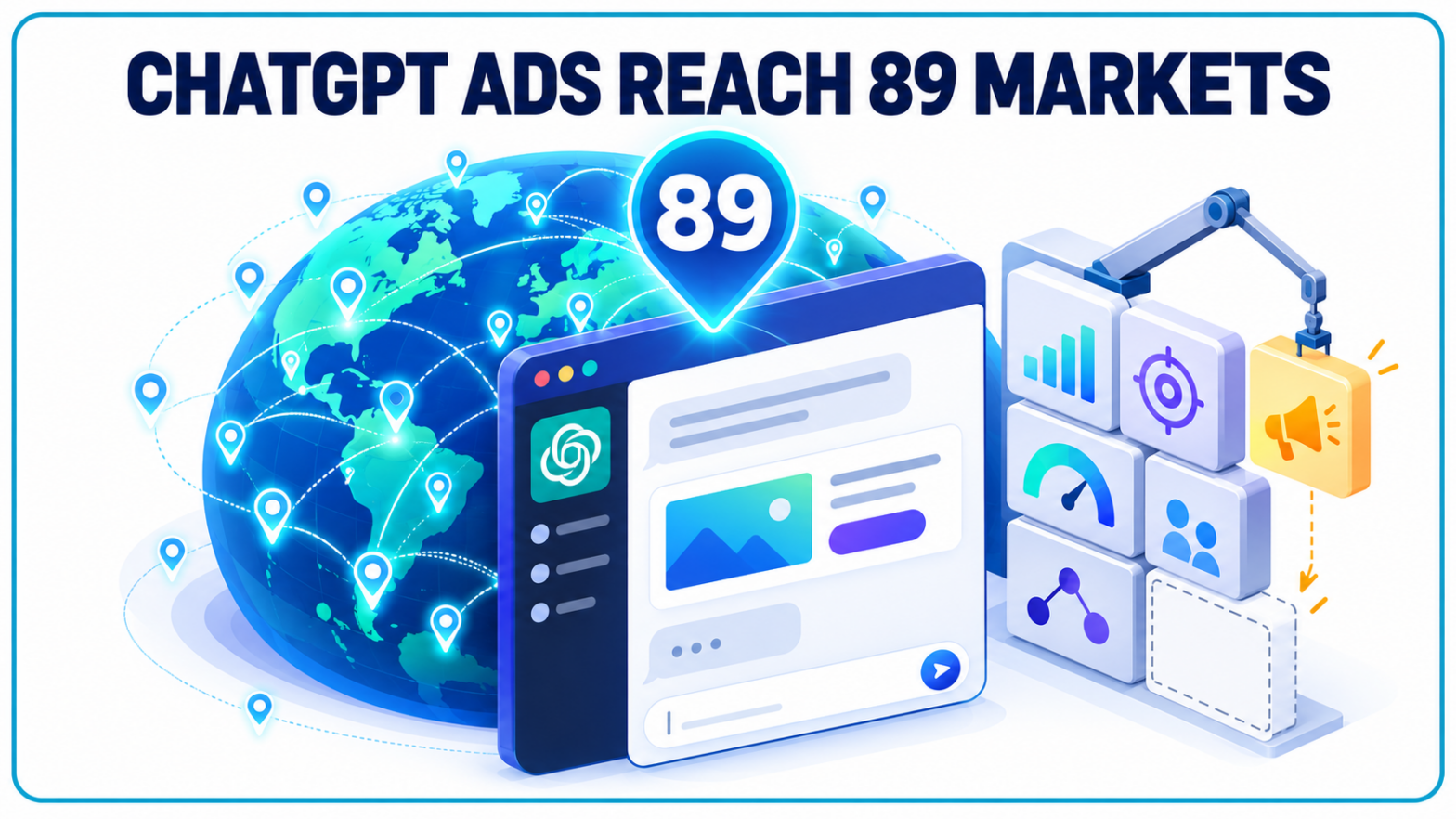
ChatGPT’s advertising business is no longer a small domestic experiment. OpenAI has opened the platform to advertisers in 26 additional countries, taking its commercial footprint to 89 markets while many of its formats and measurement tools are still being developed.
The expansion arrives just over eight months after advertising began appearing in ChatGPT. More than 100,000 advertisers have already run campaigns, according to OpenAI’s October 21 announcement.
That scale changes the question facing marketers. ChatGPT advertising is becoming easier to buy across borders, but it remains a young channel without the long performance history of search, social or programmatic media.
Twenty-Six Markets Push ChatGPT Ads Beyond the Pilot Stage
OpenAI began testing advertising in the United States on February 9, 2026. The company later added Canada, Australia, New Zealand, the United Kingdom, Mexico, Brazil, Japan and South Korea before moving into Europe, Southeast Asia and Taiwan.
The newest rollout brings ChatGPT Ads to another 26 countries. OpenAI says the service is now available in 89 markets and reaches a platform used by more than 1.2 billion people each week.
Advertiser participation has expanded nearly as quickly. OpenAI reported tens of thousands of advertisers in August. Its latest count exceeds 100,000 businesses that have run at least one campaign, although the company has not disclosed how many remain active or how spending is distributed among them.
Those figures show a channel moving into commercial scale. They do not establish how widely ads are served within each country, since consumer eligibility still depends on a user’s plan, age, location and the context of the conversation.
Ads may appear for eligible users on the Free and Go plans. OpenAI’s current advertising FAQ says Plus, Pro, Business, Enterprise and Edu accounts remain ad-free, while accounts identified as belonging to people under 18 are excluded.
Latin America Leads the New Geographic Push
Fourteen of the newly added markets are in Latin America, following earlier launches in Mexico and Brazil. OpenAI specifically named Argentina, Chile, Colombia and Peru among the additions.
The remaining expansion stretches across several regions. Nigeria and South Africa are among the new African markets, while Serbia and Ukraine extend the European footprint. Cambodia, Bangladesh and Pakistan are included in the Asian rollout.
OpenAI did not publish an exhaustive list of all 26 additions in its announcement. Its updated Ads Manager availability table provides the current country-by-country record for self-service access.
The geographic mix matters for regional and international brands. Many of the newly supported markets have previously been difficult to reach through emerging AI interfaces without working through a managed sales team or advertising technology partner.
Canada remains on the self-service availability list. Canadian advertisers running multinational campaigns now have a broader set of markets in which ChatGPT can be considered alongside established search and social inventory.
Ads Manager Access Closes a Major Buying Gap
Geographic inventory has limited value if advertisers cannot purchase it efficiently. OpenAI is pairing the expansion with self-service access rather than relying entirely on direct sales.
Businesses in supported countries can buy placements through technology partners or OpenAI’s Ads Manager. The self-service eligibility rule is tied to the advertiser: the legal entity being billed must be based in a country listed as available.
OpenAI has already added several components familiar to performance marketers, including cost-per-click and cost-per-thousand-impression bidding, conversion optimization, geographic targeting, custom audiences, a measurement pixel and a server-side Conversions API. Third-party attribution and brand-suitability partnerships have also begun filling gaps around campaign evaluation.
The platform is not presented as complete. OpenAI says its next development phase will include more formats, campaign objectives, buying options and measurement capabilities, along with more native ways for businesses to interact with consumers inside ChatGPT.
That leaves advertisers with a mix of mature buying conventions and experimental inventory. Campaigns can be purchased and measured using recognizable tools, but benchmarks for cost, incrementality and long-term conversion value remain less established than they are on older platforms.
Conversational Advertising Targets Decisions in Progress
Search advertising typically reacts to a query. Social advertising often relies on audience characteristics or past behaviour. ChatGPT can interpret an active conversation in which a person is explaining a problem, refining constraints and comparing possible solutions.
That context is the central proposition behind conversational advertising. Someone planning meals for a marathon, comparing business software or narrowing down travel options may reveal substantially more about the decision than a short search phrase would.
OpenAI can use the subject and intent of the current conversation to select an ad. When personalization is enabled, its documentation says signals may also include past chats, memory and previous interactions with ads. Those signals stay within ChatGPT rather than being shared directly with advertisers.
For marketers in practice, the expansion creates another testable paid channel rather than an automatic replacement for search or social spending. Campaign evaluation will require market-level separation, verified conversion tracking and comparison against incremental business outcomes, particularly where conversational context may influence a decision that is completed elsewhere.
The opportunity is clearest during consideration. The unresolved measurement problem is determining whether an ad created demand, accelerated an existing decision or merely received credit for a purchase already underway.
OpenAI Is Protecting the Boundary Around Answers
The expansion puts more pressure on OpenAI’s promise that commercial placements will remain separate from the assistant’s responses.
Under the company’s advertising principles, ads are labelled, visually separated from organic answers and prevented from influencing what ChatGPT says. Advertisers do not receive users’ conversations, chat histories, memories, names, email addresses, precise locations or sensitive personal information.
Users can turn off ad personalization, clear advertising data, hide individual ads or report placements. Free users in eligible regions may also choose an ad-free version with lower message limits and reduced access to certain tools. Paid ad-free plans remain another option.
OpenAI currently prohibits political advertising and says placements are kept away from sensitive conversations, including personal health and mental health discussions. Some regulated businesses may advertise if they meet additional eligibility requirements, but their placements remain subject to contextual restrictions.
Those boundaries will be tested across a much larger and more varied market base. For now, OpenAI is keeping ads on its Free and Go tiers while preparing additional formats, objectives, buying methods and measurement systems for an advertising platform that already spans 89 countries.