
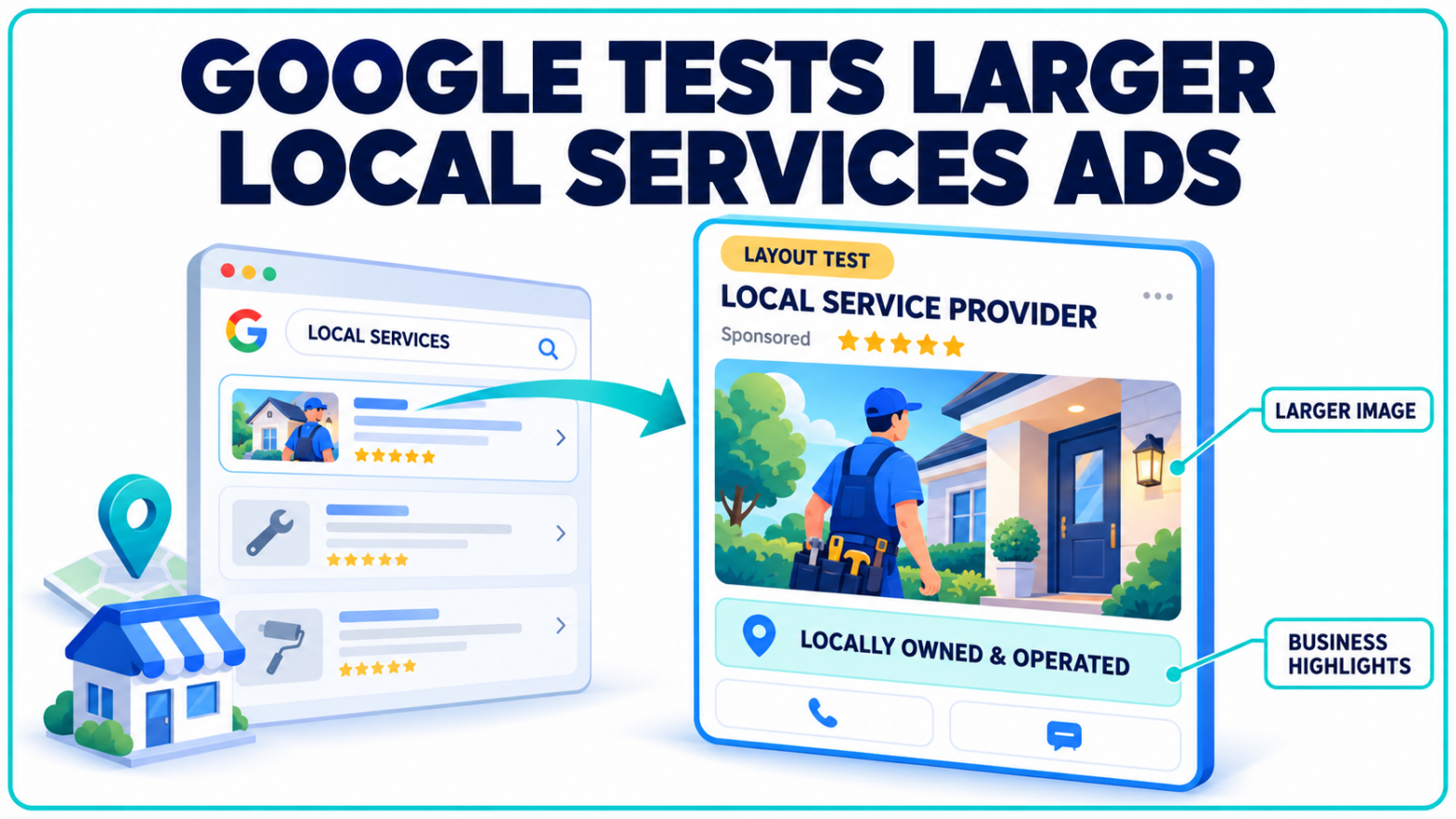
A local business can be judged before anyone opens its website. Google is testing a larger Local Services Ads layout that gives photos and business highlights more space in the search results.
The design, spotted by Adsquire founder Anthony Higman and shared on X, features larger imagery and a more prominent highlight box beneath the main listing. The observation concerns how the ad appears, with no established evidence that the format increases leads or changes which businesses qualify.
For service providers, the immediate point of interest is the information customers encounter while comparing businesses. A more prominent photograph and an expanded business highlight make the profile itself a larger part of that first impression.
Google Is MAKING LOCAL SERVICES ADS LISTINGS BIGGGGGEEEEERRRRRRRRR!!!!!!!!!!! Because Of Course They F**KING Are LOL. MUST MAKE THEM WORK! Note Though The Resources They Are NOW Putting Behind This Ad Type And That They Are Serving Them In More Places Amid The LSA To Google Ads Migration Change Over. This Is DEF Something To Watch If You Are A Local Advertiser. Chess Moves Are Being Made Here.
— Anthony Higman (@AnthonyHigman) September 23, 2026
Local Services Ads Put More of the Profile in View
The reported test builds on an existing feature of Local Services Ads: the ad is a preview of a business profile.
Google’s Local Services Ads overview explains that information supplied by the advertiser, including operating hours, services and service area, generates that profile. Clicking the ad takes the user to the profile, where more business information is available.
The larger layout changes how much visual emphasis some of those elements receive before that click.
Photos and business highlights are already documented components of the product. Their presence in the observed design does not establish a new requirement to supply a different kind of business information.
Google also says ad formatting can change over time and that alternative layouts may contain more or less information. That confirms the platform’s flexibility to vary the presentation. It does not confirm that this particular design is becoming the default.
The available evidence does not establish the test’s full geographic reach, the proportion of searches showing it or a general rollout date.
The Photo Has an Advertising Job Already
Google already uses images from a business’s Local Services profile in ad listings. Its guidance on Local Services Ads with photos recommends several high-quality images related to the business and says photos undergo a quality review before publication.
Google’s editing guidance lists employees performing work and before-and-after images as examples of photos businesses can add. Those images give the listing a way to show the service itself alongside the company name and ratings.
Google’s photo documentation cites an earlier experiment in which providers successfully uploading at least one photo could potentially receive an average of 16% more leads than providers without uploaded photos. That research covered U.S. and Canadian home-service providers between December 2023 and January 2024.
It is evidence about having photos, not a measured result from the current larger-card test.
The distinction matters when assessing an apparent improvement. A historical comparison between profiles with and without images cannot establish the incremental effect of increasing image size. Google has not supplied corresponding performance results for the design Higman observed.
Business Highlights and Google Verified Have Different Sources
The highlighted information beneath the listing sits within an established system of business descriptions and credentials.
Google’s business-information editing guidance allows advertisers to select up to six standard business highlights, with available choices varying by business type. Examples include being locally owned and operated or offering 24/7 emergency service.
Some highlights are controlled by Google. The company says it verifies eligibility for attributes such as Better Business Bureau accreditation before adding them to a profile.
Those existing controls explain how business highlights are managed. They do not establish exactly how Google selects the information shown in the tested box.
The Google Verified badge has its own qualification process. Google’s badge documentation says new advertisers must complete the applicable screening and verification requirements to receive it. Relevant verifications can also appear on the profile.
An emergency-service highlight describes availability; a verified credential describes a qualification. Both provide information a customer can use while choosing whom to contact, alongside the visual impression created by the business’s photos.
A Larger Card Leaves the Ranking Question Open
The visual test does not establish a change to the Local Services Ads auction.
Google’s ranking documentation describes an auction that considers bids and overall profile quality. Other factors include the context of the search, the services offered, responsiveness to enquiries and the likelihood that an ad will generate a lead.
Profile quality incorporates ratings, review volume, average response time, high-quality images and completed verification checks. Photos already have a documented role in that assessment.
An enlarged photo alone is therefore insufficient evidence that Google has introduced a new ranking factor or increased the weight assigned to images.
Google also states that it runs experiments in Local Services Ads. The existence of a different layout is consistent with that ongoing testing, but a screenshot cannot reveal the auction logic behind the listing.
For local marketers, the practical work remains checking that photos, service details, highlights and contact information accurately represent the business customers will reach. A review of the Google Business Profile can form part of that process, alongside the information actually displayed in the Local Services ad and profile.
Lead Reporting Still Determines the Commercial Result
A larger listing is observable. Its contribution to booked work requires performance data.
Google’s Local Services reporting guidance describes reports covering charged leads, advertising spend and lead types, including calls, messages and bookings. Advertisers can review a selected period and inspect individual lead records.
The documentation also describes marking leads as booked, a feature available in the United States and Canada. That records a later business outcome than the initial enquiry.
Those measures answer questions that a screenshot cannot: whether more people contacted the business, how much those contacts cost and whether enquiries became bookings. A change in totals would still need context before being attributed to a design test.
For now, the documented observation is a larger image and a more prominent highlight box. The test’s reach, duration and effect on lead performance remain unconfirmed.