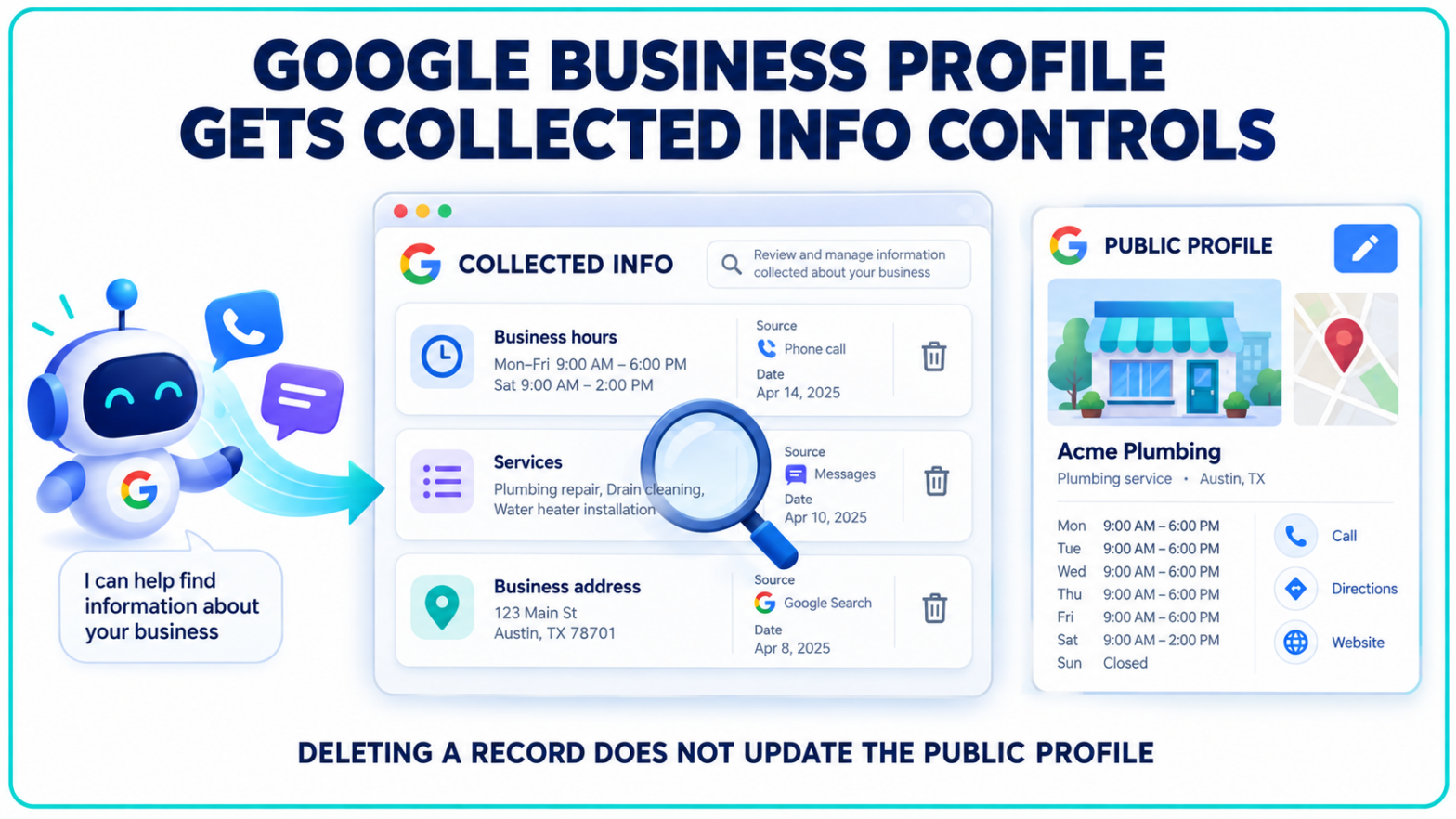
A conversation with Google’s automated assistant can become business information. Owners now have a dedicated place to inspect what was collected, but removing a record does not automatically correct what customers see.
Google is rolling out Collected Info inside Business Profile management, giving eligible businesses access to details gathered through calls and messages. The feature adds a source and collection date to the review process, making it easier to trace information back to a business interaction.
For companies managing their Google Business Profile, the change introduces a more specific form of oversight: reviewing information supplied through conversations, alongside the details already published on the listing.

Collected Info Makes Business Conversations Reviewable
Google’s Collected Info guidance describes automated outreach to the verified phone number on a profile through calls, texts or WhatsApp. Information supplied in response may be used to update the business listing.
Owners can find the feature by opening their profile, choosing Edit profile and selecting Collected info. Entries show their source and collection date, with the information displayed in the language originally used.
An unwanted entry can be removed by selecting Delete and confirming the deletion.
That source information gives a review more context than an isolated statement. A detail collected before a service changed may have been accurate at the time. Another may need to be checked with the staff member or location that handled the enquiry. The date helps distinguish an old answer from a current operating detail.
The documented controls cover reviewing and deleting collected information. Google does not describe the tab as an approval queue that requires businesses to authorize every automated update before publication.
Nor does the documentation promise a complete recording or transcript of every interaction.
Deleting a Record Leaves the Public Profile to Check
The most consequential instruction appears beneath the deletion steps.
You can now review details verified by Google’s automated assistant right inside your Business Profile dashboard. Head to the "Collected info" tab to see what was gathered and delete any outdated details. 👉 Learn more: https://t.co/HqLsmJY4dN https://t.co/Wh9wff9J9F
— Google Business Profile (@GoogleMyBiz) September 14, 2026
“Deleting collected information removes it from Google's records but does not change other details already on your Business Profile.”
A business therefore has two separate things to examine: the collected entry and the published information. Removing an outdated record is not evidence that an incorrect opening time or service detail has disappeared from Search or Maps.
Where the public listing also needs a correction, the normal profile editing process still applies.
Google’s explanation of edit reviews says submitted changes can be accepted, left pending or not approved. Reviews usually take up to 10 minutes, although some take as long as 30 days. Accepted changes appear on the profile; pending changes remain under review.
Those timings concern profile edits. Google has not attached the same timetable to deleting a Collected Info entry.
The separation matters when several people manage one location. A person clearing an outdated entry and another checking the public listing may otherwise believe they have completed the same task. The new control makes the underlying record accessible, while the customer-facing correction still has to be verified in its own place.
Local SEO Still Has Several Sources to Reconcile
Collected Info covers one route through which Google obtains business details. Google’s wider information system uses more sources.
Its business information sourcing documentation lists crawled web content, licensed third-party data, contributions from users and business owners, and information gathered through Google’s interactions with a business.
A profile can consequently contain details its owner never entered directly.
Google also explains that it may update a listing when other sources report incorrect or outdated information. Its guidance on Google updates says changed information appears in blue in the profile editor and that not every Google update can be managed through the profile.
The new tab should therefore be understood as access to a defined collection process. It is not documented as a complete inventory of everything Google knows or infers about a location.
That boundary keeps the update grounded in established local SEO work: maintaining accurate business information across the sources customers and search systems use.
For marketers, the practical change is to include collected entries in an existing location-data review. The entry’s date and source can be compared with current branch information, the public profile and the corresponding website page. Teams can then distinguish an outdated conversation record from a published error and make the correction that each requires.
Automated Outreach Has Its Own Controls
Reviewing a collected entry and deciding whether Google should contact a business are separate choices.
Google’s automated calls and texts documentation describes outreach to confirm operating hours or service availability. It also covers calls made on customers’ behalf for appointments, restaurant wait times, and product or service price and availability enquiries.
The company says routine information checks do not affect a business’s account standing.
Businesses can manage automated contact through More, Business Profile settings and Advanced settings. Google documents separate options for customer bookings and enquiries, keeping the profile updated, and posting on the business’s behalf. Its advanced settings guidance places these controls outside Collected Info.
Google also says that when it creates a post using information from a conversation, the business receives an email notification and can review or remove the post.
These are distinct actions with distinct outcomes. Deleting a collected detail addresses that record. Changing contact settings governs automated outreach. Reviewing a generated post addresses content published from the conversation.
Local Search Visibility Is a Separate Measurement Question
The feature provides more visibility into information collection, rather than a new performance metric.
Google says business details help it surface relevant local results. An address and opening hours, for example, help match a location to nearby or open-now searches. That explains the operational importance of accurate information without establishing that using Collected Info produces a ranking increase.
Businesses assessing local search visibility still need performance reporting to understand exposure and customer activity. A reviewed entry does not measure either.
Access also remains qualified. Google’s current instructions limit Collected Info to selected regions, languages and business categories, rather than confirming availability for every profile. The guidance does not provide a complete eligibility list or a date for universal access.