Getting a brand onto the pages ChatGPT cites does not guarantee it will appear in the answer. New research suggests the model’s existing familiarity with that brand may still shape the final result.
ChatGPT Can Read a Brand and Still Leave It Out
Graphite’s October 16 study compared how frequently ChatGPT mentioned the same entities when answering with and without web search.
The analysis covered 3,115 entity–question pairs across 57 comparison questions. Graphite collected the logged-out ChatGPT responses in August 2026 and analyzed them in October.
For responses involving search, the researchers also measured how often each entity received a substantial mention on the pages ChatGPT cited. Those entities were divided into three groups: brands appearing on less than five per cent of cited pages, between five and 15 percent, and at least 15 percent.
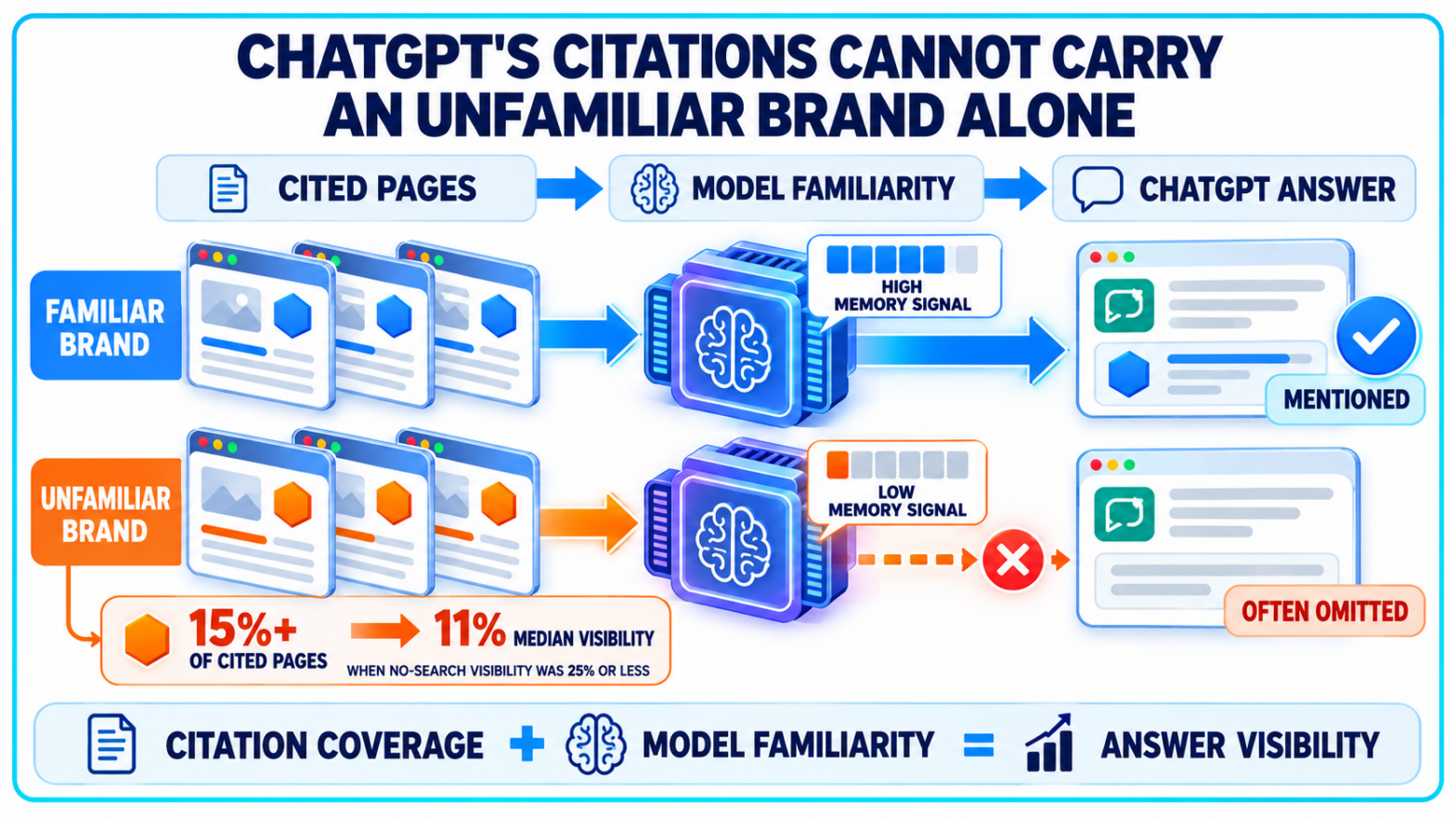
The clearest gap appeared among brands that ChatGPT rarely named without search.
Even when an entity appeared on at least 15 percent of cited pages, its median visibility in search-grounded answers was only 11 percent when the model mentioned it in no more than one-quarter of its answers without search.
That does not make citations irrelevant. Search visibility increased both as cited-page coverage grew and as no-search visibility improved. The research points to two associated factors rather than one replacing the other.
Graphite reported the same general pattern in two additional tests. One replication used 100 prompts through an API with search explicitly enabled or disabled. A second used 200 prompts from its tracking platform during a different three-week period. In both cases, visibility rose alongside cited-page mentions and the model’s existing familiarity with the entity.
Model Memory Enters Before the Citation List
Large language models do not approach every question as an empty retrieval task. They can answer from information encoded during training, commonly called parametric knowledge, or supplement that information by searching the web.
The two processes are not fully separate.
Before retrieving pages, an AI system may generate several fan-out queries covering different parts of the user’s request. Those searches can already contain companies or products the model associates with the category.
Graphite examined approximately 957,000 fan-out queries generated in response to 22,953 non-branded comparison prompts from August through early October. According to its analysis, 59.6 percent contained a brand name, and 22.7 percent used a site-specific search operator. The brand classifications were produced using Claude Haiku 4.5.
A familiar company can therefore enter the retrieval process before ChatGPT evaluates the pages returned by search. Pages featuring that company then have another opportunity to influence the answer.
This reinforces that AI search visibility can be shaped before the final sources are selected. A citation reveals which page supported an answer. It does not reveal every brand the model considered, ignored or searched for by name.
Search Behaviour Changes With the Prompt
ChatGPT does not search the web for every request, and its search behaviour is not fixed.
Within Graphite’s tracked comparison prompts, the share of logged-out ChatGPT responses containing citations climbed from 56.6 percent during the week of August 3 to 88.5 percent during the week of September 28. Graphite cautioned that the rate could change again.
The figures apply to entity-comparison prompts, where current product and company information can be especially useful. Educational, planning and problem-solving questions may produce different search rates.
That distinction complicates the measurement of ChatGPT brand mentions. A tracking system that always forces web search may collect abundant citation data while measuring an experience that many users never receive.
In an earlier prompt-tracking study, Graphite found that forcing search changed entity visibility by an average of 20 percentage points for prompts that never triggered search naturally. Its recommendation was to let the model decide whether to search and report how frequently each prompt becomes grounded in web results.
Without that grounding rate, a citation dashboard can make a small subset of search-enabled responses look representative of the entire prompt.
Answer Engine Optimization Now Runs on Two Timelines
The findings split answer engine optimization into two distinct timelines.
Live retrieval operates on current web content. Brands can publish accurate pages, correct technical access problems and earn relevant third-party coverage that may become available when ChatGPT searches.
Model training moves much more slowly. Graphite calculated the gap between vendors’ disclosed knowledge cut-off dates and model release dates, describing it as the minimum time newly published information could take to affect parametric knowledge. It does not show when a page was collected, whether it entered the training set or whether it changed an answer.
Crawler settings also differ across these layers. OpenAI’s crawler documentation identifies OAI-SearchBot as the control for appearing in ChatGPT search results, while GPTBot collects content that may be used to train future generative models. Allowing either crawler creates eligibility, not a guarantee of retrieval, citation or training use.
For marketers, the practical implication is to measure more than AI citations. A visibility audit can compare no-search brand recall, natural search frequency, cited-page coverage and the final answer, while checking that product names, capabilities and target audiences are described consistently across owned and credible third-party sources.
Graphite calls the training-focused side of this work “parametric knowledge optimization,” or PKO. The term describes an emerging proposal, not a proven ranking discipline. Its suggested tactics, including broader third-party coverage and access for training crawlers, remain exploratory because model developers do not publish complete training datasets or identify which documents influenced an individual response.
The Study Shows Association, Not a Visibility Formula
The study does not establish that increasing online mentions will cause ChatGPT to recommend a brand. It shows that no-search visibility and cited-page coverage were both associated with stronger visibility when search was used.
Several boundaries matter.
The main dataset involved logged-out ChatGPT responses to comparison questions. It does not represent every prompt type, signed-in experience, model or market. The research also cannot isolate every reason a familiar brand performs well, and Graphite itself sells AEO services.
Brand prominence may connect with multiple advantages at once, including broader media coverage, more customer discussions, stronger distribution and a greater number of relevant web pages. The analysis cannot reduce those overlapping signals to a single optimization lever.
Nor can marketers reliably trace a model’s answer back to particular training documents. A company can see that its brand is absent, but it cannot inspect the model’s weights and identify one missing article responsible for that absence.
The delay is measurable even when the inputs are not. For text models released since July 2026 in Graphite’s dataset, the average disclosed cut-off-to-release gap was 4.6 months for OpenAI, 2.4 months for Anthropic and 4.4 months for Google.