

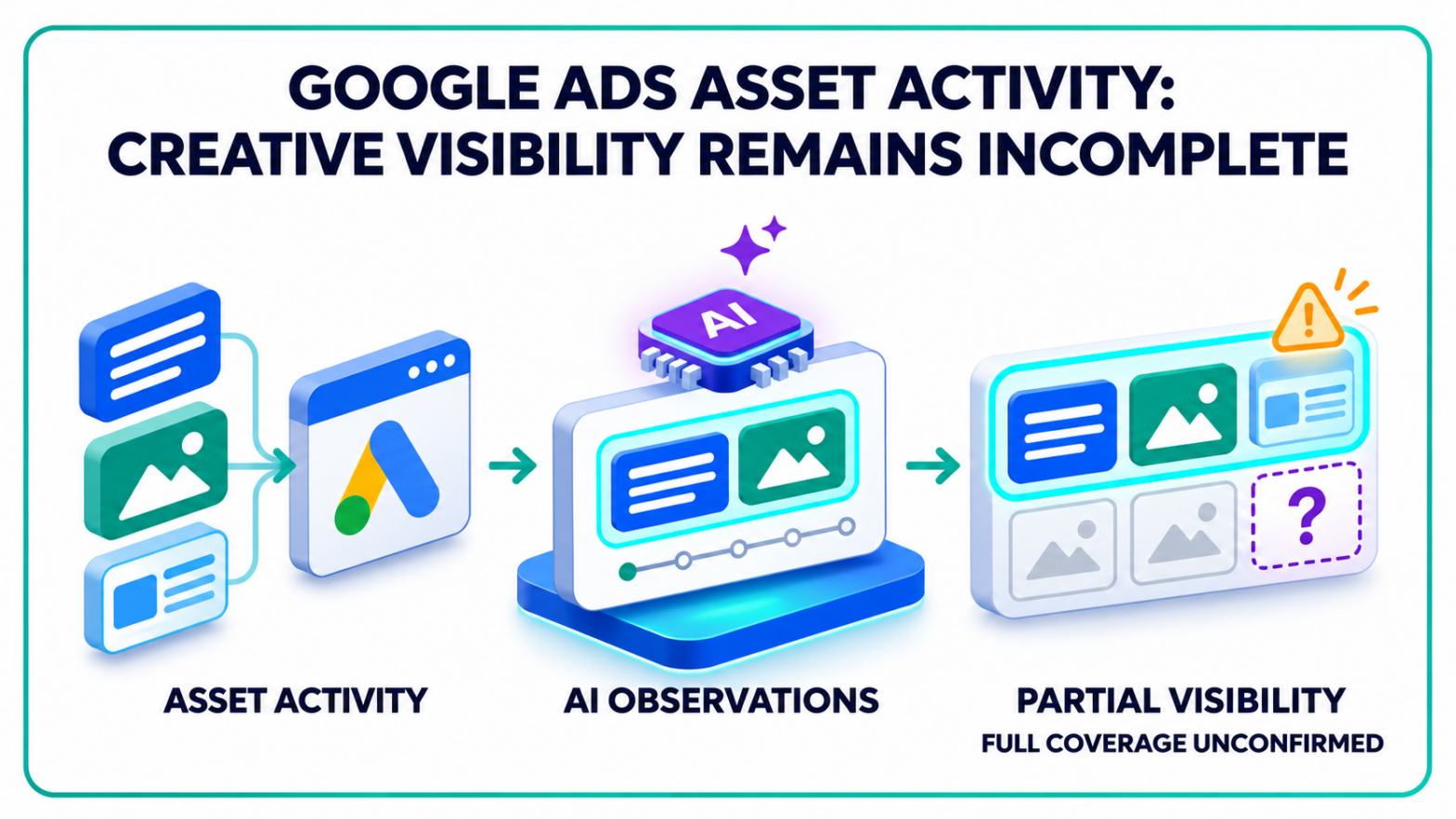
An AI feature called Asset activity has surfaced in Google Ads, but its appearance does not establish that advertisers can inspect every creative asset Google serves. The distinction is central to understanding what the newly observed section adds to existing reporting.
Google Ads practitioner Anthony Higman identified the Asset activity section in a LinkedIn post. He welcomed the AI feature while asking for broader visibility into other served assets, including Google Business Profile photos.
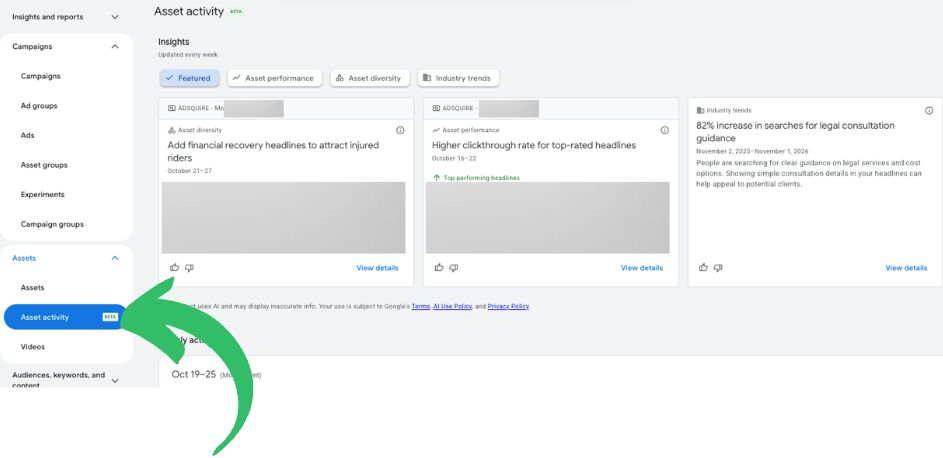
His observation raises a practical question for advertisers: does another AI reporting surface reveal more of what customers actually see, or provide another way to interpret the information already available?
Asset Activity Does Not Establish Complete Creative Coverage
Higman’s post combines approval of the new section with a request for more transparency. Those are separate points.
The appearance of Google Ads Asset activity supports an account-level sighting. It does not, by itself, establish universal availability, supported campaign types or comprehensive coverage of automatically generated and selected creative.
His comments about Google Business Profile photos are also a request for additional visibility, not evidence that the observed feature includes those photos.
For advertisers, the difference is consequential. A system that identifies a promising creative theme answers a different question from a report showing exactly which text, image or combination appeared in an advertisement. Both can support account analysis, but one should not be presented as proof of the other.
Google’s existing documentation provides a firmer basis for understanding the reporting advertisers can already access.
Performance Max Asset Reporting Already Tracks Changes
The Performance Max asset reporting documentation supplied alongside the sighting describes an established reporting system, rather than announcing Asset activity.
Google says advertisers can examine performance at the individual-asset, asset-group and campaign levels, including across several campaigns. Detailed statistics cover advertiser-uploaded assets and assets created through text customization.
The documentation also identifies a Last updated column on the Assets page. It records the most recent date an asset was added, edited, paused or removed at the relevant account or campaign level.
That history provides useful context when campaign results change after a creative refresh. It identifies when the inventory changed, although the timing alone cannot establish that an edit caused a performance difference.
The distinction between observation and proof also runs through Performance Max asset reporting and controlled testing. Reporting describes activity within the combinations Google served. An experiment compares defined alternatives.
Asset-Level Metrics Cannot Isolate a Headline’s Contribution
Google’s asset-level metrics guidance places explicit limits on interpreting individual creative results.
Click-through rate, cost per click, cost per acquisition and return on ad spend are directional measures at the asset level. Google explains that the assets served together influence these ratios, preventing them from accurately describing one component operating alone.
The totals need care too. When one advertisement contains three assets, each can record an impression. Adding asset-level figures therefore may not reproduce the corresponding asset-group totals.
An AI interpretation does not remove those measurement limits.
A favourable observation about a headline can identify something worth investigating. It cannot establish that the headline independently generated a conversion or that replacing another headline will improve acquisition costs. Google recommends evaluating performance at the asset-group or campaign level.
For marketers, the practical implication is to treat creative observations as test hypotheses, check proposed wording against the actual offer and assess results against the campaign’s business objective. A higher click-through rate and a lower cost per qualified lead answer different questions.
AI-Powered Reporting and Creative Testing Serve Different Purposes
Google already documents other tools for interpreting performance and developing creative ideas.
Its Insights page draws on account performance and searches across Google to identify relevant market trends. Google says those insights update daily, although individual insight types depend on campaign eligibility and sufficient data.
Separately, Ask Advisor supports account questions, creative audits and suggestions for headlines and images. Its documented capabilities should not be assumed to describe Asset activity.
These tools sit within a broader expansion of AI-powered reporting, where advertisers increasingly receive interpretations alongside tables of results. The additional interpretation can change where an investigation begins without changing what the underlying evidence proves.
Controlled creative testing addresses a narrower question: how selected alternatives perform against each other. Google’s Performance Max asset A/B testing documentation describes comparisons between two asset sets within the same asset group, with common assets available alongside both.
Google continues to label that experiment capability beta. Its documentation recommends running the comparison for at least four to six weeks, with the estimated duration determined by the selected campaign.