


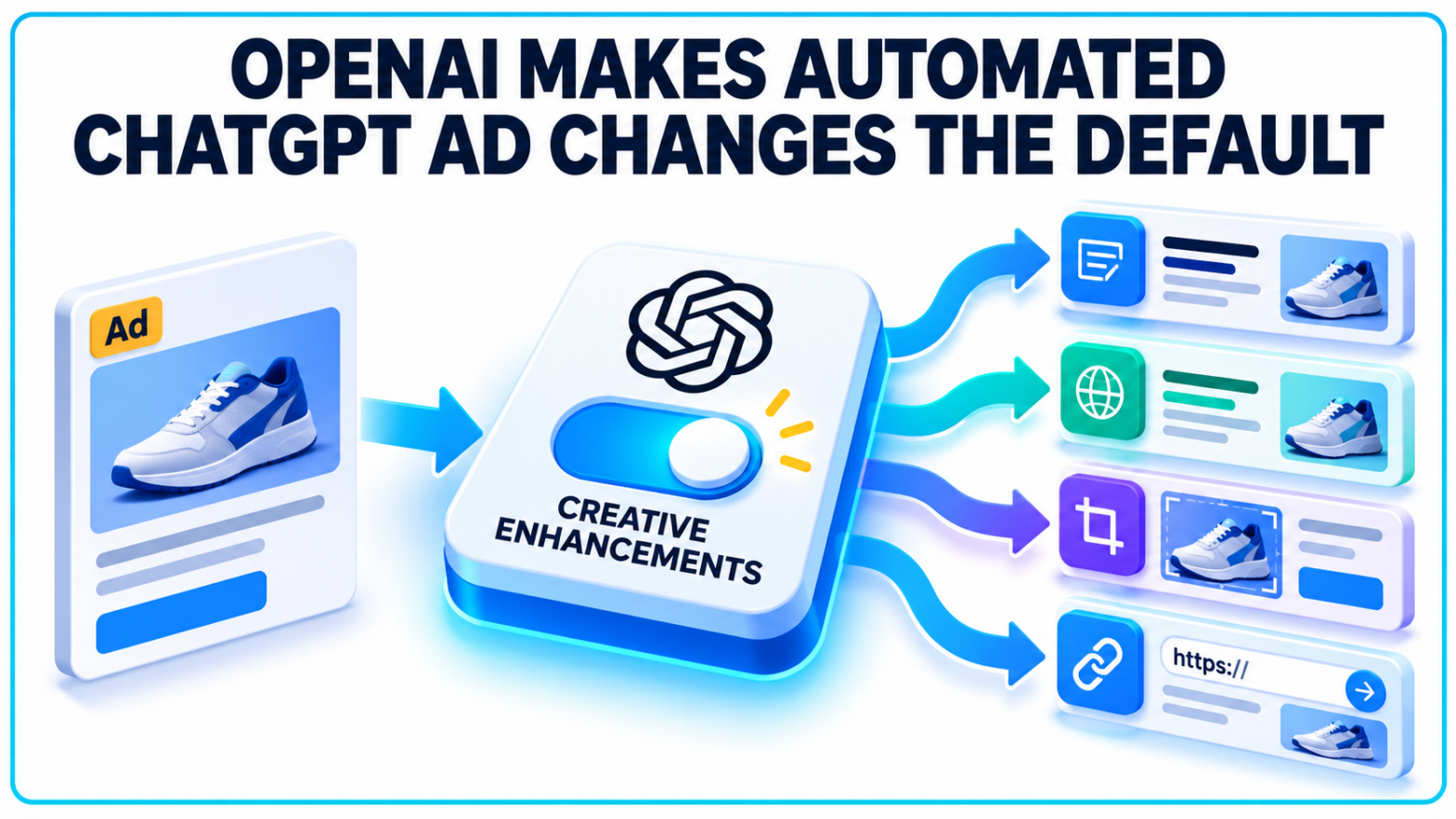
Advertisers are about to surrender some direct control over how their ChatGPT campaigns appear. Beginning October 29, OpenAI will automatically enable creative enhancements that can rewrite copy, translate text, resize images and change destination URLs.
The system can generate variations before an impression or adapt an ad in real time to suit the conversation in which it appears. Those versions may run without individual review or approval.
OpenAI Is Turning Creative Enhancements On Automatically
OpenAI’s creative enhancements use an advertiser’s existing ad, landing-page content and available conversational context to produce a more relevant sponsored message.
The feature will be enabled by default for new and existing campaigns on Thursday, October 29, 2026. Advertisers can opt out before that date or change the setting later through Ads Manager.
Existing account-level and campaign-level opt-outs will remain in place. Campaign-specific settings take priority over the default selected for the wider account, giving advertisers some room to apply different controls across products, markets or campaign types.
The default activation is more consequential than an optional creative tool. Advertisers who take no action may begin serving variations they did not write, translate or preview.
That gives ChatGPT Ads a more automated creative layer at the same time OpenAI is expanding its bidding, targeting and conversion-measurement infrastructure.
Headlines, Descriptions and URLs Can All Change
The enhancements can modify four main parts of an ad.
OpenAI may generate or revise headlines and descriptions to connect the advertiser’s offer with the conversation or a user’s interests. It may translate copy into another language, resize images for the available format or direct the user to a different relevant page on the advertiser’s website.
In OpenAI’s example, a general grocery-delivery headline becomes a message about groceries for quick weeknight dinners when that subject matches the conversation. The offering remains the same, but the framing becomes more specific.
Destination-URL optimization adds another layer. Instead of sending every click to the page originally associated with an ad, the system may select a page it considers more relevant to the user’s interests.
That can shorten the path between an ad and a useful product, category or service page. It also makes the quality and accuracy of the wider website part of the creative system.
OpenAI advises advertisers to keep prices, promotions, product information and availability current across both ads and landing pages. Its advertiser documentation also says OAI-AdsBot must be able to access landing pages so the company can validate them and assess compliance.
The Landing Page Is Now a Creative Input
Landing pages have traditionally been treated as the destination that takes over after an ad receives a click. Under this model, they also help shape what the user sees before clicking.
That raises the stakes for outdated website content.
An expired promotion, discontinued product or vague service description could affect more than the post-click experience. It could become source material for an automatically generated message or influence which destination the system selects.
OpenAI’s ad policies require consistency across ad copy, media and landing pages. Approved creative cannot lead to a destination that introduces prohibited or materially different content. The company reviews these elements as part of the overall advertising experience.
For advertisers working across several countries, translation introduces a similar concern. Automated language changes may help one campaign address more users, but product names, disclaimers, regulated wording and promotional conditions do not always transfer cleanly between markets.
The practical implication for marketers is immediate: creative approval can no longer stop with the uploaded ad. Teams using the feature will need current landing pages, clearly documented offers and a defined process for monitoring live variations. High-risk campaigns may require campaign-level opt-outs even if creative automation remains enabled elsewhere in the account.
Automated Ad Creative Comes Without a Full Preview
OpenAI says advertisers will not be able to preview every enhanced version before it runs.
Some variations may be prepared ahead of time. Others may be generated in real time using the context of a conversation or information about a user’s interests. When creative enhancements are active, both types can serve automatically.
That creates a familiar tension in AI advertising: automation can produce more combinations than a team could reasonably build by hand, but it also reduces direct oversight of each impression.
The risk will not be equal for every advertiser. A retailer with stable product information may have more flexibility than a business operating under strict legal, financial, healthcare or brand-language requirements. Even an accurate variation can become unsuitable if it changes the emphasis of an offer or directs traffic to a page intended for another audience.
Creative teams will also need to consider whether landing-page language is descriptive enough to guide the system. OpenAI recommends clear, specific copy explaining what the advertiser offers and why it may be useful.
Vague source material gives automation less reliable information to work with.
Performance Reports Will Not Isolate the Feature’s Impact
Advertisers can monitor impressions, clicks, spend, click-through rate and attributed conversions at the campaign, ad-group and ad levels. Conversion reporting depends on the advertiser having measurement configured.
Those metrics can show whether performance changes after October 29. They will not, by themselves, prove that creative enhancements caused the difference.
OpenAI explicitly cautions against treating a change over time as evidence of the feature’s effect. Campaign performance can also move because of bids, budgets, targeting, competition, seasonality, website changes or shifts in the conversations where ads become eligible.
A cleaner assessment would require advertisers to control those variables and compare similar campaigns or periods. Even then, the lack of a preview for every variation may make it difficult to connect a particular wording or destination change with the resulting performance.
That limitation matters because automated bidding and conversion optimization are already influencing campaign delivery. Creative, auction and measurement systems can change at the same time, making simple before-and-after comparisons unreliable.
The Ads Remain Separate From ChatGPT’s Answers
Creative enhancements affect sponsored placements, not the answers ChatGPT generates. OpenAI says advertisements remain separate from responses and are clearly labelled.
The distinction remains central as ads become more responsive to conversational context. A headline may be adapted to match the subject a person is discussing, but the advertiser cannot pay to alter ChatGPT’s answer.
OpenAI also gives users controls to dismiss or report ads, see why a placement appeared and manage ad personalization. Turning personalization off does not necessarily remove advertising; ads can still be selected using the context of the current conversation.
For advertisers, the immediate control sits in Ads Manager. Account defaults determine the starting position, campaign settings can override them, and previously recorded opt-outs will remain intact when automatic activation begins on October 29.