Six months ago, buying an ad inside ChatGPT was mostly an experiment.
Now OpenAI is building the controls required to answer a harder question: did the ad actually produce a business result?
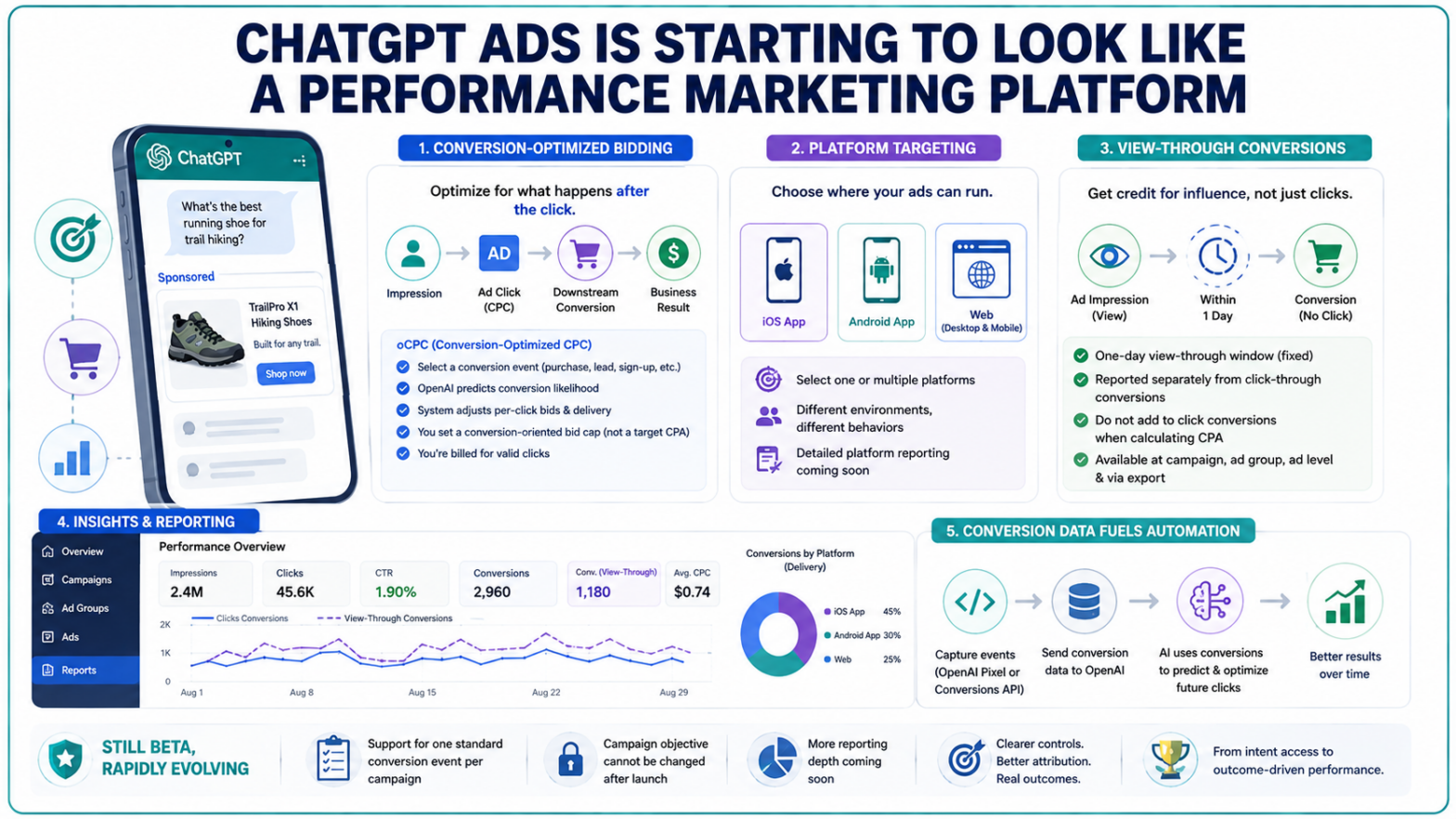
ChatGPT Ads is adding deeper automated bidding, platform-level targeting and one-day view-through conversion reporting as OpenAI continues expanding its advertising infrastructure. Advertisers can optimize campaigns around downstream conversion events, control whether ads run on iOS, Android or the web, and see conversions that happened after an impression without a qualifying click.
Taken together, the additions push ChatGPT advertising further away from novelty media and closer to the operating model performance marketers already use across mature paid platforms.
There is one important distinction. OpenAI currently describes its conversion-focused buying option as conversion-optimized cost per click, or oCPC, rather than a traditional target CPA strategy. Advertisers are still billed for valid clicks.
ChatGPT Ads Can Now Optimize Past the Click
OpenAI's earliest advertising products were built around familiar media outcomes: impressions and clicks.
That is changing.
Advertisers can now create campaigns with a Conversions objective and select a specific downstream event, such as a purchase, lead submission or sign-up. OpenAI then uses predicted conversion likelihood to influence the per-click auction bid and delivery of the campaign.
The underlying billing model remains CPC.
That matters because conversion optimization and paying per conversion are not the same thing. OpenAI explicitly says advertisers using oCPC are charged for valid clicks, while the system attempts to find clicks that are more likely to produce the selected conversion event.
Advertisers also set a conversion-oriented bid cap at the ad-group level. That cap feeds into OpenAI's bidding system, but it is neither a guaranteed CPA nor the amount ultimately charged for a completed conversion.
For teams that first encountered ChatGPT Ads as a CPC experiment, that is a meaningful shift.
The platform is beginning to optimize for what happens after somebody leaves ChatGPT.
Platform Targeting Separates Web, iOS and Android Inventory
OpenAI is also giving advertisers more control over where a campaign can appear.
Campaign setup now includes optional platform targeting across the iOS app, Android app and web. Web covers both desktop and mobile browsers. Advertisers can select one or multiple supported platforms when building a campaign.
That sounds like a small campaign-setting change. For performance teams, it creates a useful segmentation layer.
A user researching a product on desktop may behave differently from someone encountering the same advertiser while using ChatGPT on a phone. Checkout experience, form completion, app-to-browser transitions and landing-page design can all create meaningful performance differences across devices.
Advertisers previously had fewer ways to isolate those environments.
OpenAI's reporting still has some catching up to do. Its documentation says Insights currently groups device reporting into Mobile and Desktop, with mobile web counted under Mobile. More detailed platform reporting is planned.
So advertisers can control delivery at a more granular platform level than they can currently analyze it in every report.
That mismatch is likely temporary, but it illustrates where the product stands: the buying controls are developing quickly while the reporting layer continues to fill in behind them.
View-Through Conversions Expand What Gets Credit
Clicks are no longer the only conversion path visible inside Ads Manager.
OpenAI has added one-day view-through conversion reporting for eligible accounts. A view-through conversion is recorded when someone sees an eligible ChatGPT ad and converts within one day without a qualifying ad click receiving credit.
If both an impression and an eligible click qualify for the same conversion, the click receives attribution.
OpenAI reports view-through conversions separately from its primary Conversions metric. The company specifically advises that view-through conversions should not simply be added to click-through conversions when calculating core metrics such as CPA.
That separation is important.
Introducing impression-based attribution can make an advertising channel appear to generate more outcomes even when click-driven performance has not changed. Paid media teams evaluating conversion optimization will need to distinguish between conversions OpenAI associates with an actual ad click and conversions that followed exposure alone.
The reporting is available at campaign, ad-group and ad levels and can also be exported in CSV files. OpenAI currently fixes the view-through window at one day.
That gives advertisers another attribution signal without quietly folding it into the headline conversion number.
Conversion Data Is Becoming Fuel for Automated Bidding
Automated bidding only becomes useful when the platform has enough reliable outcome data to optimize against.
OpenAI is building that plumbing at the same time.
Its conversion measurement system can receive events through the OpenAI Pixel, the Conversions API or both. Those events can represent actions such as purchases, registrations or lead submissions and can then be connected back to eligible ad interactions.
For an oCPC campaign, at least one supported standard conversion event must already be available. Each campaign optimizes toward one selected event, and that event cannot currently be changed after the campaign is created. Existing CPM or CPC campaigns also cannot simply be converted into oCPC campaigns. Advertisers must create a new campaign.
Those limitations reinforce that the product remains in beta.
They also reveal how OpenAI sees the direction of its ad business.
The company is no longer treating conversion reporting merely as a dashboard feature. Conversion signals are becoming an input into campaign delivery itself.
That follows the trajectory TechWyse has been tracking since OpenAI launched its self-serve Ads Manager with CPC buying and conversion measurement in May.
First came access. Then measurement. Now the measurement system is beginning to steer the auction.
The Bigger Shift Is From Intent Access to Outcome Buying
ChatGPT already offered advertisers something unusual: access to conversational context while a user is researching, comparing or deciding.
OpenAI's advertising system considers the context and intent of the current conversation, along with signals such as the ad's landing page, copy, advertiser-supplied context hints and targeting selections. When ad personalization is enabled, additional permitted ChatGPT signals can also contribute to relevance.
That contextual inventory was enough to make AI advertising interesting.
It was not enough by itself to make it operationally comparable with established performance channels.
Media buyers need bidding strategies, conversion signals, attribution, segmentation and controls that allow campaigns to be managed against business outcomes rather than curiosity metrics. OpenAI is now assembling those layers surprisingly quickly.
For marketers, the practical implication is that ChatGPT campaigns can increasingly be evaluated using familiar performance disciplines. Conversion tracking needs to be reliable before automated optimization is trusted, platform splits can expose differences in user behaviour, and view-through results need to remain separate from click-based CPA analysis.
The platform is still missing some of the depth advertisers take for granted elsewhere. OpenAI labels Ads Manager a beta product, detailed platform reporting remains limited, conversion-optimized campaigns support only one selected standard conversion event, and campaign objectives cannot be changed after launch.
But the pace is difficult to miss.
OpenAI launched CPC bidding and self-service buying in May. It has since added custom audiences, broader geographic availability and deeper conversion measurement, while its August expansion brought ChatGPT Ads into 31 European markets. OpenAI says tens of thousands of marketers have already advertised through the platform.
The latest bidding and targeting controls make the direction clearer. ChatGPT Ads is still an emerging channel, but OpenAI is now building it around the same question that governs established performance media: not simply who saw the ad, but what happened after they did.