
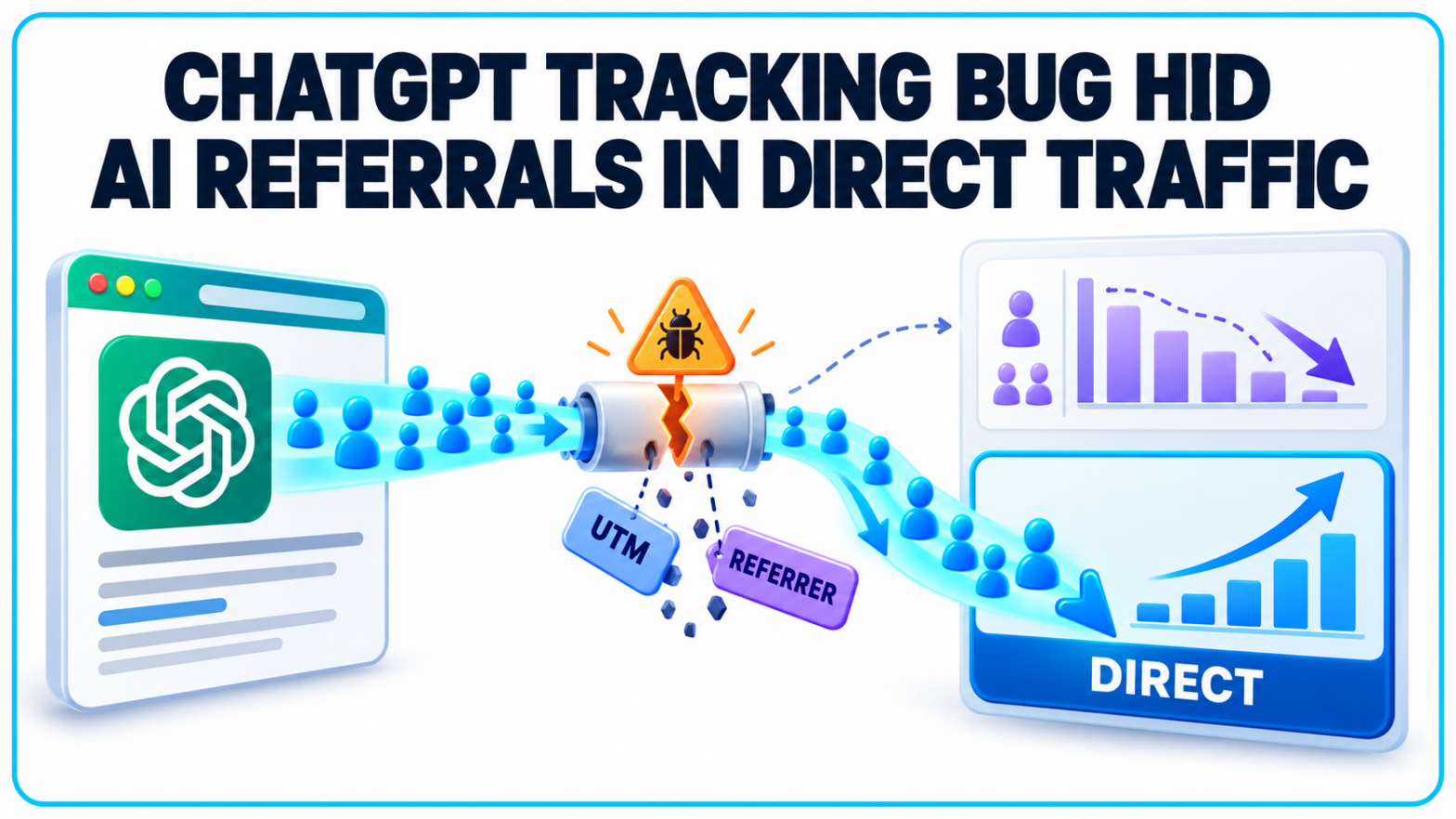
ChatGPT did not suddenly stop sending visitors to websites this week. A tracking bug temporarily removed the signals that told analytics platforms where many of those visits came from.
The issue has now been fixed, according to analyst Cedric Huesler, who documented the traffic shift and updated his findings on October 15. The short-lived failure offers a sharper warning for marketers: AI referral numbers can collapse even when user behaviour has barely changed.
The Traffic Drop Was an Attribution Failure
Huesler first reported a steep decline in tracked ChatGPT visits between October 9 and 13. The timing overlapped with the rollout of GPT-6 across more ChatGPT responses, prompting concern that the new model had reduced outbound traffic.
The data suggested a different explanation.
Huesler examined roughly 500 pages where ChatGPT had previously generated more than 5% of visits. Compared with the preceding week, identifiable ChatGPT traffic fell by approximately 31,000 visits per day. Direct traffic to the same pages increased by roughly 26,000 visits per day.
Organic search traffic declined by 7%, but Huesler noted that the movement was consistent with the broader search trend rather than being concentrated on the affected pages.
Direct traffic also increased on two-thirds of pages that lost measurable ChatGPT visits. During the previous week, that relationship had appeared on only about half of comparable pages.
The simplest reading was not that the audience had disappeared. Much of the traffic had lost its source label.
Huesler’s updated analysis now marks the incident as resolved.
“It was a bug. OpenAI confirmed it on Oct 14, and the fix rolled out overnight.”
He reported that ChatGPT links were once again carrying utm_source=chatgpt.com and that tagged visits had returned to normal levels.
Missing UTM and Referrer Signals Changed the Channel
The tracking failure involved two separate attribution signals.
First, affected outbound URLs no longer included the utm_source=chatgpt.com parameter. UTM parameters are query-string labels that analytics platforms can use to identify the source, medium or campaign associated with a visit.
Second, Huesler observed ChatGPT opening links with noopener,noreferrer. The noreferrer instruction prevents the browser from sending the referring page’s address to the destination website.
Losing one signal can make attribution less reliable. Losing both leaves analytics platforms with little evidence that the session originated in ChatGPT.
When neither a UTM source nor a usable referrer is present, tools such as Google Analytics commonly classify the visit as Direct. That category does not prove a user typed the address into a browser or opened a bookmark. It often functions as a holding area for sessions whose origin cannot be determined.
The bug therefore changed the reported channel without necessarily changing the visit itself.
A person could still select the same ChatGPT citation, reach the same deep landing page and complete the same actions. The session would simply appear under Direct rather than an AI or referral category.
A Narrow Dataset Still Revealed a Strong Pattern
Huesler’s findings should not be treated as a complete measurement of all ChatGPT traffic.
The analysis covered four days of sampled data and focused on pages where ChatGPT already represented a meaningful share of visits. That selection made the attribution shift easier to detect but limits how broadly the figures can be applied.
The behavioural evidence nevertheless supported the misclassification explanation.
Among mobile Direct visitors to the affected pages, the share encountering a consent banner as a new visitor increased from 36% to 44%. ChatGPT-referred visitors had previously recorded a 55% rate on the same measure.
The post also noted that newly classified Direct visitors behaved more like the earlier ChatGPT audience than the site’s usual Direct audience. Combined with the near-offsetting traffic volumes, the pattern pointed to hidden referrals rather than a broad loss of demand.
The episode exposes a persistent weakness in ChatGPT referral traffic reporting. Analytics platforms can count only the AI visits that arrive with recognizable evidence. A source parameter, referrer header or another explicit signal has to survive the handoff from the assistant to the website.
When that handoff breaks, the traffic does not become invisible. It becomes incorrectly labelled.
The Fix Restores Reporting, Not Full Journey Visibility
OpenAI’s current ChatGPT Search documentation confirms that web-enabled responses can include citations and source links. Users can select those citations to open the underlying publisher or website.
Direct clicks are only one part of the journey.
A user may see a company recommended in ChatGPT, close the conversation and search for the brand later. Another may return through an untagged mobile app, forward a source link or revisit the website from browser history. None of those paths is guaranteed to retain the original AI touchpoint.
TechWyse has previously examined this broader AI traffic attribution problem. Research showing ChatGPT recommendations followed by branded searches illustrates how an AI platform can influence a visit without receiving credit in the final acquisition report.
The restored source tag improves measurement for direct outbound clicks. It does not capture every user influenced by a ChatGPT answer.
Google’s GA4 AI Assistant channel has made recognizable chatbot visits easier to separate from generic referrals. That classification still depends on the analytics system receiving enough information to identify the originating assistant.
No classification rule can recover a signal that never reaches the website.
Marketers Need to Preserve the Broken Week in Their Data
For marketers and analytics teams, the immediate work is limited. Reports covering October 8 to 15 should be annotated to identify the temporary tracking disruption. Teams can compare Direct and ChatGPT sessions on historically strong AI landing pages, but the two categories should not be permanently merged or retroactively rewritten without supporting evidence.
Year-over-year, week-over-week and campaign reports may otherwise show an artificial decline in AI referrals followed by a sudden recovery. Dashboards, automated alerts and executive summaries using that period will need the same context.
The incident also demonstrates why individual channel totals should be checked against landing-page patterns and overall traffic. A sharp fall in one source accompanied by a similar increase in Direct on the same URLs is often a measurement clue before it is a demand signal.
Huesler reported that tagged ChatGPT visits had returned to their previous range on October 15. OpenAI has not published a public incident report detailing the bug’s precise technical cause or the full set of interfaces and users affected.