

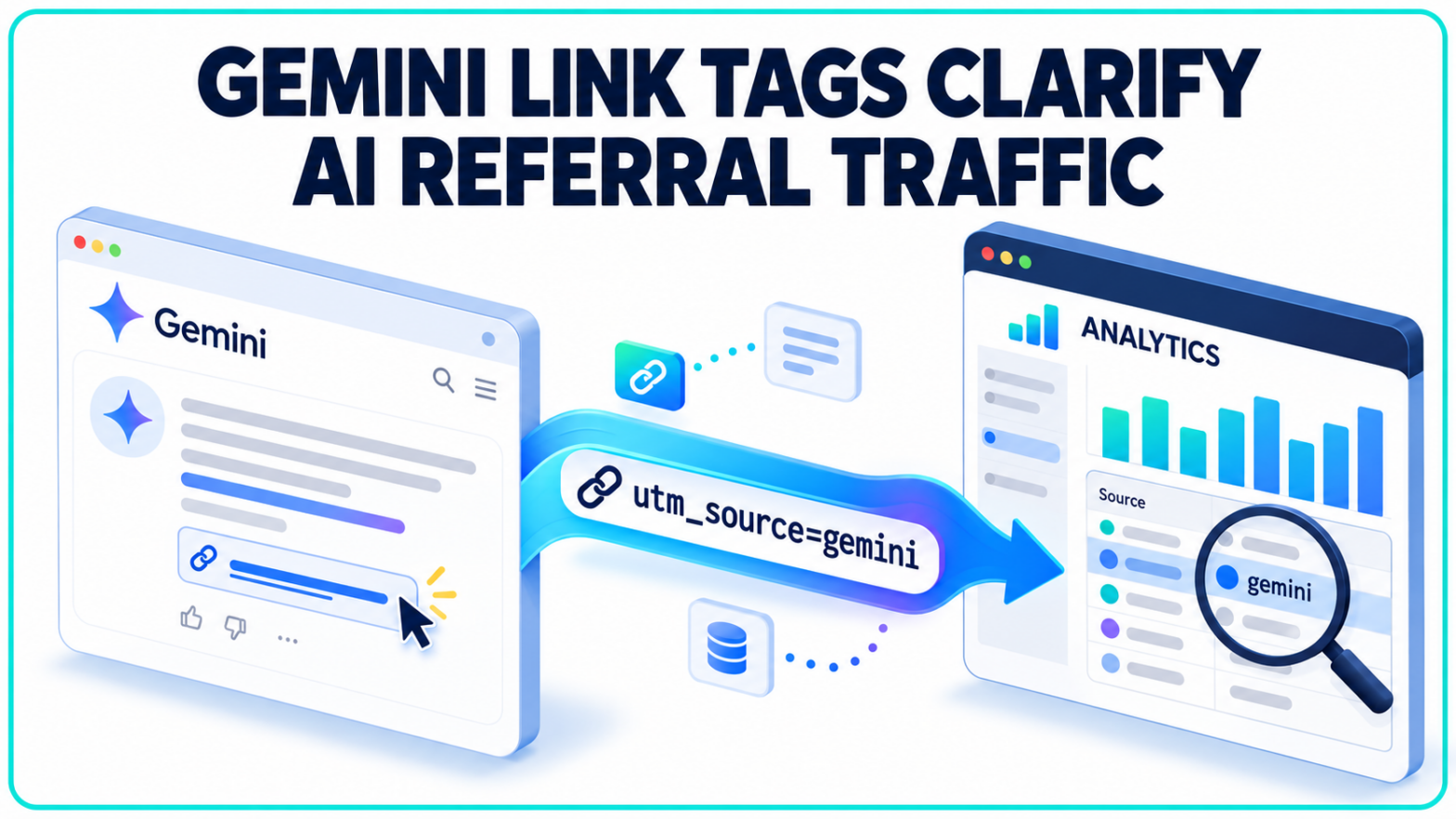
Some Gemini visits are getting a clearer label before they reach a website. Outbound links have been observed carrying utm_source=gemini, adding source information that analytics tools can read from the destination URL.
For publishers and marketing teams, the change offers another way to identify chatbot visits when referral information is incomplete. It does not make Gemini traffic measurable for the first time, or establish that every outbound click now carries the tag.
The reporting question is narrower: how much traffic can websites now identify that previously arrived without enough source information?
Gemini UTM Tags Add Evidence to the Click
In the original public discussion, a Gemini user described seeing the parameter when requesting source links. Google’s John Mueller confirmed that he could see the tagging too:
“Nice. I see it too. Doesn't Gemini have a referrer too though? I thought you could already track them.”
His response establishes an observed change, rather than a published specification covering every Gemini interface.
UTM parameters are labels attached to a URL. Google’s campaign URL documentation explains that Analytics receives those values when a visitor follows a tagged link and makes them available in acquisition reporting.
Here, the reported value identifies Gemini as the source. That is separate from a browser passing the address of the referring page. The URL carries its own source label, providing an additional input for measurement.
A source tag alone does not describe the prompt, the surrounding answer or the reason Gemini selected the destination.
Additional info that another user provided:
Comment
by u/Funny-Temporary-1578 from discussion
in SEO
Google Analytics Already Had an AI Assistant Channel
Google introduced native AI Assistant traffic measurement on May 13, 2026. The release included Gemini alongside other assistants and described automatic classification when Analytics recognizes the referrer.
Under that system, the medium becomes ai-assistant, the campaign receives the value (ai-assistant), and the traffic appears in the AI Assistant channel.
The new link tagging therefore complements an existing measurement route. Websites receiving usable Gemini referrer data already had a basis for identifying those visits in Google Analytics. Missing referral information remains a separate collection problem.
There is also a boundary between Google's products. Its default channel definitions place Gemini in AI Assistant but exclude AI Overviews and AI Mode. Non-ad traffic from those Search experiences belongs to Organic Search.
Combining those categories into one Gemini total would mix different sources. The UTM observation concerns Gemini links; it does not establish a matching tagging change across Google Search.
A Source Label Does Not Guarantee a Channel Label
Identifying where a visit came from and assigning it to a channel are related operations, but they are not interchangeable.
Google’s default channel rules specify an exact ai-assistant medium for the AI Assistant category. A URL containing only utm_source=gemini does not, by itself, demonstrate that this medium was also supplied or assigned.
That makes the source and medium fields relevant even when the channel report looks unchanged. Google uses Unassigned when the available event data matches no channel rule.
Its traffic-source documentation maps UTM values to manual dimensions, including Session manual source and Session manual medium. It also warns that missing UTM parameters can leave reporting values unset.
The observed source tag should therefore be treated as evidence to inspect, rather than a promise of one universal source/medium combination. Neither the Reddit discussion nor Gemini’s public release notes provide a complete parameter specification for the change.
That distinction prevents a reporting error: assuming all tagged Gemini visits must appear in one channel, then overlooking records that carry the source elsewhere.
Better AI Referral Traffic Counts Can Change the Baseline
A rise in identified AI referral traffic after a tagging change would not, on its own, prove that Gemini sent more visitors. As a measurement inference, some of the increase could reflect visits becoming easier to classify.
Direct traffic is not a reliable inventory of missing Gemini sessions. Google’s tagging troubleshooting guidance describes several configuration problems that can increase Direct traffic, leave values unset or prevent channel assignment. The total cannot simply be reassigned to an AI assistant.
The destination site's implementation still matters. Google warns that firing events before the appropriate configuration can disrupt user and session identification. Adding information to an inbound URL does not repair those collection problems.
For marketers, the practical work is to compare source, medium and channel data around the first observed tagged visits, confirm that incoming parameters reach measurement, and assess engagement or business outcomes for the identifiable sessions. Recording that measurement change alongside performance reports helps distinguish improved attribution from a change in demand.
AI Search Visibility Still Extends Beyond Tagged Visits
Google’s Manual report provides session-level dimensions populated from successfully received UTM parameters. Its metrics include sessions, engaged sessions and event counts, allowing teams to examine what identifiable visitors do after arrival.
Those measurements concern website activity. A tagged visit does not count every Gemini answer that mentioned a business, every citation a user saw, or every answer that ended without a click. Referral reporting and AI search visibility answer different questions.
Google also notes that UTM parameters are omitted from the Landing page + query string and Page path + query string dimensions. They are instead captured in Page location, a useful distinction when checking whether a tag reached Analytics.
The remaining product uncertainty is coverage. The Gemini release notes reviewed for this article do not describe the UTM implementation or establish which interfaces and link types receive it.
In the public discussion, Mueller asked for reproducible examples of missing referrer information that he could forward to the team. His request addressed retaining referrers alongside UTM tagging, leaving the two mechanisms as complementary sources of attribution data.