
A sudden disappearance of source links from Google AI Mode looked like another blow to publisher traffic.
It wasn't supposed to happen.
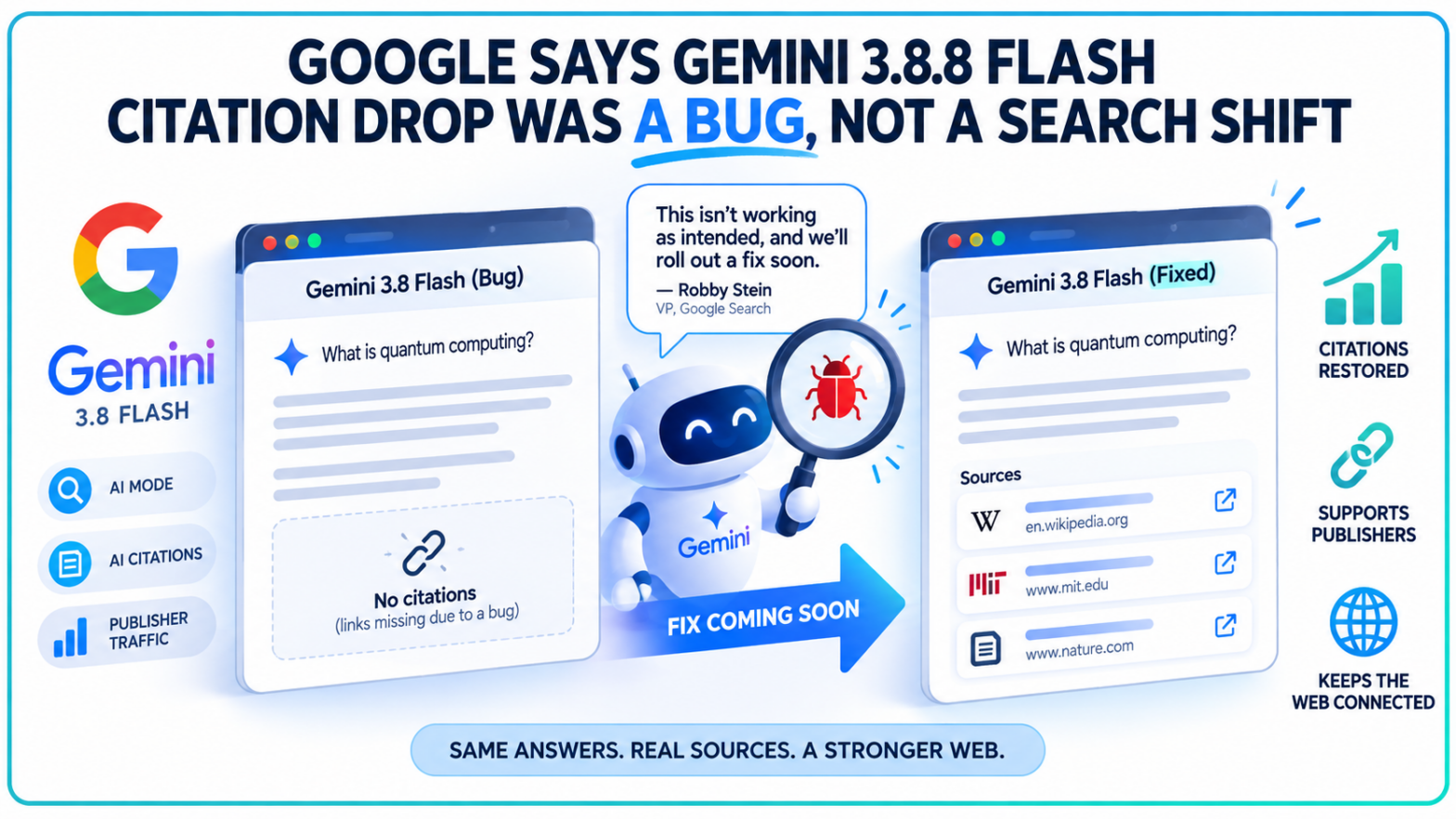
Google has confirmed that Gemini 3.8 Flash was incorrectly dropping citations and web links from some AI Mode responses, turning what initially appeared to be a product-level shift in Google's linking behaviour into a temporary technical problem.
Robby Stein, Vice President of Product at Google Search, acknowledged the issue after search industry observers documented stark differences between Gemini 3.8 Flash and Google's default AI Mode model.
“Hey — thanks for flagging. This isn’t working as intended, and we’ll roll out a fix soon”
- Stein said.
For publishers, SEOs and brands tracking traffic from AI search, that distinction matters. A citation decline caused by a model regression tells a very different story from Google deliberately making AI Mode less likely to send users back to the web.
testing new Gemini 3.8 Flash in AI Mode right now
— Gagan Ghotra (@gaganghotra_) September 2, 2026
for a lot of TOFU level queries it's not showing any citation ...
concerning #SEO!!! pic.twitter.com/MTYALsrBg6
Whoa, Gagan is right. See below between default model and 3.8 Flash. What is going on here? First is 3.8 Flash and second is default model. @rmstein @rajanpatel https://t.co/EH958CMDOn pic.twitter.com/VIY201Mbva
— Glenn Gabe (@glenngabe) September 3, 2026
Gemini 3.8 Flash Was Answering Without Showing Its Work
The problem surfaced almost immediately after Gemini 3.8 Flash began appearing inside AI Mode for Google AI Pro and Ultra subscribers.
Search professionals testing the model found that broad informational queries could produce detailed answers with few or no visible sources. Gagan Ghotra documented several examples, while Glenn Gabe compared 3.8 Flash with Google's default model and found that the citation behaviour changed when the newer model was selected.
The responses themselves were not necessarily empty or broken. The missing layer was the path back to the web.
That is significant because source links are one of the mechanisms Google uses to connect generative answers with publishers, businesses and other websites supplying information behind those answers.
Google has spent much of 2026 expanding the role of links inside its AI-generated search experiences. Earlier changes added new link treatments and source previews to AI Overviews and AI Mode, part of Google's effort to make it easier for users to continue from an AI answer into the wider web.
The Gemini 3.8 Flash behaviour cut against that direction.
Google's response now makes clear that the change was not intentional.
A Traffic Drop Can Look Like an SEO Problem When the Interface Is Broken
The timing made the bug particularly difficult for marketers to interpret.
Google has only recently begun giving site owners clearer first-party reporting for generative search visibility. Its dedicated Search Console AI reports now separate impressions generated through AI Overviews and AI Mode from conventional search exposure, giving SEOs a better view of where pages surface inside generative results.
That reporting is useful, but attribution remains incomplete.
A site can appear in an AI response without receiving a visit. Conversely, removing a citation from the interface can eliminate an opportunity for referral traffic even if Google's underlying systems still retrieve or use the same page.
For teams monitoring Google AI Mode performance, a sudden drop in clicks or visible citations after the Gemini 3.8 Flash rollout could therefore resemble a loss of organic visibility.
The cause may have been much simpler: the link was not being rendered as intended.
That makes short-term comparisons around the rollout unusually noisy. Referral traffic, citation tracking and manually sampled AI Mode responses can all be affected when the product's presentation layer changes unexpectedly.
Google Has Been Moving Toward More, Not Fewer, AI Citations
The bug also landed in the middle of a larger debate over how much traffic Google's generative search products return to publishers.
Google's position has consistently been that AI-powered Search should still connect users with the open web. The company has added more source treatments to generative results and has continued developing ways for users to inspect the information supporting an AI response.
Google CEO Sundar Pichai has previously pointed to the addition of more links as part of the company's response to publisher concerns around AI search.
That context makes the disappearance of AI citations under Gemini 3.8 Flash especially noticeable.
If Google had intentionally reduced source links, it would have represented a meaningful departure from its recent product direction. Stein's acknowledgement removes that interpretation, at least for the behaviour documented during this rollout.
There is no indication from Google that citations are being removed from AI Mode as a broader policy or design decision.
The company has also not published a detailed technical explanation for what caused the regression.
Gemini Model Updates Are Now Search Updates
The episode shows how quickly a model change can alter what publishers see on the search results page.
Gemini is no longer operating only behind a standalone chatbot. New models are being integrated directly into Search, where differences in retrieval, answer generation and interface behaviour can affect visibility for websites almost immediately.
Gemini 3.8 Flash arrived in AI Mode as part of that deeper integration.
A model regression can therefore resemble an algorithm update from the outside. Rankings do not necessarily have to change for traffic patterns to move. If the same answer suddenly contains fewer links, the commercial effect for a publisher can still be measurable.
That creates another variable for SEO diagnostics.
When traffic changes coincide with a major AI Mode model rollout, teams increasingly need to distinguish between changes in ranking, changes in citation selection and changes in how Google's interface presents those citations.
Those are three different failure points.
Marketers Should Treat the Affected Data as an Anomaly
For marketers and SEOs, the practical implication is narrow but important: citation and referral data collected during the affected Gemini 3.8 Flash rollout should not automatically be treated as evidence that a site's AI search visibility deteriorated.
Teams investigating a sudden decline in AI referral traffic should compare the timing against the model rollout, Search Console AI impressions, conventional organic performance and direct AI Mode testing before making content or technical changes.
A page that stopped receiving citations during the bug window may not have lost relevance or authority. The citation itself may simply have failed to appear.
Google has not provided a specific deployment date for the fix beyond Stein's statement that it will roll out soon.
Until that correction is confirmed, Gemini 3.8 Flash citation data remains a shaky baseline for judging longer-term AI search performance.
The larger question around how much traffic AI Mode will send publishers is still unresolved.
This particular drop, however, has an explanation: Google says the links were supposed to be there.