

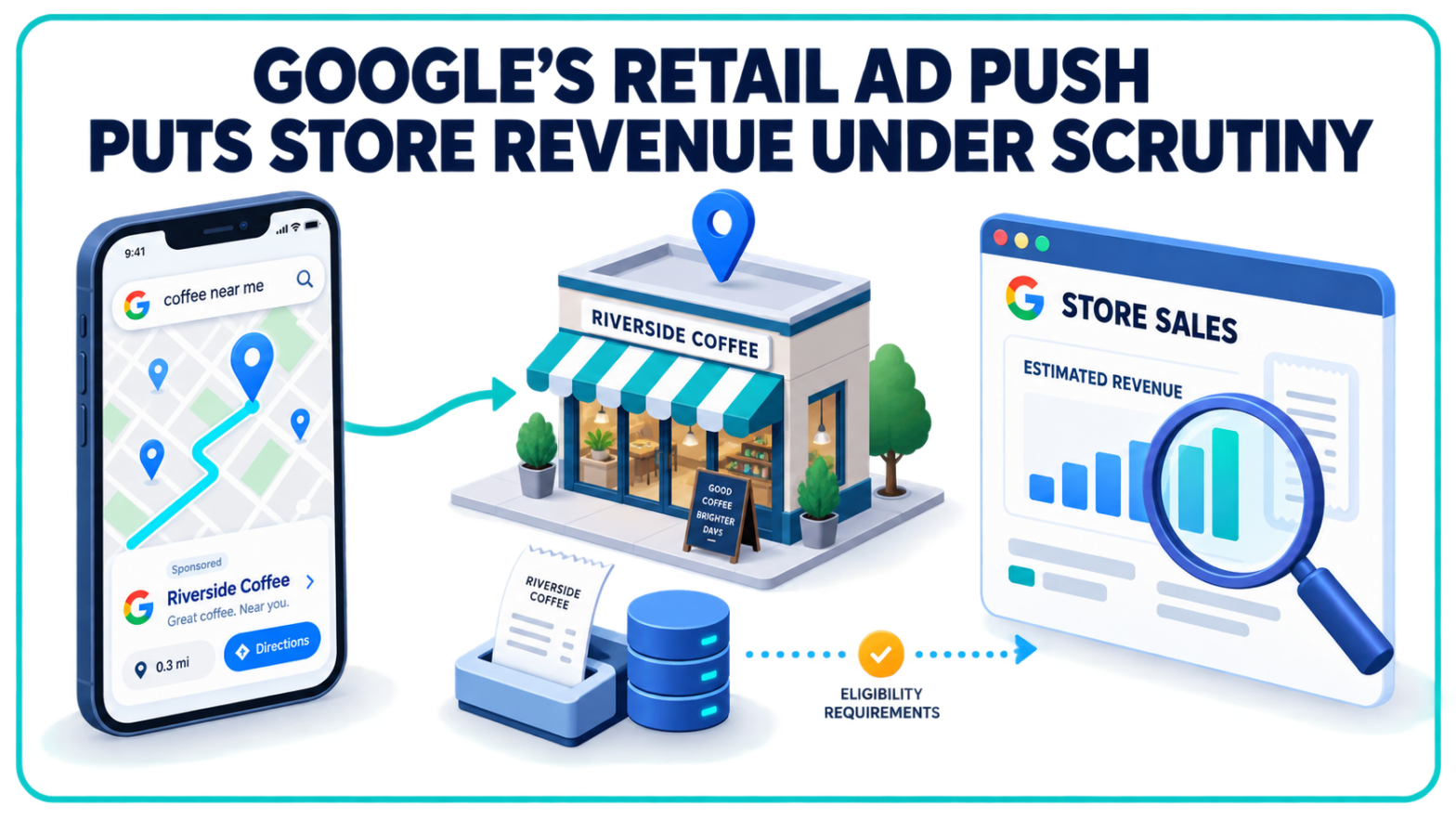
A directions request is not a sale. Google’s latest retail advertising changes address both sides of that gap: finding people likely to act locally and bringing in-store transaction data into campaign measurement.
Local Customer Optimization prioritizes local intent in eligible campaigns. A separate Store Sales integration announcement describes Google Ads Data Manager connections to sales records held in systems such as a CRM or Google Sheets.
For retailers preparing holiday campaigns, the consequential question is which parts of that connection their accounts can support. The targeting feature has campaign restrictions. Sales measurement has separate approval and data requirements, including thresholds that put it beyond many smaller businesses.
Store Sales Measurement Has a High Entry Threshold
The first constraint arrives before a retailer connects its transaction records.
Google requires accounts to be allowlisted for store sales measurement. Its published requirements for counts and default-value reporting include approximately 300,000 store visits and more than 500,000 account-level ad interactions over the preceding 90 days. Store visit reporting must also be based on the appropriate location assets, according to its store sales eligibility documentation.
Uploading first-party transactions for manual dynamic values adds another requirement: at least 30,000 transactions within 90 days, with regular uploads of more than 10,000 new transactions from the past 30 days. Google recommends daily uploads, or at least weekly.
Retail, restaurants, automotive manufacturers and telecommunications are among the supported verticals. Access to particular value models varies by market and advertiser.
A simpler connection cannot remove those conditions. For a small shop, having sales records in a spreadsheet does not establish eligibility. For an approved chain already meeting the thresholds, the operational question is how consistently those records reach the advertising account.
Local Customer Optimization Requires an Offline Campaign
The targeting change has a different boundary.
Local Customer Optimization applies to Performance Max campaigns for store goals. Google describes an audience that is nearby or interested in the business area and showing intent to visit or make contact, including people navigating, planning trips or searching for locations.
Physical proximity is therefore only part of the definition. Someone researching a destination can also fit the stated use case.
Google’s feature documentation excludes campaigns with online goals and campaigns advertising Merchant Center products. Retailers cannot simply activate it inside an existing product-feed campaign and retain that configuration.
Eligible goals include store visits, store sales, Google-hosted contacts and directions. The setting can be enabled during campaign creation or through budget and bidding settings in an eligible existing campaign. Adding an online goal requires turning it off.
The implication for an omnichannel account is structural: its store-focused activity needs a compatible campaign, even when the business measures online and offline revenue together elsewhere.
Maps and Waze Reach Customers During the Journey
Local advertising can reach a consumer before they arrive at a business, while the destination is still being chosen.
Google’s Performance Max store-goals guide describes Maps placements including promoted pins, search ads, suggestions and place-sheet ads. Search activity and interest in an area help connect those placements with business locations.
On Waze, a promoted place appears as a branded square pin along a driving route. Tapping it reveals business information and directions. Canada is among the markets Google lists for Waze availability through eligible store-goals campaigns.
Those placements put an advertiser closer to a route or destination decision. They do not establish that a person subsequently entered the store or made a purchase.
Store-goals campaigns use advertiser-supplied locations, budgets and creative assets, with Google’s systems optimizing bids and placements. Google also states that advertisers cannot serve exclusively on Maps. The local setting should not be read as a promise of complete control over an individual channel.
Google Ads Data Manager Changes the Upload Work
The Store Sales integration addresses the movement of transaction records into the account. That is distinct from the measurement model that uses them.
Google Ads Data Manager sits within a broader set of options for supplying first-party data. Google’s existing store sales upload guidance already supports manual files, scheduled Google Sheets uploads, API connections and approved partners. Store sales data imports themselves are not new.
The announced CRM and spreadsheet connection focuses on reducing the work needed to maintain that flow. It does not eliminate the need to prepare usable transaction records.
Google’s data formatting instructions require a conversion name, time, value and currency, together with an eligible customer identifier. Customer names, email addresses and phone numbers require hashing; Google Ads can perform the required hashing during supported uploads.
For a retailer with fragmented sales records, the connector and the source data solve different problems. Automating delivery can keep a valid dataset current. Missing identifiers or incorrectly formatted transaction values still need correction at the source.
Performance Max Reporting Still Uses Estimated Sales
The revenue figure deserves its own scrutiny.
Google describes store sales measurement as an estimate of in-store transaction counts and value associated with advertising. Its models draw on signals including ad interactions, store visits, surveys and, where available, transaction uploads or other supported data sources. Reporting is aggregated.
Default values apply a static average order value to estimated transaction counts. Dynamic values use additional data to reflect sales value more closely. Neither description amounts to a receipt-by-receipt account of every purchase caused by an ad.
The distinction carries into bidding. Eligible advertisers can use store sales counts and values in Smart Bidding, so offline data can affect auction decisions as well as reported results.
In practice, teams assessing Performance Max reporting distinguish directions, visits and revenue, and record when measurement inputs change. A rise in reported conversion value after adding offline sales can reflect broader measurement coverage; by itself, it does not demonstrate an increase in total business revenue.
An account using default store sales values still calculates revenue from a fixed average order value. Connecting transaction data supports a different value model only when the advertiser qualifies and supplies the required records.