
Performance Max has always been good at finding conversions. The problem for local businesses was that Google's idea of a valuable conversion did not necessarily match theirs.
A form submission from anywhere in the target area could compete with a customer ready to visit a nearby store. An online sale could carry more weight than a directions request. For businesses whose revenue depends on geography, that distinction is not small.
Google is now giving those advertisers a more direct lever.
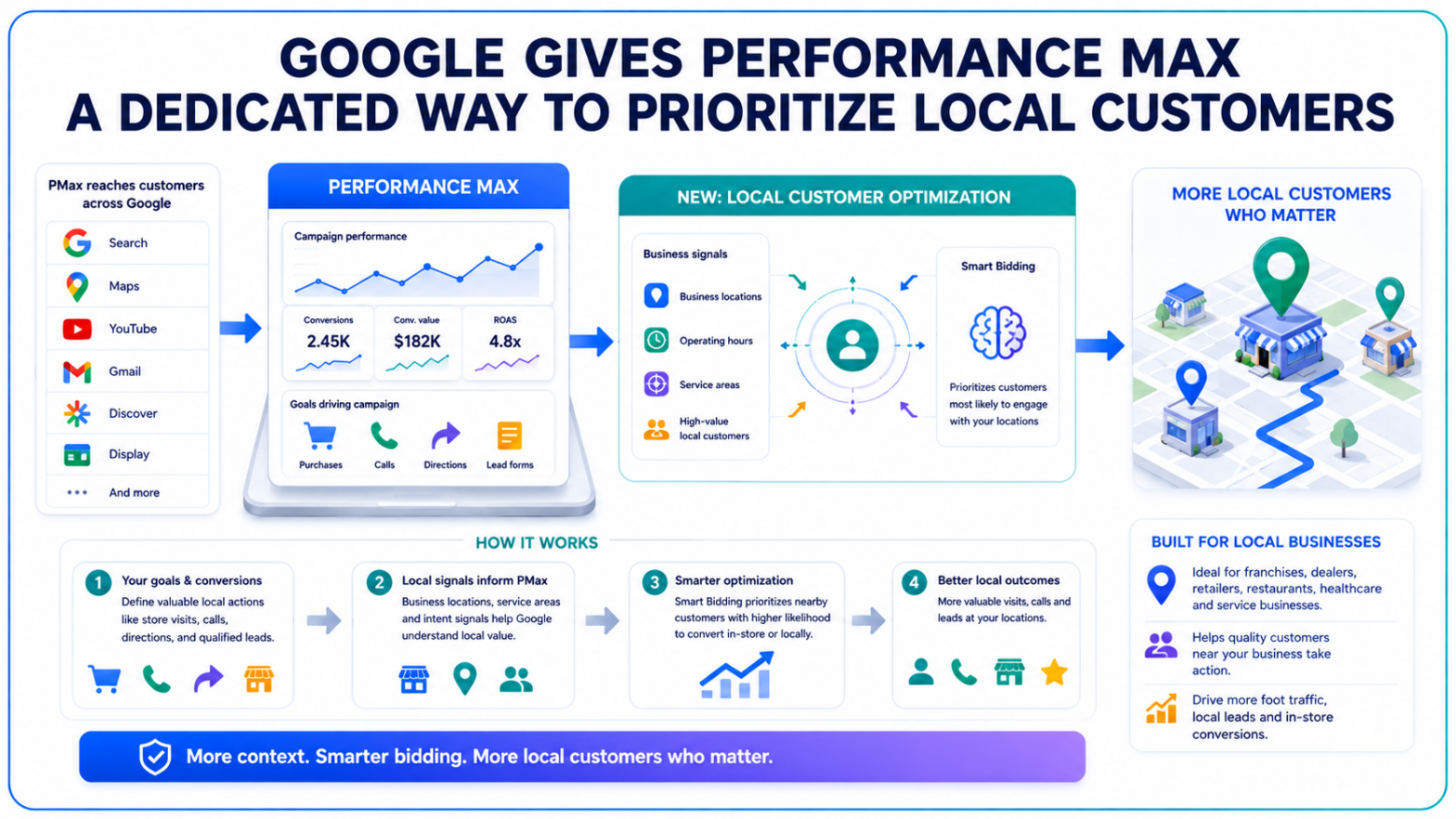
A new Local Customer Optimization option in Performance Max is designed to help campaigns prioritize customers who are likely to engage with physical business locations. The addition brings local intent further into Google's automated bidding system at a time when the company is consolidating more of its local advertising products around Performance Max.
PMax Can Finally Optimize Around the Local Customer
Performance Max already gives advertisers access to inventory across Search, Maps, YouTube, Display, Discover, Gmail and other Google properties. That breadth is one of its main advantages.
It has also been one of its weaknesses for local advertisers.
A campaign optimizing broadly for conversion volume can find inexpensive actions without necessarily finding the people most valuable to a physical location. Google has supported store goals and local actions for some time, including actions such as calls and requests for directions, but advertisers have had fewer ways to explicitly tell PMax that nearby customers deserve different treatment.
Local Customer Optimization moves that instruction closer to the campaign's core optimization logic.
Google's documentation says local actions can already be included as campaign-level conversion goals in Performance Max, Search and Shopping campaigns, allowing Smart Bidding to optimize toward interactions with local businesses.
The newer local customer setting goes further by giving Performance Max another business signal for deciding which users should receive priority.
That is particularly relevant for franchises, dealership groups, healthcare networks, restaurants, retailers and other multi-location advertisers where a conversion's geographic context can materially affect its value.
Google has been steadily pushing Performance Max beyond simple conversion maximization and toward customer-specific optimization. New customer acquisition, retention and prospecting controls already let advertisers tell the system which customer relationships matter most. Local Customer Optimization applies a similar idea to geography.
Local Intent Has Been Getting More Weight Inside Google Ads
The change did not appear in isolation.
Google altered its treatment of offline conversions in Performance Max in June 2025, shifting optimization toward users showing stronger local intent on high-intent surfaces such as Search and Maps. The adjustment applied to campaigns using omnichannel goals and was designed to favour customers more likely to take meaningful offline actions rather than simply maximizing the total number of attributed conversions.
Local Customer Optimization gives advertisers a more explicit mechanism within that same direction.
Google's own local-actions documentation says advertisers can optimize bidding toward interactions with physical businesses, including directions requests. Those actions can originate from an ad or from a later organic interaction with the store, showing how Google's local measurement increasingly stretches beyond the immediate ad click.
That matters because local customer journeys rarely stay inside one channel.
Someone may see a YouTube ad, search for the brand later, open Maps, request directions and then walk into the location without ever completing a traditional website conversion.
Performance Max was built to operate across that messy journey. Until recently, advertisers had relatively little influence over how strongly local behaviour should shape the system's decisions.
Google is gradually changing that.
The company's recent decision to bring Local Services Ads into the Performance Max ecosystem points in the same direction. Local advertising is becoming less of a separate Google Ads product category and more of another set of business signals feeding automated campaigns.
Multi-Location Advertisers Have a Different Conversion Problem
A national ecommerce business can often optimize around a relatively straightforward outcome: a transaction.
A multi-location business has more variables.
The same customer might call one branch, visit another, book online for a third location or search for directions without completing anything on the website. Two leads with the same reported conversion value can have completely different commercial value once location, service availability and customer proximity are considered.
That has made broad automation difficult to judge.
For local service advertisers, lead quality creates another layer. A submitted form is technically a conversion, but it may represent a customer outside the service area, a duplicated inquiry or someone looking for a service that particular location does not provide.
Google has been trying to close that feedback gap elsewhere in the platform. Its new Google Ads lead management dashboard allows advertisers using Google-hosted lead forms to organize and qualify leads within Google Ads, creating a clearer route for better downstream signals to reach automated bidding systems.
Local Customer Optimization addresses the problem earlier in the process.
Instead of asking PMax only to find another conversion, advertisers can give the system more context about which customers matter because of their relationship to a physical location.
For a business with dozens or hundreds of branches, that can change what "efficient" campaign delivery actually looks like.
Google Business Profile Data Is Becoming Harder to Separate From Paid Media
Local campaign optimization also depends heavily on Google's understanding of the business itself.
Locations, operating hours, contact information and geographic relevance increasingly connect Google Business Profile with paid campaign delivery. That relationship is becoming more visible across Google's measurement stack.
Google recently added the ability to link Google Business Profile data with Google Analytics, bringing more Search and Maps engagement into the same analytics environment as website and app activity.
Performance Max sits directly in the middle of that convergence.
Google retired standalone Local campaigns years ago and moved them into Performance Max, arguing that advertisers could gain access to additional inventory while retaining store-focused campaign objectives. Now, local optimization controls are being built deeper into the campaign type that replaced them.
The direction is fairly clear.
Google does not appear to be rebuilding the old Local campaign structure. It is teaching Performance Max to understand more local business context instead.
For advertisers, the quality of the underlying location data therefore matters. An automated campaign cannot reliably distinguish high-value nearby customers if the account's business locations, conversion goals or offline signals do not accurately represent how the company operates.
Local Customer Optimization Does Not Make PMax a Local Campaign Again
The practical implication for marketers is narrower than simply switching the new setting on.
Multi-location advertisers should first confirm that the conversions feeding Performance Max distinguish meaningful local outcomes from generic website activity. Store visits, calls, direction requests, qualified local leads and offline sales can carry very different business value from softer actions such as page views or engagement events.
Location assets and Google Business Profile connections also need to reflect the locations the campaign is expected to support.
Local Customer Optimization gives Smart Bidding more context. It does not remove Performance Max's cross-channel automation, nor does it guarantee that spending will concentrate exclusively on Search or Maps. Performance Max remains a campaign type built to allocate delivery across Google's eligible inventory according to the goals and signals supplied to it.
That distinction matters for businesses that previously avoided PMax because they wanted strict channel control.
Google is not giving them that control back.
It is doing something different: adding more information about what a valuable customer looks like so the automation has less reason to treat an online conversion and a locally valuable action as equivalent.
For multi-location businesses, that is a meaningful change. The campaign is still automated, but geography is becoming part of the optimization decision rather than merely a boundary around where ads are allowed to run.