

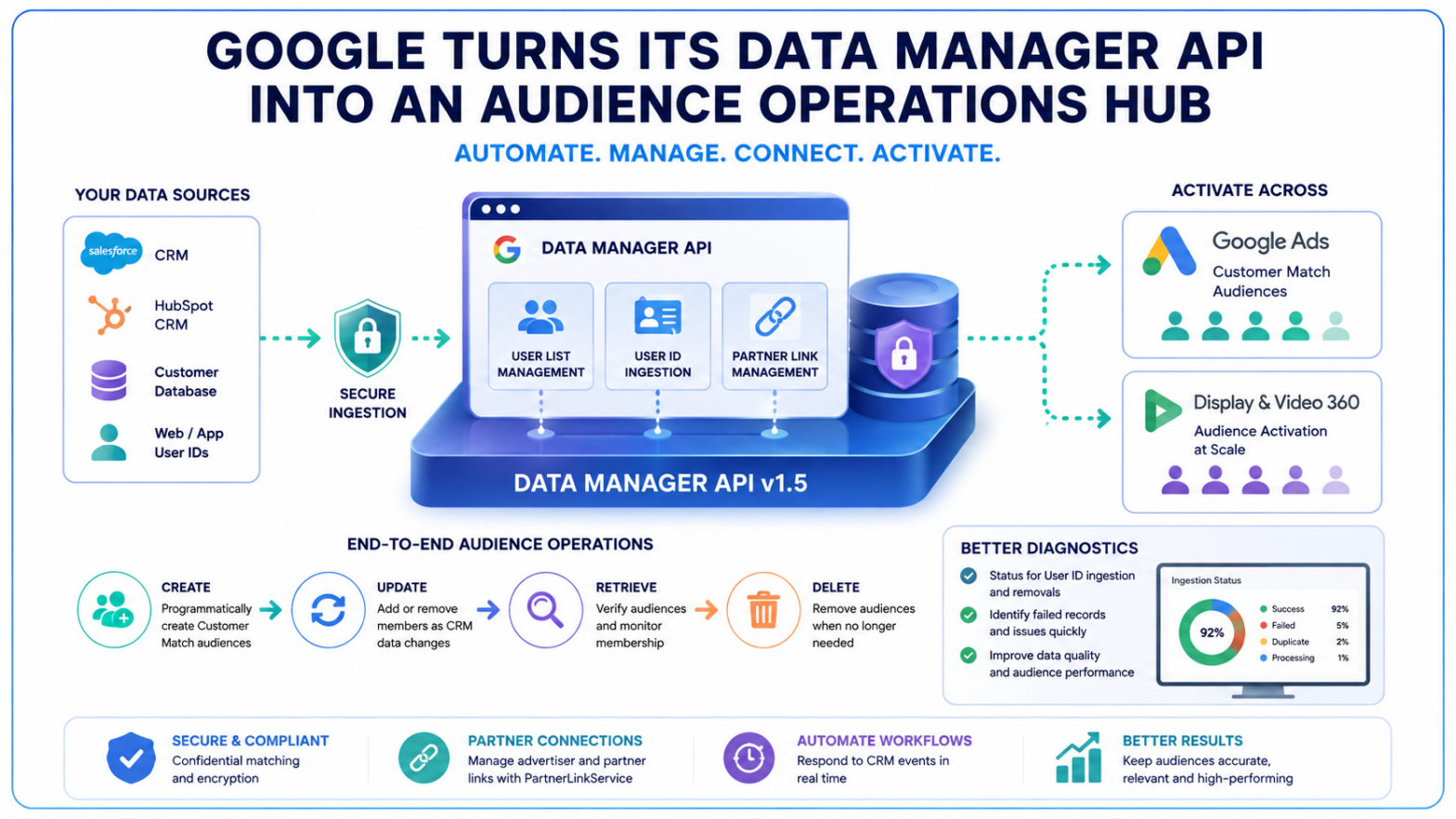
Uploading customer data is only one part of audience activation. Keeping lists current, connected and usable across advertising platforms is where the process usually breaks down.
Google is closing that gap.
Version 1.5 of the Data Manager API gives advertisers and data partners direct control over the full lifecycle of Customer Match lists. The release adds tools for creating, retrieving, updating and deleting audiences, alongside secure partner connections and another identifier for matching users.
For businesses connecting a CRM to Google Ads, the API is becoming more than a delivery pipe. It can now run much of the audience workflow itself.
Customer Lists No Longer Need a Separate Management Layer
The Data Manager API originally focused on moving first-party data into Google’s advertising systems.
That role has expanded.
Google’s new UserListService lets developers create, retrieve, update and delete user lists through the same API used to populate them. Google describes the release as an end-to-end workflow covering audience creation, ingestion and retrieval.
Previously, an advertiser might use one integration to send audience members while relying on another API, platform interface or internal process to manage the list itself. Version 1.5 puts those jobs closer together.
A CRM integration could now create a Customer Match audience when a customer reaches a defined lifecycle stage, add or remove members as CRM records change, retrieve the audience for verification and delete the resource when it is no longer required.
That opens the door to more automated audience management.
A software company, for example, could maintain separate lists for active customers, expired trials and sales-qualified leads without requiring a media buyer to upload revised files every week. An ecommerce advertiser could remove recent purchasers from a prospecting audience as orders are recorded.
The API does not decide which segments a business should create. It gives developers a more direct way to translate existing CRM logic into Google Ads audiences.
Google’s broader direction is already visible elsewhere in the platform. The company is automatically assigning customer types to some conversion-based lists, making audience classification a more important input for bidding and campaign automation. TechWyse recently covered how Google Ads will classify eligible customer lists beginning in August 2026.
Now, the infrastructure for maintaining those lists is becoming more programmable.
User IDs Give Customer Match Another Route Into Google Ads
The release also adds support for uploading User IDs as audience identifiers.
Customer Match has traditionally relied heavily on contact information, such as email addresses, phone numbers and postal addresses. The Data Manager API can now ingest an advertiser’s internal User IDs for Customer Match in Google Ads. Google has also added dedicated status fields for diagnosing User ID ingestion and removal.
Those IDs are not universal identities supplied by Google. They are identifiers assigned by the advertiser, typically within a website, application, customer database or account system.
That distinction matters.
A User ID can give a business a persistent internal reference for a known customer without requiring every audience update to depend on a newly supplied email address or phone number. It may be particularly useful for subscription platforms, logged-in services and companies with established account systems.
Diagnostics are part of the update too. Developers can retrieve status information specific to User ID uploads and removals, helping them identify failed records or ingestion issues without treating the entire audience job as a black box.
Better diagnostics will not repair poor source data.
Duplicate profiles, expired consent records, inconsistent identifiers and incorrect lifecycle labels can still flow from a CRM into an advertising platform. The API can automate a flawed audience definition just as efficiently as a clean one.
That puts data governance upstream of campaign activation.
Advertisers and Data Partners Get a Formal Connection
Google has also introduced PartnerLinkService, which manages connections between advertiser accounts and data partners across Google Ads and Display & Video 360.
These links give approved partners a structured route for working with advertiser data.
The service can create, delete and search partner links. Google’s technical documentation describes separate login-account and linked-account headers that establish which account is authorizing the request and which connected account is being accessed.
For agencies, customer data platforms and marketing technology vendors, that could reduce some of the custom authorization work required to maintain audience integrations across clients.
It may also make access easier to audit.
A defined partner link is clearer than an integration built around loosely shared credentials or manual file transfers. Advertisers can establish a specific connection between accounts, while developers have a formal service for managing that relationship.
The feature does not make every agency or software provider a Google data partner. Google directs interested organizations through a separate application process, and some API capabilities remain available only to approved data partners.
Still, the direction is clear. Google wants first-party audience activation to operate through documented account relationships rather than improvised data handoffs.
The Data Manager API Is Replacing Fragmented Data Pipes
Audience management is not the Data Manager API’s only job.
Google positioned the API as a common ingestion layer when it became generally available in December 2025. Advertisers can send data once and apply it across multiple Google advertising products instead of maintaining a separate integration for each destination.
Google now supports audience management for Google Ads and Display & Video 360. The API can handle Customer Match audiences built from contact information, User IDs and mobile device IDs, depending on the destination. Google says confidential matching is used to process Customer Match data and that encryption is supported.
The company is also steering more measurement workflows toward the same infrastructure.
New adopters of offline conversion imports were directed away from the Google Ads API and toward Data Manager API beginning June 15, 2026. Existing importers received additional migration time, but the policy established Data Manager API as the primary route for new offline conversion integrations. TechWyse reported on that Google Ads API offline import cutoff in May.
Taken together, the changes show Google consolidating first-party data activation and measurement around one API.
That is less glamorous than a new campaign type.
It may be more consequential for advertisers running mature data operations.
A CRM record can influence conversion reporting, Customer Match membership, customer lifecycle goals and automated bidding. When those workflows depend on different integrations, delays and mismatched definitions become difficult to spot. A shared data layer gives teams fewer pipelines to maintain, though it also makes errors in that pipeline more widely felt.
CRM Automation Still Depends on Consent and List Quality
For marketers, the practical change is not that Salesforce, HubSpot or another CRM will automatically become a perfect Google Ads audience source.
The opportunity is that developers can build a tighter workflow between the systems.
Audience creation, membership updates, deletions and diagnostics can respond to CRM events without waiting for recurring spreadsheet uploads. Teams could remove customers after account closure, shift leads between lifecycle segments or refresh high-value customer lists on a more useful schedule.
Those workflows still have to follow Google’s Customer Match requirements and applicable privacy rules.
First-party data cannot be treated as unrestricted targeting material simply because it came from the advertiser’s own database. Google limits personalized advertising in sensitive categories and applies additional restrictions to Customer Match use. TechWyse has examined how Google’s personalized targeting rules affect first-party audiences in finance, housing, employment and other restricted areas.
Consent signals, retention policies and suppression logic therefore need to travel with the data strategy.
A CRM-to-Google Ads connection should answer more than who belongs in an audience. It should also define why the data can be used, when a person must be removed and which campaign purposes are allowed.
Google released Data Manager API v1.5 on February 17, 2026. The accompanying documentation now presents the API as the end-to-end path for creating, populating and verifying Customer Match audiences in Google Ads and Display & Video 360.
The upload file is not disappearing overnight.
But Google is building for a system in which audience lists change whenever the underlying customer record does.