
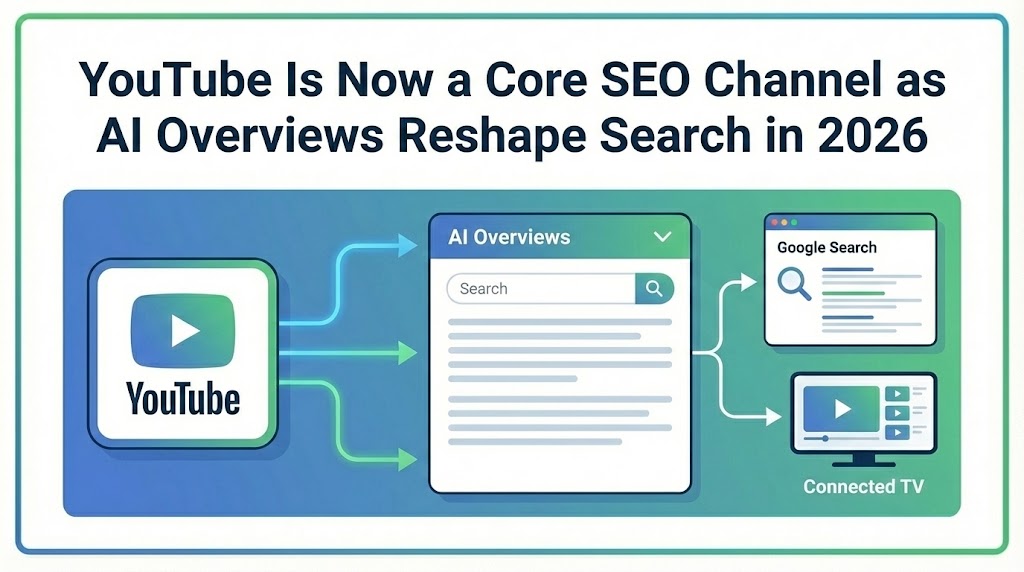
As search engines increasingly rely on AI-generated answers, YouTube has moved from a supporting channel to a foundational part of modern SEO strategy.
With Google AI Overviews, conversational search, and generative engines pulling from multimodal sources, video is no longer optional. Brands that underinvest in YouTube risk losing visibility not only in traditional rankings, but also in the AI-driven experiences that now sit at the top of the search funnel.
From Platform to Search Infrastructure
YouTube is no longer just a social or brand-awareness platform. Its scale, engagement signals, and integration across Google products have effectively turned it into core search infrastructure.
As one of the most visited websites globally, YouTube functions as both a destination search engine and a content source that feeds Google Search, Discover, Shorts, and AI Overviews. When users look for explanations, demonstrations, comparisons, or visual proof, YouTube content increasingly satisfies that intent more effectively than text alone.
This is especially true as viewing behavior shifts toward connected TVs. Long-form videos, live streams, podcasts, and Shorts are now consumed in living-room environments, creating an interactive, multimodal discovery surface that blends entertainment, education, and search behavior.
Why AI Search Relies So Heavily on Video
AI-powered search systems prioritize clarity, engagement, and contextual understanding. Video excels on all three fronts.
AI Overviews and conversational interfaces frequently surface YouTube videos because they provide:
-
Step-by-step demonstrations for complex tasks
-
Visual confirmation of techniques, products, or outcomes
-
Rich engagement signals that help models assess usefulness
As a result, YouTube is cited disproportionately often in AI-generated answers, particularly for tutorials, product research, pricing questions, and how-to content.
If a brand’s video presence is thin, poorly structured, or disconnected from real search intent, it is far less likely to be included as a source when AI systems synthesize answers.
Discovery Is Now Creator-Led
Another major shift reshaping YouTube’s role in SEO is the dominance of creator-driven discovery.
Audiences increasingly gravitate toward channels that deliver clarity, personality, and consistency rather than purely polished brand content. Episodic formats, community interaction, and repeat engagement now drive discovery far more than one-off uploads.
For brands, this means success on YouTube is less about posting isolated videos and more about building recognizable formats, series, and topical authority that audiences return to.
What This Means for SEO Strategy
AI-driven search does not reward content in the same way as traditional rankings.
Instead of ten blue links, AI Overviews synthesize responses and expose only a small set of sources. In this environment, the goal shifts from ranking for a keyword to earning inclusion as a trusted reference.
On YouTube, that inclusion depends on how clearly a video communicates its topic and value to both viewers and machines.
Metadata, structure, and on-screen language all act as signals that help AI systems understand whether a video deserves to be summarized or cited.
Building YouTube Content for AI Visibility
An effective YouTube SEO strategy in 2026 is built around four core principles:
1. Intent-Driven Metadata
Titles and descriptions should mirror real search questions rather than internal branding language. Framing videos around problems users are actively trying to solve improves alignment with both YouTube search and AI Overviews.
Descriptions should function as structured summaries, clearly stating who the video is for, what it addresses, and which concepts are covered.
2. Structural Optimization
Videos should be treated as navigable resources. Chapters, timestamps, and accurate transcripts allow search systems to surface specific moments that directly answer user questions.
Captions and transcripts also reinforce topical relevance and ensure that technical terms, product names, and step-by-step instructions are correctly understood.
3. Topical Authority Through Series
Sporadic uploads are no longer enough. Building topical clusters through playlists and recurring formats signals depth and expertise.
Series that explore a subject from multiple angles—explainers, walkthroughs, case studies, and live discussions—mirror the topic-cluster models already familiar in traditional SEO.
4. Integration With Shorts and Creator Ecosystems
Short-form video acts as an acceleration layer, driving discovery and engagement back to long-form content.
Collaborations with creators, guest appearances, and reaction-style formats help brands plug into existing communities, reinforcing authority through repeated association and visibility.
Common YouTube SEO Pitfalls to Avoid
Many teams still treat video as a secondary asset, which limits its impact in AI-driven search.
Common mistakes include:
-
Prioritizing branding over clarity in titles
-
Writing descriptions only for human readers
-
Skipping chapters and timestamps
-
Relying exclusively on auto-generated captions
-
Posting inconsistently without a clear topical focus
Equally damaging is separating YouTube strategy from SEO strategy. As AI systems pull from both video and web content, siloed approaches reduce visibility across channels.
Redefining “All the Right Places” in 2026
Being discoverable today means showing up across:
-
Google AI Overviews
-
Conversational search interfaces
-
YouTube search and recommendations
-
Shorts feeds
-
Creator networks and podcast platforms
YouTube now sits at the center of this ecosystem.
Brands that treat YouTube as a core SEO asset—designed to educate users and train AI systems—will be better positioned to maintain visibility as search continues to evolve.
In the age of AI-driven discovery, YouTube is no longer optional. It is infrastructure.