

OpenAI says ChatGPT handles search-like queries equivalent to roughly one-fifth of Google’s query volume. That comparison describes activity inside the platforms, not the visitors they deliver to websites.
Adam Fry, OpenAI’s consumer product lead for ChatGPT, made the claim during an OpenAI-hosted discussion in New York on November 2. The original interview, published on November 3, presents the figure as OpenAI’s assessment rather than an independently audited industry measurement.
For publishers and marketers, the distinction changes the commercial question. A platform can handle substantial information-seeking activity without sending a comparable proportion of visitors to the businesses and publications supplying that information.
AI Referral Traffic Shows a Much Wider Gap
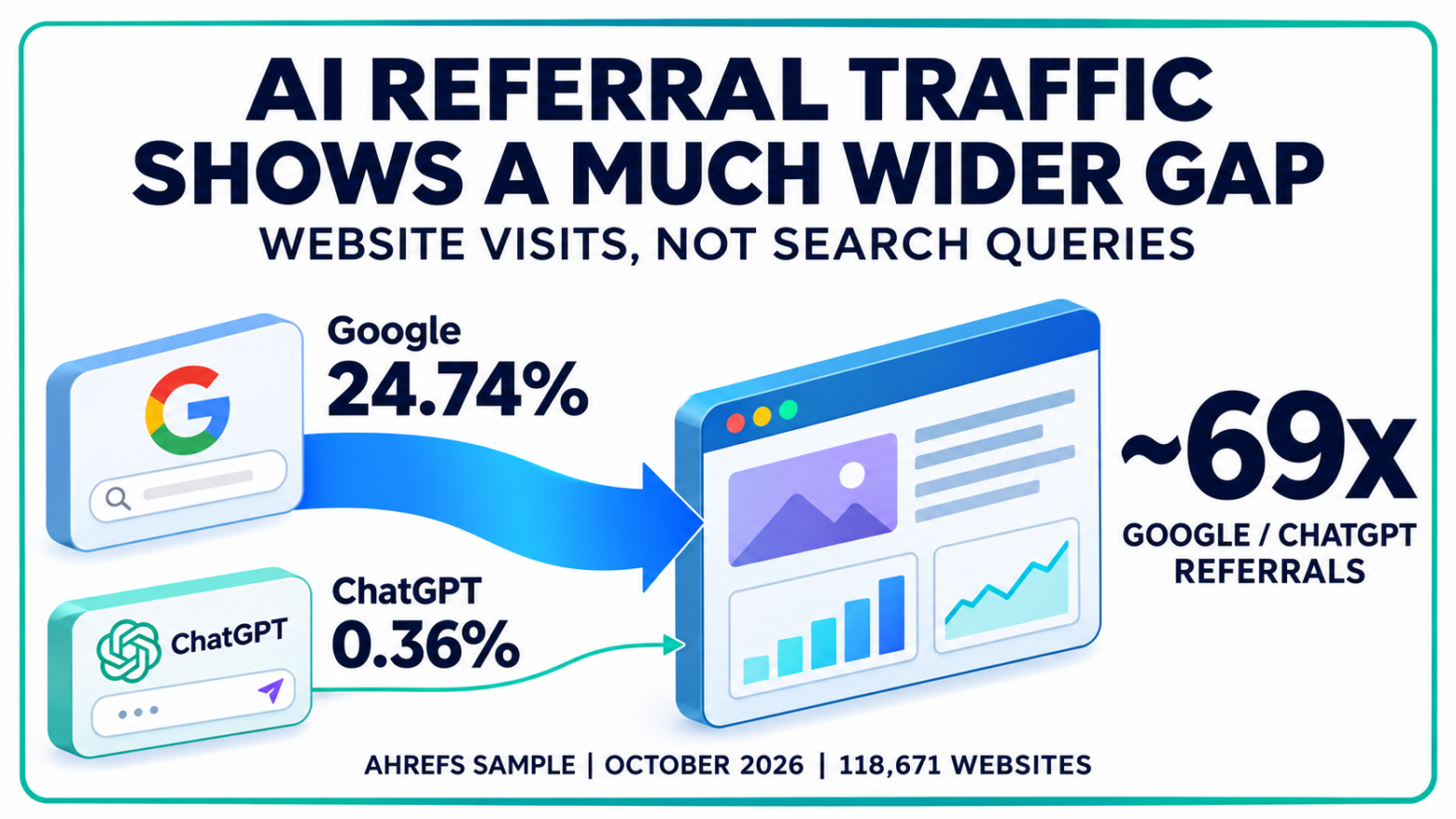
Ahrefs’ AI versus search traffic benchmark, updated November 3, provides a separate view of the competition. Across 118,671 websites using its Web Analytics tool, Google accounted for 24.74% of tracked traffic in October 2026. ChatGPT accounted for 0.36%.
Those shares put Google’s contribution at approximately 69 times ChatGPT’s within that dataset. They do not contradict OpenAI’s five-to-one query comparison: one measures traffic arriving at websites, while the other compares search-like activity.
The benchmark has limits. Participating websites are not a representative census of the internet, and their traffic mix cannot establish a universal ratio for every industry or country. A Canadian retailer, local service business and international publisher could each see different results.
Tracking AI referral traffic also depends on identifying where a visit originated. Source attribution is a separate measurement problem from counting the searches that happened before someone clicked.
The October figures describe observed website traffic, not ChatGPT’s complete influence on purchasing decisions or brand discovery.
A Search Answer Is Not a Website Visit
OpenAI’s explanation of its search experience describes a conversational product that can retrieve web information automatically or respond to a user’s decision to search. Answers can include source links, and follow-up questions retain the conversation’s context.
Retrieving a page does not require the user to visit it.
That creates several distinct events: a person asks for information, the system retrieves material, an answer references a source, and the person may then open a website. Counting one event does not establish how frequently the next occurs.
For ChatGPT search, appearing among the sources and earning a visitor are separate outcomes. Neither alone establishes that the user subsequently became a customer.
Fry described search-like use as including requests for current information about people, places and other topics. The accessible interview excerpt does not identify the comparison’s measurement period, geographic coverage or the Google query total used.
The one-fifth figure therefore remains a company-reported comparison with incomplete publicly accessible methodology. It is not evidence that ChatGPT holds 20% of the entire search market.
The Earlier 12% Estimate Used a Different Definition
An earlier Ahrefs analysis published February 11 estimated ChatGPT’s search-equivalent activity at roughly 12% of Google’s volume. Treating that estimate and OpenAI’s newer statement as successive readings of the same metric would be misleading.
Ahrefs started with approximately 2.5 billion daily ChatGPT prompts from July 2025. Its author, Patrick Stox, classified 65% as activities people had traditionally used Google to perform, producing an estimated 1.625 billion daily search-like requests.
The calculation used Google’s disclosure of more than five trillion annual searches as its comparison point. Stox explicitly distinguished his broader classification from narrower categories in the underlying research.
That approach classified what people were trying to accomplish. It was not simply a count of requests that triggered live web retrieval.
The difference matters when assessing AI search. A request can resemble something previously typed into Google without requiring a fresh search of the web.
The two percentages cannot establish a growth rate without consistent definitions, observation periods and comparison data.
Google Reports Accelerating Query Growth
Google’s own disclosures add another constraint to claims that ChatGPT’s expansion necessarily represents lost Google searches.
In Alphabet’s third-quarter results released October 28, chief executive Sundar Pichai said Google’s year-over-year search query growth rate was its highest in five years. He attributed overall query growth, including commercial queries, to the company’s AI investments.
That is a statement about the pace of growth, not a new absolute query total. It cannot independently validate the denominator in OpenAI’s comparison.
Nor does growth at both companies settle whether individual searches are moving between services. Establishing substitution requires evidence about user behaviour over time, rather than two aggregate platform figures.
For marketers, the practical implication is to keep platform scale, website acquisition and business outcomes separate in reporting. Search-like query volume describes potential activity; attributable visits show traffic received; leads and sales show recorded commercial outcomes. Comparing Google and ChatGPT on consistent dates and attribution settings avoids treating a platform-wide usage claim as a forecast for an individual website.
Alphabet’s third-quarter filing reported US$63.35 billion in Google Search and other revenue, up 12% from a year earlier. The release did not provide an absolute search query count.