
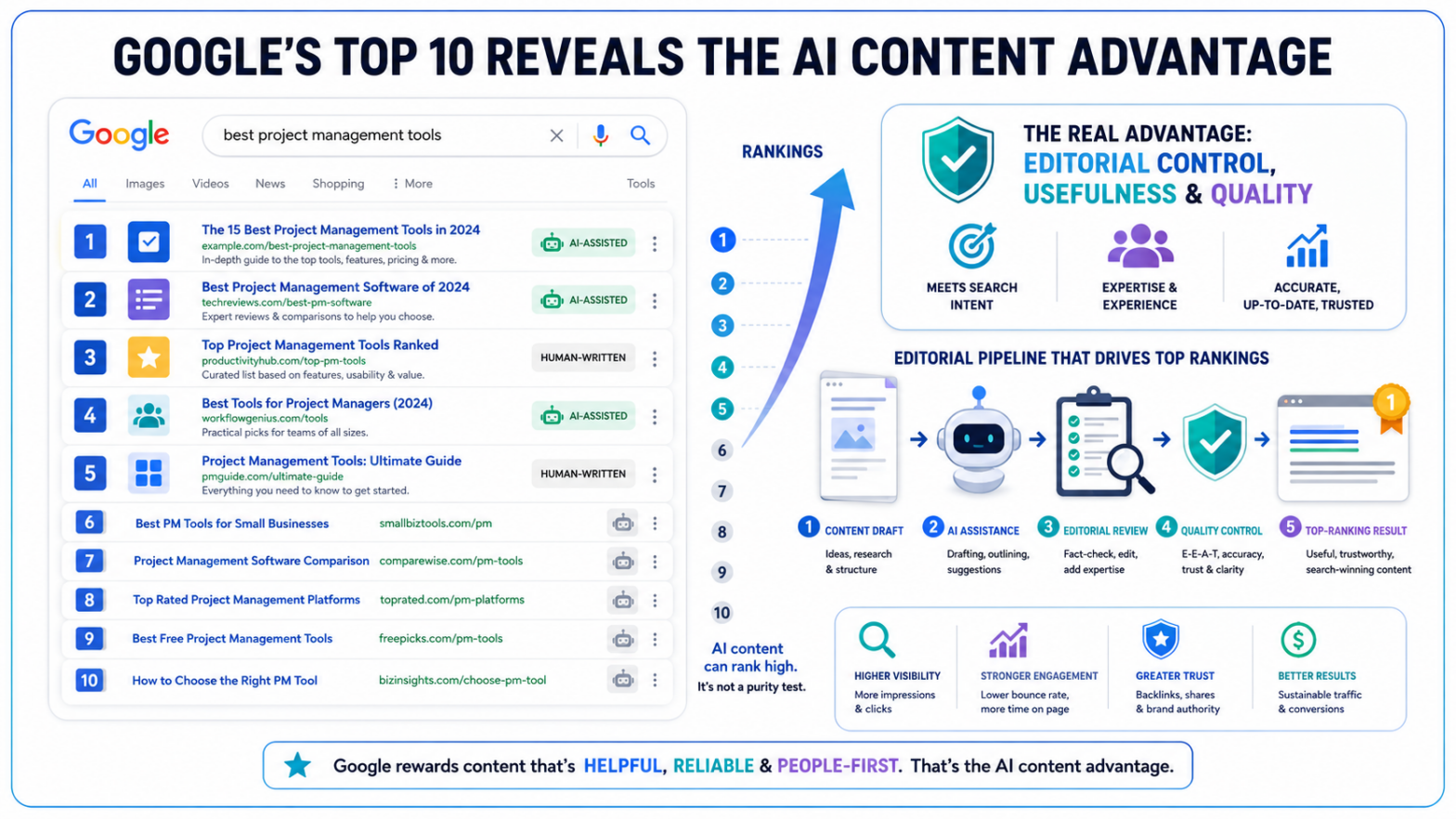
Google’s Top 10 is not behaving like an AI detector. Pages flagged as almost entirely machine-written still appear at every ranking position, including number one.
That breaks the simplest version of the “AI thin content penalty” theory. The latest data shows no visible purity test separating human prose from machine-assisted work. The competitive divide sits somewhere else: usefulness, authority, originality and editorial control.
Google’s Top 10 Is Not an AI Content Purity Test
A large-scale analysis of roughly 331,000 pages examined separate samples covering rankings, indexation and organic impressions. For the ranking portion, researchers pulled one million URLs from the Top 10 results across 100,000 Google searches conducted in June 2026. About 150,000 pages contained enough text for the detector to assess.
The result should end any claim that Google automatically removes heavily AI-generated pages from competitive search results.
Among pages ranking in positions one through three, 5.3% were flagged as fully AI-generated. Nine per cent scored at least 80% AI. At position one, 8.4% of pages fell into that very-high category. At position 10, the share was 11.7%.
Those pages are not dominating the majority of results. Human-led or lightly assisted content still holds most top positions. But heavily flagged pages are far too common to support a blanket suppression theory. They are present at every point in the Top 10, not stranded at the bottom or excluded from the index.
For marketers still treating AI content as an automatic ranking liability, that distinction matters.
The Google Rankings Gap Is a Gradient, Not a Penalty
The data does show a performance gap. It just does not look like a punishment switch.
Average estimated AI usage rose from 27.1% at position one to 30.9% at position 10. Median scores moved from 17.1% to 19.5% across the same range. Pages with less than 50% AI-generated text accounted for 82.2% of the top three results.
Indexation followed a similar slope. The study found an estimated indexation rate of 49.28% for pages with low AI scores, compared with 40.35% for pages scoring 80% or higher. That is a meaningful difference. It is not a ban.
The organic impression data adds another layer. Low and moderately flagged pages earned two to three times more impressions than the high and very-high groups. Yet the heavily flagged groups remained broadly stable over the periods examined. There was no obvious traffic cliff several months after publication.
A binary AI penalty should leave a sharper footprint. These Google rankings show a gradual relationship instead, and correlation still cannot explain the cause. Sites publishing large amounts of generic AI copy may also be newer, weaker, less authoritative or less selective about what they publish.
The detector score captures how the text reads. It does not capture whether the page deserves to rank.
AI Content Strategy Wins in the Editorial Layer
The strategic lesson is not that AI-generated copy can rank without limits. It is that production method alone does not decide the outcome.
Google’s current guidance on generative AI content tells publishers to focus on “accuracy, quality, and relevance.” It warns that generating many pages without adding value may violate spam policies, but it does not prohibit AI-assisted publishing.
That leaves room for a disciplined AI content strategy. AI can reduce the time spent collecting background information, organising source material, testing structures and producing an initial draft. None of those efficiencies replace the editorial decisions that give a page competitive value.
Someone still has to choose the angle. Someone has to verify the claims, remove invented details, identify what competitors missed and decide whether the page adds anything new to the search result.
That is the masterclass hidden inside the ranking data. The winning move is not disguising AI output so a detector labels it human. It is building a process in which the finished page carries evidence, judgement and context that a generic generation cannot supply on its own.
A high detector score can coexist with strong research. A low score can coexist with empty writing.
Scaled Content Abuse Is Still the Real Line
Google’s policy boundary is based on purpose and value, not authorship.
Its spam documentation defines scaled content abuse as producing many pages “for the primary purpose of manipulating search rankings and not helping users.” The policy applies regardless of whether the pages were created by generative AI, scraped feeds, automated transformations, freelancers or internal teams.
That distinction becomes more important as production costs fall.
AI can help a publisher produce ten useful pages faster. It can also help the same publisher produce 10,000 near-duplicate pages that repeat existing search results, invent expertise and consume crawl resources without earning sustained demand.
The tool is neutral. Scale is not.
Once output volume outruns editorial review, factual verification and topic authority, the operation begins to resemble scaled content abuse, even when every individual page reads smoothly. Fluent copy does not fix a weak publishing premise.
The new data does not weaken Google’s spam policy. It clarifies where enforcement is likely to land. AI presence is not the violation. Low-value multiplication is.
Detector Scores Are the Wrong KPI
AI detectors estimate probability from language patterns. They do not know who wrote a page, how it was researched or which parts were edited. The study itself cautions that its detector is imperfect and may operate very differently from anything Google uses internally.
For marketers and SEOs, the practical response is to stop using a detector score as a publishing verdict. A stronger review asks whether the page answers the query clearly, introduces information or experience not already common across the result set, supports factual claims, fits the site’s established subject matter and gives readers a reason to choose it over the next result.
The same review should be applied to human-written work.
A page does not become useful because a person typed every sentence. It does not become disposable because AI helped produce the draft. Google’s public standard remains focused on manipulation, accuracy and added value, while detector scores remain external estimates of writing patterns.
The Top 10 now contains enough heavily AI-flagged pages to make that separation impossible to ignore.