
Search visibility is usually treated as a feature. For platforms that generate link-only pages, Google now wants it managed as a controlled permission.
The New Guidance Starts With Page Intent
Google updated its guidance for preventing user-generated spam on October 26, expanding the document beyond comment sections and forum posts.
The revised spam-prevention guidance now explicitly covers hosting platforms and tools that allow users to publish shared pages, generated outputs or web applications. Google warns that spammers can exploit these systems to create large numbers of low-value or policy-violating URLs on a domain they do not own.
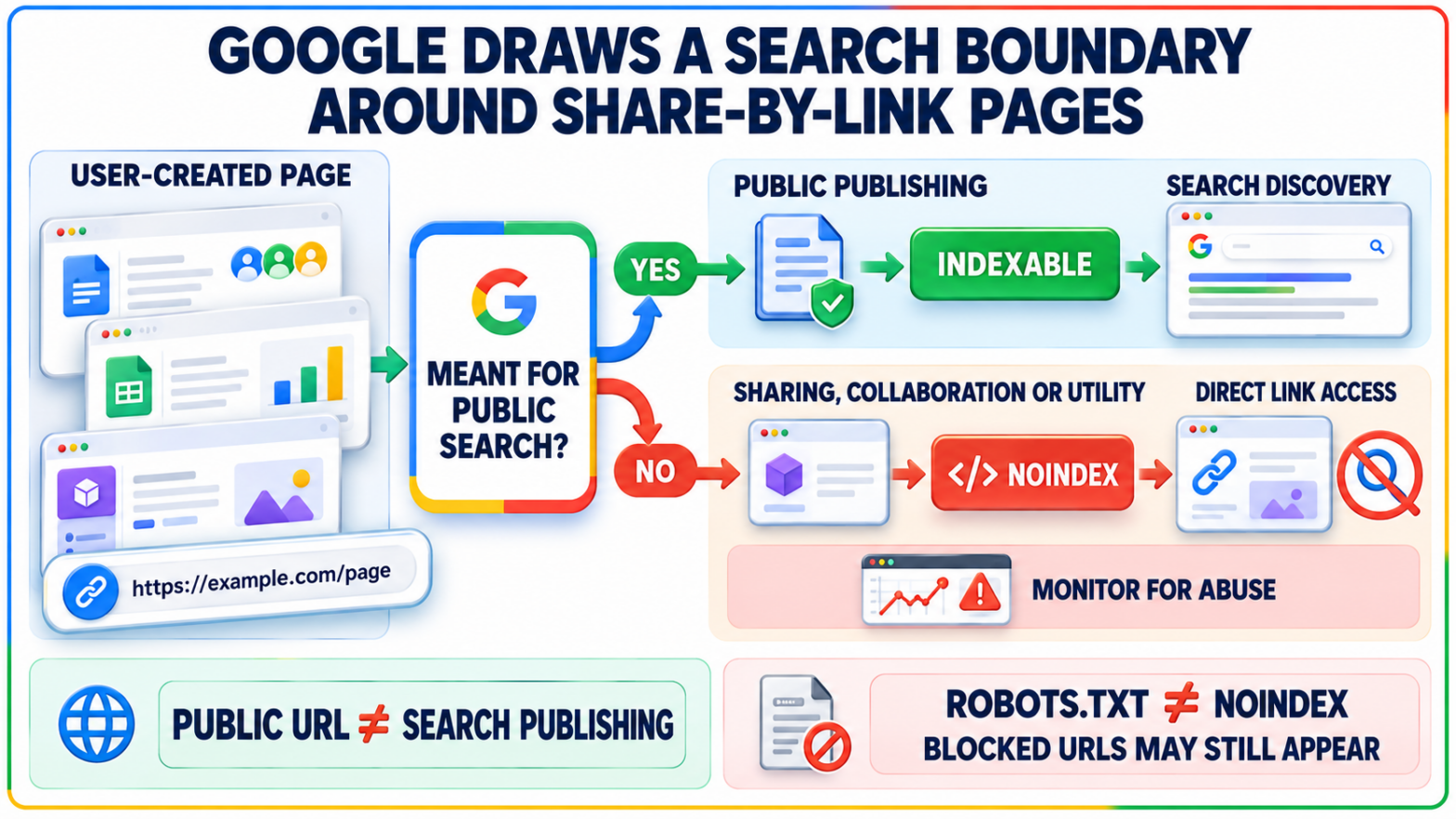
A new section asks platform operators to decide whether each type of user-created page is intended for public search discovery or direct access by people who already have the link.
For pages built primarily for sharing, collaboration or utility, Google recommends applying a noindex directive or blocking crawling through robots.txt by default. The October 26 Search Central documentation log says the goal is to keep user-created pages that were not meant for Search out of the index and help platforms detect abuse earlier.
This is a documentation update. Google did not announce a new ranking system, spam update or enforcement deadline.
The change instead places an indexing decision much earlier in the product workflow. Platforms should no longer assume every publicly accessible URL belongs in search results simply because a user can open it in a browser.
A Share Link Is Not Automatically a Search Landing Page
Share-by-link systems can produce enormous URL inventories.
A single platform may host collaborative drafts, generated reports, design previews, calculators, temporary workspaces or interactive outputs. Those pages can be useful to their intended recipients without serving a broader search audience.
That distinction creates the central test in Google’s guidance: was the page created to be discovered, or was it created so a specific person could open it?
A publicly accessible URL is not necessarily a public publishing decision.
The guidance is not a blanket instruction to remove all user-generated content from Search. Public forum discussions, community posts, reviews and other moderated contributions may provide lasting value for people searching the web.
Google made that distinction especially clear earlier in October when it documented the UGC Fresh Data Program, which allows approved platforms to submit timely public community posts and engagement data. Eligible posts need stable URLs, public accessibility, creator attribution and active moderation.
The two updates address opposite sides of the same platform problem.
Content deliberately published for a public audience can remain indexable and may qualify for specialized submission programs. Content created only as a collaboration surface or private-by-convention share link should not quietly enter the searchable web.
The Robots.txt Shortcut Can Leave a URL Behind
Google’s new guidance offers two controls: a noindex rule or a robots.txt crawl block. Those options do not produce identical outcomes.
A noindex tag tells Google to remove a page from search results after Googlebot crawls the URL and processes the directive. The instruction can appear as a robots meta tag in an HTML page or as an X-Robots-Tag in the HTTP response header.
Googlebot must be allowed to access the URL for noindex to work.
If a platform combines noindex with a robots.txt disallow rule, the crawler may never see the indexing instruction. Google’s noindex documentation warns that the blocked URL could still appear in results if other pages link to it.
Robots.txt primarily controls crawler access and server load. Google’s separate robots.txt guidance says it is not a reliable mechanism for keeping a web page out of Search. A disallowed page can still appear as a URL-only result without a description.
For public pages that must remain accessible by link but should not appear in results, noindex is the more direct indexing control. For URL spaces that should not be crawled at all, a robots.txt rule may reduce crawler access, although it does not provide the same exclusion guarantee.
Neither option makes content private. Confidential documents, customer records or sensitive collaborative material require authentication, password protection or removal from the public web.
Search Console Becomes an Abuse Alarm
Google also expanded its monitoring recommendations.
Platforms are now advised to verify their site or relevant subdomain in Google Search Console. That allows owners to receive notifications about manual actions and security problems while reviewing aggregate indexing and search-performance data.
The Page Indexing and Performance reports can expose patterns that do not match the platform’s intended use. Google specifically points to unexpected increases in indexed URLs, impressions or search queries as possible warning signs.
A sudden rise in indexed pages is not automatically abuse. A product launch, migration or legitimate publishing feature can produce the same pattern. The surrounding platform data determines whether the growth makes sense.
Google recommends tracking how many public pages users create, how many become indexed and whether a small number of accounts generate a disproportionate share of indexable URLs. Other suggested signals include suspicious redirects, spam-related keywords, excessive advertising sections, encoded JavaScript and unusual traffic spikes in server logs.
The company also advises platforms to monitor signup behaviour, including form-completion speed, repeated IP ranges, user agents and submitted account names. Content from new or untrusted users can remain noindexed until the account develops a credible reputation.
Links inside untrusted submissions can carry rel="nofollow" or rel="ugc" attributes. Those attributes address link treatment rather than whether the containing page should be indexed.
For marketers and SEO teams, the practical change is to define index eligibility as part of the publishing system. Product, moderation and search teams need a shared rule for which page types launch with noindex, what evidence allows a page to become indexable and how that transition is monitored after Google recrawls the URL.
The Update Does Not Create a New Penalty
Google has not said that every indexed collaboration page violates its rules. The risk arises when open publishing features are exploited to create spam, manipulate rankings or flood Search with pages that provide little or no public value.
Existing Google spam policies already allow automated systems or human reviewers to act against violations. Affected pages or websites may rank lower, disappear from results or receive a manual action visible to the verified owner.
The October 26 revision gives platforms a prevention model rather than announcing a new offence. It combines default indexing controls, user-reputation systems, moderation, link attributes and anomaly monitoring around one question: which user-created pages were genuinely published for Search?
Google documented both ends of that boundary within the same month. On October 8, it opened an application route for eligible platforms to send fresh public community posts directly to Search. On October 26, it told those platforms to keep collaboration and utility pages out of the index when public discovery was never their purpose.