Controlling how Google uses website content is no longer one technical decision. It is a series of choices covering crawling, indexing, search snippets, AI-generated answers and individual Google properties.
Google has now pulled those choices into a clearer map.
Google Search Content Controls Now Sit on One Page
On October 21, Google refreshed its Control what you share with Google Search documentation to include several existing options that had previously been documented across different resources.
The consolidated page now points site owners towards the noindex rule, robots.txt, robots meta tags, data-nosnippet, X-Robots-Tag and the Search generative AI control. It also covers removing content, protecting files with passwords and opting out of specific Google properties.
This is a documentation change. Google did not announce a new ranking system, crawler directive or removal tool.
Its Search Central documentation changelog describes the controls as existing options and says the update was intended to keep the page current. Google also clarified that the guidance applies specifically to Google Search.
That boundary matters. Preventing content from appearing in Search is different from limiting model training, blocking an advertising crawler or removing information from other services operated by Google.
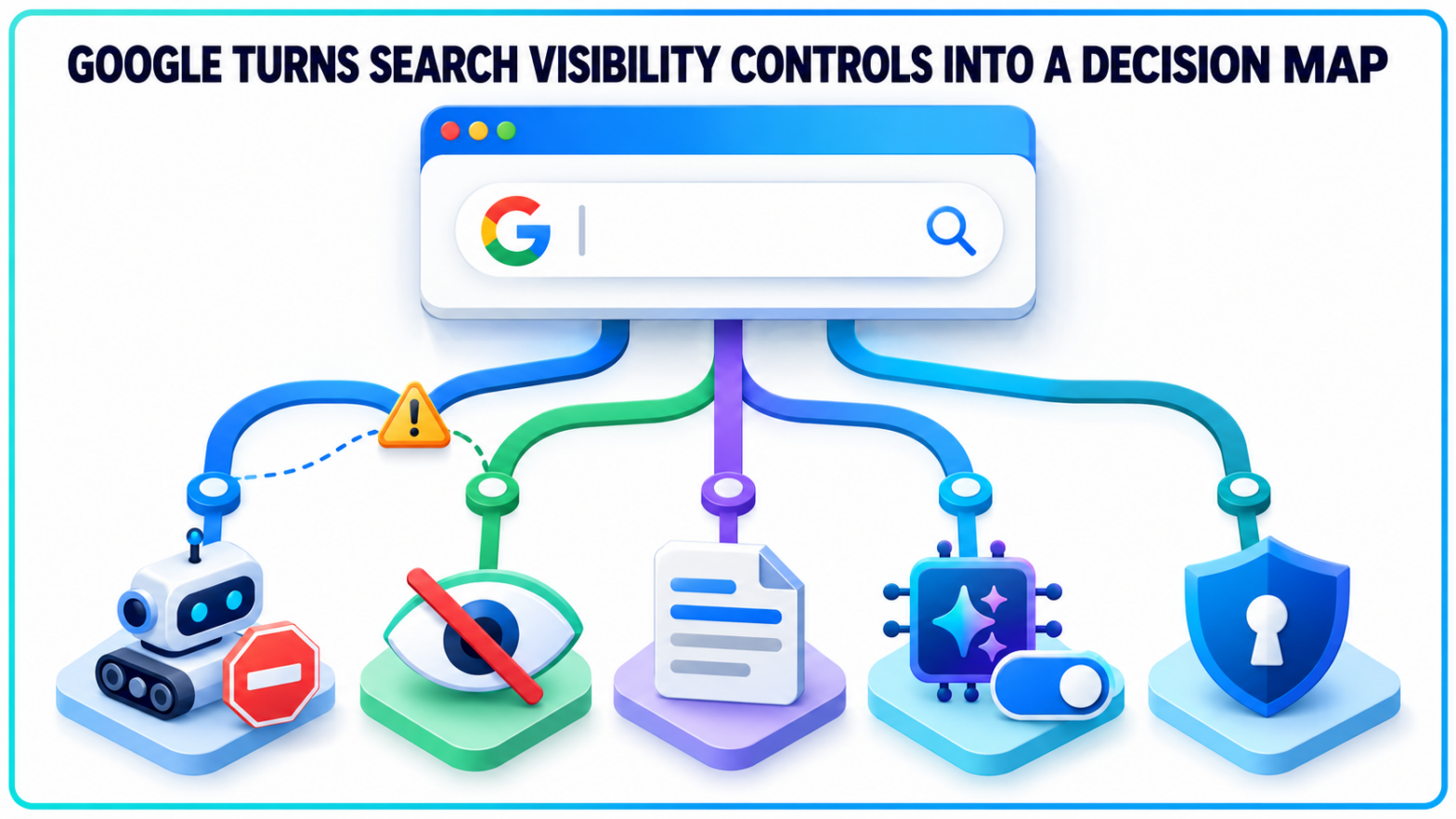
The refreshed page is most useful as a decision map: first identify the outcome, then select the control designed for it.
Noindex Robots.txt and Snippet Rules Do Different Jobs
The noindex tag remains the direct instruction for keeping an accessible page or resource out of Google Search results. Users with the URL can still visit the content, and other pages can still link to it, but Google will not show it in Search after processing the rule.
Googlebot must be able to crawl the URL to see that instruction.
Blocking an HTML page in robots.txt while also adding noindex can therefore create a conflict. If Googlebot cannot fetch the page, it may not discover the noindex tag. Google’s consolidated guide presents robots.txt as an option for preventing the crawling of image and video files, rather than as a universal search-removal command.
The refreshed guidance also brings presentation controls into the same framework. A robots meta tag can govern how an HTML page is indexed or displayed, while X-Robots-Tag can carry equivalent instructions in an HTTP response header. The latter is particularly useful for non-HTML resources such as PDFs, images and video files.
Data-nosnippet operates at a narrower level. Site owners can apply it to supported HTML elements when a particular passage should not appear in a search snippet, without removing the entire page from Search.
Snippet rules can also reach Google’s AI experiences. Google says nosnippet prevents page content from being used as a direct input for AI Overviews and AI Mode. The max-snippet rule limits how much content may be used, but it also changes the conventional search snippet.
That trade-off separates snippet management from a dedicated AI participation decision.
The AI Control Is Not an Indexing or Training Switch
The Search generative AI control gives verified Search Console owners a site-level way to manage participation in AI Overviews, AI Mode and generative AI features in Discover.
Google completed the worldwide rollout of the AI Search control on August 31, 2026. Inclusion is the default.
When a property is excluded, its links and content are prevented from appearing in the covered generative features or helping to ground their responses. The site will also stop receiving traffic and impressions from those experiences.
The setting does not remove pages from conventional Google Search. Google says it is not used as a ranking or inclusion signal for other parts of Search, nor does it override separate participation choices involving services such as Merchant Center or Google Ads.
It also does not govern AI model training. Google directs site owners to Google-Extended for that purpose. As TechWyse has previously reported, Google-Extended separates AI training preferences from Googlebot access, allowing a site to communicate a covered training restriction without automatically disappearing from Google Search.
Search Console property structure adds another layer. Child properties normally inherit the choice of the nearest configured parent, but an owner can override that setting for a specific URL-prefix property. Google says exclusions generally take effect within several days, with applicable content typically removed within one or two days after the control becomes active. Cached content can take longer.
The Wrong Control Can Create the Wrong Outcome
The practical implication for marketers and SEOs is simple: start with the business requirement, not the directive name.
A page that should remain private needs authentication or password protection. Robots instructions are not access controls, and publicly available confidential information should not be treated as secure merely because a crawler has been asked not to index it.
A public page that should stay out of all Google Search results calls for noindex. A page that should rank but expose less text may require a snippet restriction. A site that wants conventional Search visibility without participation in Google’s generative experiences must use the Search Console AI setting.
Those decisions should also be reflected in reporting. Changes to noindex rules belong in crawling and indexing checks, while changes to AI participation should be evaluated through generative AI performance data. TechWyse’s coverage of Google Search Console indexing data has shown why reporting layers should not be confused with Google’s underlying crawling and indexing activity.
For larger organizations, ownership may be the harder problem. SEO, development, legal, privacy and content teams can each control a different part of the implementation. A robots.txt edit, HTTP header or Search Console setting can quietly outlast the policy decision that created it.
Google’s Guide Still Stops at the Edge of Search
The consolidated documentation also lists removing content from the website as the strongest way to prevent it from appearing anywhere online. Password protection is the recommended route for confidential material that must remain available to authorized users.
Separate opt-outs remain available for specific properties including Google Shopping, Google Hotels and vacation rentals. Those settings are not replaced by the broader Search controls.
For information that is already appearing in results, Google points site owners towards its removal process. That workflow addresses existing visibility, while the underlying noindex, access or deletion decision determines whether the content can return later.
Google’s October 21 update does not give publishers a single master switch. It documents a set of controls whose effects remain deliberately separate.